78 – Organisational comfort zones in local government. Where is yours?

Posted by Colin Weatherby                                                                         730 words

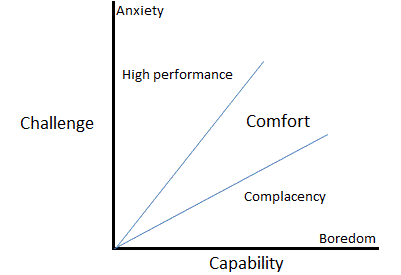
Challenge capability diagram
The idea that people are often in their comfort zones and that learning and improvement occurs when you move out of it has currency in local government today. The concern is that when people find their comfort zone they settle in and thereafter resist change, even beneficial change. Individuals are regularly being asked to leave their comfort zone and accept challenges. Does an organisation also have a comfort zone?

I think many organisations do – and they stay in them. It will usually be the zone that the organisational leaders, the council or the CEO and Executive, allow it to be in. Frequently, it is a place that they understand and there will be a level of challenge and change activity that the leaders are comfortable to support. The question is what is that level at your organisation? Continue reading

65 – Service suppliers to local government. What do they do differently and why?

Posted by Parkinson                                                                                       350 words

integrated systems

It has always intrigued me that the major suppliers of services to local government operate quite differently. What are some of the differences and why?

The first difference that is obvious is the investment in enterprise management systems. Some are better developed and more integrated than others but all have a third party accredited quality (ISO 9001), safety (AS4801), and environment (ISO 1400) systems. They will also have a corporate operations manual and a management manual setting out company policy and requirements. Continue reading

61 – Public value gap analysis. Some actions.

Posted by Colin Weatherby                                                                         280 words

gaps

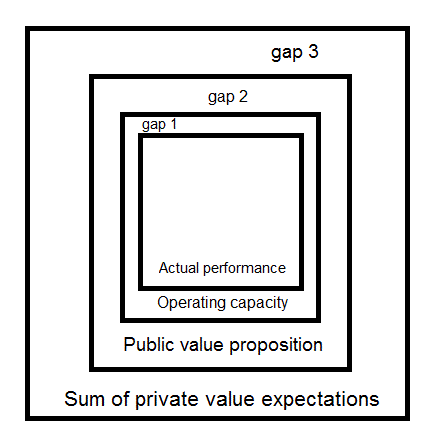
I posted on a tool that can help to identify gaps in public value creation. This post briefly suggests some actions for each gap.

The first gap between actual performance and operating capacity, or potential performance, is best addressed though organisational processes to improve productivity. Recognising the gap is important and then it is in the hands of the organisation to justify its performance or improve it. Utilising all available operating capacity efficiently is the responsibility of organisational management.

Gap 2 requires something new to happen. It isn’t simply a matter of being more efficient and productive. Continue reading

60 – Public value gap analysis. A tool.

Posted by Colin Weatherby                                                                         790 words

private public operation actual

One of the challenges in local government is understanding public value – what it is for your community and how you can create it. It can  be difficult to separate it from private value expectations and to see the relationship with the operating capacity of the organisation. This post explores a conceptual tool to understand public value and gaps that need to be addressed in achieving it.

Many years ago when asked to be the officer leading a community advisory committee I developed a model to help the group understand what we were talking about and to focus on gaps where we could be most effective in making a difference. It worked very well. At the time I didn’t really understand why. Now I think it was because is identified the public value gap that the group could work on. Here it is. Continue reading

41 – ‘Where does the customer fit into a service operation?’ A brief discussion of the work of Richard B. Chase.

Posted by Lancing Farrell                                                                                                     1200 words

In 1978 Richard B. Chase published his paper Where does the customer fit into a service operation? John Seddon says this article began the separation of front and back office operations; something that he believes has created many problems in public sector service delivery today. Maybe he is right. But when you read the article, what Chase is advocating makes sense and I can’t help thinking that it isn’t necessarily a bad idea, rather it is an idea that has been used badly.

Chase is an operations manager. By 1978 he had already co-authored a popular operations management text. He starts his paper stating that a manager needs to understand the ‘operating characteristics that set one service system apart from another’ in order to make improvements. Continue reading

35 – Accountability in local government. Who are we really accountable to and why does it matter?

Posted by Lancing Farrell                                                                                              650 words

The demands for accountability in local government are continuous. The challenge is that they come from many different places and focus on different aspects of performance.   Sometimes they create conflicts. For example, strict adherence to procurement policies can remove the flexibility required to respond quickly and meet complex community needs. But it keeps the Audit Committee happy. A community interest group gains political support for a project that hasn’t been included in the budget. But the councillor and their constituents are happy. I am sure you can think of other examples. Continue reading

34 – Middle managers in local government: the ‘scrapers of burnt toast’?

Posted by Colin Weatherby                                                        620 words

burnt toast

This is the phrase used by Peter R. Scholtes in The Leaders Handbook to describe the work of many middle managers as ‘expediters or troubleshooters’ in organisations that have yet to eliminate waste and create ‘efficient, smooth, uncluttered flows of work’.   He says that in a ‘flat’ organisation the layers of middle management have been removed as part of the focus on eliminating waste. In an efficient system, they are unnecessary and non-value adding roles. I am sure he doesn’t think that middle managers aren’t required.  You just need less.  It is an interesting idea.

Scholtes says that removing layers as part of improving organisational performance reduces opportunities for promotion. As a result, people leave to find less efficient organisations where their skills in ‘expediting and troubleshooting’ are required to deal with inefficiencies and waste to make the system work. I started thinking about my role and the role of colleagues in middle management, and what we spend each day doing. What do we talk about when we meet in the corridors? Are we mostly adding value or just spending our time making dysfunctional systems work? Continue reading

33 – Developing an organisational performance measurement system. Some ideas.

Posted by Lancing Farrell                                                                                     820 words

I have been thumbing through ‘Improving Performance – How to Manage the White Space on the Organisation Chart’ by Geary A. Rummler and Alan P. Brache, in particular the chapter about performance measurement. In it they describe measurement is the single greatest determinant of an organisation’s effectiveness as a system, and as the primary tool for ‘communicating direction, establishing accountability, defining roles, allocating resources, monitoring/evaluating performance, and taking improvement action’.

I haven’t seen a local government that has actively used performance measurement this way. Instead, it tends to be driven by external accountability requirements. We use the performance measurement that we do to convince others that we are doing what we should. Continue reading

28 – Local government shared services. Is it the silver bullet for rate capping? – Part 1

Posted by Colin Weatherby                                                                                         620 words

The Victorian state government plan to cap municipal rates has revived discussion about shared services. Some leaders see shared services as a silver bullet to reduce costs. What potential do shared services have to help councils respond to rate capping?

The article Government shared service back in vogue notes that shared services are usually justified by business cases promising operational efficiencies and cost savings. However, the article cites numerous examples of shared services that have failed to deliver.

In 2011, the West Australian government disbanded its Office of Shared Services centre after an Economic Regulation Authority review found the project was over budget and unlikely to deliver promised savings of $57 million a year. Instead the project had cost $401 million and achieved minimal savings.

The Queensland Health payroll upgrade was developed under the auspices of a shared services group. Originally with a budget of $98 million, and due for completion in July 2008, the project was the subject of a royal commission last year and is expected to cost taxpayers $1.2 billion by 2020.

In The Whitehall Effect John Seddon documents examples of similar failures in the United Kingdom. The track record of failure suggests that there are significant risks associated with shared services. So why are they regularly on the public sector reform agenda? Continue reading

26 – The first 25 posts. What have you missed?

Posted by Lancing Farrell                                                                                              1100 words

Writers have posted 25 times since the start of the year. A number of themes and ideas have been discussed. This post provides a brief overview.

The goals are set out in post 1 – track current issues and discuss the issues that are ‘everlasting, widespread and insoluble’ (using the least amount of words). A range of issues have since been covered from the daily media, day to day work life, and the things people often talk about but seldom resolve.

Post 2 and 5 discuss local government services – what we do and how we can define it. The conclusion is that local government needs to provide services that fit within legislated requirements, are responsive to broader community needs and expectations, and meet the individual purpose for each person receiving a service. Each service can be defined as a cross-functional process or value chain.

In post 3 the complexity evident in local government is discussed, including the involvement of customers in service delivery, the variability they introduce, the difficulty measuring service quality or setting service goals and measures, and the impossibility of separating service delivery from politics.

The impact of training on performance is discussed in post 4 in response to media criticism of the Australian government public service for its spending on training. The post suggests that understanding, documenting and improving processes would yield more benefit than providing more training for most councils.

In post 6 the differences between customers, clients, citizens, residents and ratepayers are discussed. Understanding which role someone has chosen to take in an interaction is important in determining the value they expect. This can be useful in differentiating between public and private value expectations.

Post 7 looks at public service job cutting and the link to productivity. Some key messages from the Centre for Policy Development report False Economies: Unpacking public sector efficiencies are discussed. The post identifies the importance of defining public value so that any changes to resource levels can be made in the knowledge of the impact they will have on the value produced.

Post 8 presents an imaginary script for an episode of Gordon Ramsay’s ‘Kitchen Nightmare’ in which he assesses the performance of local government as if it were a restaurant.   Hopefully it is both entertaining and thought provoking. What would Gordon Ramsay say?

In post 9 some emerging characteristics of people and councils are discussed. Obligatory empiricism, oblivious narcissism, and consensual lying are put forward as reasons why councils always seem to learn everything from scratch, leaders set out to meet their own needs first, and why people tell others what they want to hear for the sake of convenience.

Post 10 draws a ‘line in the sand’ with a discussion of the changes that have impacted in Victorian local government since the 1990’s. Part history lesson and part explanation of the present, the post concludes that the most influential change has been to the tenure of the CEO and their increased dependence on the goodwill of their council for survival .

Planning in local government gets a thorough airing in posts 11, 12, 18, 19, and 20. In posts 11 and 12 the current organisational planning processes is critiqued. Posts 18 and 19 suggest ways to better integrate planning. Post 20 discusses the role of the Council Plan.  All posts provide commentary on how to develop plans that are realistic, achievable and focused on delivering the value expected by the community. Constraints identified include the need to work within legislated requirements and the need for leadership to really understand ‘the business’ to be able to implement a ‘top down’ and ‘bottom up’ planning process.

In post 13 the role of policies and strategies is discussed. Are they becoming convenient but ineffective solutions to difficult problems, devices to avoid doing something that needs to be done, or just a way to be seen to be doing something?

Post 14 is an attempt to explain why councils stick with conventional organisational structures and avoid dealing with cross-functional processes; why systems seek to control risk and increase compliance without regard for producing public value; and why council culture encourages people to avoid making decisions. The discussion centres on what an organisational culture survey, an ABEF organisational self-assessment, and the Executive’s risk appetite can reveal.

Four books that should be read by every leader in local government are discussed in posts 15 and 17. The books are Recognising Public Value by Mark H. Moore, The Whitehall Effect by John Seddon, Improving Performance – How to Manage the White Space on the Organisation Chart by Geary A. Rummler and Alan P. Brache, and The Leaders Handbook by Peter R. Scholtes. Each book has a different focus and there is a mixture of public sector and business reading.

Post 16 discusses the rate capping proposed for local government in Victoria. The history of rate capping in Victoria and the long-term effects of it that are apparent in NSW provide a backdrop to a discussion about what councils can do in response. This post covers the potential for shared services and the potential impact on capital and operating budget cuts.

In post 21 the way councillors feel about their role is discussed. Do they feel inundated and manipulated or respected and influential? The difficulties they face as volunteers and in becoming skilled in their role, working together in an adversarial system, and coping with very demanding workloads, are covered. The message is stop complaining and support them more effectively.

What does a high performance local government organisation (HPLOGO) look like? In post 22 a methodology is proposed to define and create a HPLOGO. Based on the work of Andre de Waal, a set of characteristics of a HPLOGO are described (as actions) and prioritised.

Post 23 is a bit tongue in cheek. It is an attempt to pick up on the ‘chip on the shoulder’ prevalent in some parts of local government. Is local government a plaintive country tune or a majestic aria?

In post 24 an article by Frank Ostroff from Harvard Business Review (Change Management in Government) is discussed in relation to making high performance happen. He describes four unique barriers to change in the public service related to leader skills, leader tenure, rules that create inflexibility, and stakeholder resistance to reform.

Finally, post 25 looks at local government budgeting and how it is focussed on the past and has difficulty coping with improvement and innovation.   The need to balance investment in compliance with improving customer service and developing new services is discussed with reference to Christopher Stone’s work on public sector efficiency.