121 – Squire to the giants. Who are the giants in common?

Posted by Colin Weatherby                                                                                                 830 words

squire

I recently found a new and interesting blog called ‘Squire to the Giants’. Much like thinkpurpose.com this blog site is aimed at people who have an interest in improving their organisation through systems thinking. A recent post talks about the ‘giants’ that have influenced the Squire’s thinking. I am familiar with some of the ‘giants’ and have others of my own.

The Squire lists the following giants:

Regular readers of this blog will be familiar with the work of Peter Scholtes  and John Seddon. Both have influenced the thinking of writers. The biographical pieces written by the Squire  are worth a look.

I have decided to produce a blog on one of my giants.


mark h moore picProfessor Mark H. Moore

First some background. Mark H. Moore is the Hauser Professor of Nonprofit Organisations and director of the Hauser Centre for Nonprofit Organisations, at the John F. Kennedy School of Government at Harvard University.

His research interests include public management and leadership, civil society and community mobilization, and criminal justice policy and management. Continue reading


118 – Improving service operations. Why it doesn’t happen in local government.

Posted by Whistler                                                                                          500 words

 walking the plank

I have read Lancing Farrell and Colin Weatherby’s posts on characteristics of demands, redesigning operations and improving service operations through action plans and service redesign, with some interest. It is all good stuff and not too difficult to understand or do. The question I ask myself is why I don’t see it happening everywhere across the sector. The ‘special and different’ posts partially explain it but I think there is more to it.

To begin with, the motivation to make improvements doesn’t really exist. People say they want to improve the quality of services to their community, and in response to threats like rate capping they say they want to be more efficient. But they don’t really want to do either.

Most councils have the potential to improve productivity by 10-15% (more in some councils). Continue reading

103 – Classic paper – ‘Managing Government, Governing Management’. Henry Mintzberg.

Posted by Colin Weatherby                                                                         1850 words

In 1996 Henry Mintzberg published a paper in the Harvard Business Review entitled ‘Managing Government, Governing Management’. In the paper Mintzberg covers four broad topics relevant to local government:

  1. Private, public, cooperative and non-owned organisations.
  2. The roles of people in society as customer, client, citizen and subject.
  3. The management myths that activities can be isolated, performance can be fully evaluated using objective measures, and activities can be entrusted to autonomous managers responsible for performance.
  4. The machine model, network model, performance-control model, virtual model and normative-control model available to organise government.

What relevance does it have for local government today?

95 – Making high performance happen through value-led management.

Posted by Lancing Farrell                                                                              850 words

tug of war

Some time ago I posted on Frank Ostroff and the barriers that he believes prevent change in government . Ostroff makes a lot of sense – formulate a vision, be mindful of your present situation, seek the support of stakeholders, set a clear path, understand the complexity in what you are doing, and hold people accountable. However, I have found that sometimes you need a simple tool to take those ideas into practice. I was once asked by a CEO.

‘How do you get people to fundamentally re-think what they are doing instead of making incremental improvements to optimise what they are currently doing?

Maybe this is the answer. Continue reading

94 – ‘An interview with Wanksy, Penis Doodler and Pothole Avenger’, The Atlantic CITYLAB, 1 May 2015.

Posted by Colin Weatherby                                                                                         430 words

Wanksy image

Image from CITYLAB.

The sub title to this article says it all – ‘How an English construction worker is fighting for better road infrastructure by scribbling on the streets like a third-grader’. What is it that reduces people to this behavior? Why do they feel compelled to break the rules to get something done? There have been various articles on guerilla gardening, depaving and other aspects of DIY urbanism, but this is the first ‘guerilla maintenance’ article I have seen.

According to the article, Wanksy is a surveyor and professional artist who became fed up with the numerous potholes in his hometown, so he started drawing penises around them. And it seems to be working Continue reading

88 – Classic paper – ‘Managing the public service institution’. Peter F. Drucker.

Posted by Colin Weatherby                                                                         Long read 1900 words

Editors Note: This is the first of a new type of post – the long read. Rather than split long pieces or edit out important ideas they will be a run as a long read. It is only recommended for those scoring more than 7/10 in the local government reading test!

In this insightful paper published in 1973, Peter F Drucker looks at why public service organisations are less efficient than business enterprises. In it he reaffirms public services as being ‘load-bearing members of the main structure’ of modern society – a provider of services that are essential to society. Despite this importance, he says the performance of public service organisations is unimpressive. They have large budgets and require ‘ever-growing subsidies’ but are providing poorer service. Citizens are complaining about ‘bureaucracy and mismanagement’ in the institutions that are supposed to serve them.

Why was that the case in 1973 and is it still the case in local government today?

61 – Public value gap analysis. Some actions.

Posted by Colin Weatherby                                                                         280 words

gaps

I posted on a tool that can help to identify gaps in public value creation. This post briefly suggests some actions for each gap.

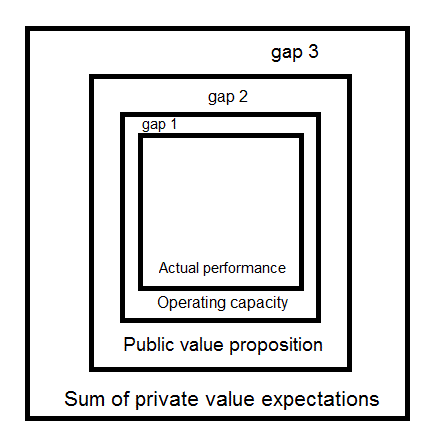
The first gap between actual performance and operating capacity, or potential performance, is best addressed though organisational processes to improve productivity. Recognising the gap is important and then it is in the hands of the organisation to justify its performance or improve it. Utilising all available operating capacity efficiently is the responsibility of organisational management.

Gap 2 requires something new to happen. It isn’t simply a matter of being more efficient and productive. Continue reading

60 – Public value gap analysis. A tool.

Posted by Colin Weatherby                                                                         790 words

private public operation actual

One of the challenges in local government is understanding public value – what it is for your community and how you can create it. It can  be difficult to separate it from private value expectations and to see the relationship with the operating capacity of the organisation. This post explores a conceptual tool to understand public value and gaps that need to be addressed in achieving it.

Many years ago when asked to be the officer leading a community advisory committee I developed a model to help the group understand what we were talking about and to focus on gaps where we could be most effective in making a difference. It worked very well. At the time I didn’t really understand why. Now I think it was because is identified the public value gap that the group could work on. Here it is. Continue reading

46 – Labor’s rate cap to hurt services and infrastructure, ratings agency warns’. The Age, 27 February 2015.

Posted by Colin Weatherby                                                         900 words

 slices of cake
Image from http://www.that-is-good-crap.com

This article follows an earlier piece in The Age,  ‘Plan to cap council rates at inflation could lead to service cuts and job losses in Victoria’ on 23 February 2015. Both articles are about the planned legislation in Victoria to restrict councils to rate increases at or below the Consumer Price Index from 2016 unless they seek an exemption from the Essential Service Commission. Some councils have already started to cut jobs to reduce expenditure ahead of rate capping. Others are forecasting cuts to their services and reduced maintenance or renewal of community infrastructure.

This is occurring at the same time that the State government is shifting more costs onto councils and national grants to councils are being frozen. I have previously posted on rate capping (see here , here and here). As you can imagine, rate capping is dominating talk within local government circles. Continue reading