292 – Check–Plan–Do or Plan–Do–Hope?

600 words (4 minutes reading time) by Tim Whistler

When reading local government plans, you could be forgiven for thinking that The Secret (2006) was a management manual: “ask, believe, and receive”. It is hard to see how some councils think they will make a difference from the way they plan.

To be fair, I agree that councils usually aren’t intentionally stupid or reckless. They’re juggling rate caps, grant uncertainty, ageing assets, and a community that wants more of everything. They are under pressure, and when it comes to their long-term plan, the temptation is to plug the spreadsheet gaps with “efficiency dividends” and “future asset sales” and hope it all works out.

But that doesn’t make it strategic. I call it Plan–Do–Hope.

Council plans

Continue reading

272 – What is the big deal about the Wigan Deal?

1200 words (13 minutes reading time) by Lancing Farrell

In his post on the Victorian local government enquiry, Colin Weatherby mentioned the Wigan Deal as an example of how councils can avoid the politics of sacrifice – i.e. being forced to give up what you have today – and instead move to the politics of transition – i.e. finding better ways in the future. It seems like a no brainer to me and I am sure every elected representative would agree that this would be better politics. Unfortunately, they are not necessarily getting to make the decision – or, if they are, they are being given limited options by their bureaucracy about the decision they can make.

Strategic versus operational decisions

As an aside, this has been a point of contention in Victoria where the Local Government Act restricts councillors to making ‘strategic decisions’, while the CEO and staff make ‘operational decisions’. The definition of each type of decision seems to be quite flexible. For anyone wanting to see how this plays out, watch the Mornington peninsula Shire Council meeting on the 28 May 2024 at the 4 hour and 25 minute mark. Fascinating.

In contrast, the Wigan Deal was created and implemented with the commitment and direction of both elected representatives and the organisational leaders.

Continue reading

200 – Using a local government service catalogue.

Posted by Colin Weatherby                                                                                                                         700 words

menu

Some time ago I discussed how to create a local government service catalogue. The process was simple and effective in describing services in customers’ terms and linking services to cost centres in the budget and those responsible for the cost centres. You might ask, what else needs to be done? Well, for the service catalogue to be really useful it needs to be linked to the organisational planning processes. Here’s how that can be done.

To begin, it is a good idea to test the service catalogue with the community. I have heard of a council using it to lead discussion with ‘peoples’ panels’ about the services delivered, how rates can best be spent, and whether or not the council should seek an exemption from the municipal rate cap being imposed in Victoria. If the community can relate to the services described in the catalogue and understand what they involve, it is likely that you have got the catalogue right. It doesn’t mean that it can’t be further improved, but it is a good start.

The next step is to link the service catalogue to the traditional ‘business unit by business unit’ planning that occurs in local government. Continue reading

176 – In-vehicle GPS – Part 2: How every council can have it.

Posted by Lancing Farrell                                                                              550 words

hurdles

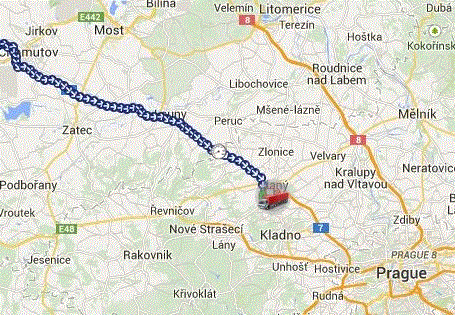
In part one I discussed the features and benefits of in-vehicle GPS. Because councils deliver services at locations dispersed across a large geographic area and vehicle ownership is expensive and utilization is often low, in-vehicle GPS has the potential to provide significant benefits. It links the planning undertaken in asset maintenance systems to in-field work planning and delivery to ensure that resources are used efficiently to complete the planned work. The key barrier has been how to get in-vehicle GPS installed in all vehicles.

I think the trick to implementing in-vehicle GPS is the strategy and policy sitting behind it. Here are some tips. Continue reading

175 – In-vehicle GPS – Part 1: Why every council should have it.

Posted by Lancing Farrell                                                                                              1100 words

in vehicle gps

I remember looking at in-vehicle monitoring devices in the 1990’s. The technology was basic and there was no 4G network. Since then councils have flirted with in-vehicle GPS. As far as I know, no council in Victoria has installed it throughout their vehicle fleet. This is partially explained by the industrial relations implications (see the next post) but I think it is really explained by the lack of focus on customer service and productivity that pervades the sector. Rate capping will change that.  Most councils wouldn’t even be aware of the potential benefits from the technology. Hence this post.

So, what are the features and benefits of in-vehicle GPS that councils should be thinking about? Continue reading

137 – EPM, PMO or JACI. What are our CEO’s talking about now?

Posted by Colin Weatherby                                                                         1180 words

project flow diagram

I recently attended a presentation on enterprise portfolio management or project management offices in Victorian local government. It seems to be the latest idea that has caught the attention of CEO’s in their search for solutions to problems they can see.

I must have been working in local government for too long. I have seen management by objectives, evidence-based decision making (or decision-based evidence making as I like to more accurately describe it), total quality management, reengineering, and more recently, lean and high performance teams. It is as though we look out our window and see someone doing something that looks like what we think we should be doing and we just copy them.

In two of the long reads (here and here) the shortcomings of copying the private sector are dissected by Peter Drucker and Henry Mintzberg. Continue reading

115 – Roadmap, recipe or game plan. Does it matter which metaphor you use?

Posted by Whistler                                                                            360 words

neverland cake

There are various metaphors for organisational strategy in circulation. The idea that it is a road map for a journey to a predetermined destination undertaken in a car while watching the dashboard (to know the car is working properly) is popular. One I was less familiar with is Norton and Kaplan’s cooking metaphor.

They describe an on organisation is an assemblage of ingredients brought together to make a meal. Making the meal requires raw materials (ingredients), tangible capital and assets (cooking implements, an oven), and intangible human assets (the chef). A great meal requires a recipe to take advantage of these tangible and intangible assets. The recipe transforms assets that each has standalone value into a great meal with greater combined value. The recipe corresponds to an organisational strategy that combines resources and capabilities to create unique value.

Another metaphor that I relate to is the game plan. Continue reading

113 – Improving service operations. Finish with service redesign.

Posted by Colin Weatherby                                                                         1300 words

service redesign board

The first post on improving service operations covered service action planning. Both posts have followed a discussion about service improvement with a colleague in which he described a process he has been using with operational staff to work out how their work can be improved. This post discusses redesigning services when that has been an action identified in the service action plan.

If the need to redesign services has been identified in the service action plan there is a good chance that all team members are on board and prepared to discuss some big changes. This is really a prerequisite for significant change in local government, otherwise there is a risk that you are just ‘revolutionising’ people and will have no long term effect.

Stage 2 – Service redesign.

The first step is to separate the services with different demands, operations typology and performance objectives (this has been the subject of an earlier post). Then related services are grouped together. The last step is to redesign services to integrate similar services and plan implementation of the new service. This includes risk analysis of key aspects of the service and planning the new supervisory role required to make the service design work. Continue reading

110 – Improving service operations. Start with a service action plan.

Posted by Colin Weatherby                                                                         1250 words

service brainstorming

I was recently discussing service improvement with a colleague. He described to me a two-stage process he has been using with operational staff in his team to determine how their work can be improved generally, and then how to re-design services if required.

It is an intensely practical two-stage approach to working with teams collaboratively to understand work and improve operations to get better customer outcomes.

The first stage involves bounded brainstorming by the whole work group, their Team Leader and the Manager to respond to the question – how can we do our work better? It is not intended to question whether or not services should be delivered, just how they can be improved. The process is intended to be inclusive and to quickly lead to action. The output is a service action plan.

The second stage involves redesigning services if this has been identified the way to make improvement. The redesign process is led by the Team Leaders and Manager using some simple reengineering and operations management tools. The output is a new service design.

Stage 1 – The service action plan Continue reading

105 – Some characteristics of services demands that are important.

Posted by Lancing Farrell                                                              1100 words

operations typology 2

Image from Operations Management, 1998.

Some time ago I posted on high performance job design using four characteristics or spans; control, accountability, influence and support. At the time I linked the concept to the operations typology describing four characteristics of design of operations for high performance. This post picks up that discussion to look at the characteristics of demands that it is essential to understand if you want to design and manage your operations for high performance or excellence in local government.

A number of recent books on public sector management have discussed demands and how it is essential to understand them in public services because payment is not made at the time of service consumption and, therefore, price does not directly influence the amount and nature of demands placed on the system.

In his Vanguard Method John Seddon describes the importance of fulfilling purpose if failure demand is to be avoided. He also talks about understanding flow in relation to how work enters a system. Both of these ideas relate to demands. If purpose (i.e. the value sought by someone or their demand on the system) is not correctly understood the work system will not meet their need. They will come back.

Mark H. Moore includes operational capacity in his ‘strategic triangle’ concept linking decisions from the authorising environment to the public value provided. An organisation must have the operating capacity (or capability as Moore describes it in his earlier book Creating Public Value) to deliver on the political commitment to create particular public value. Continue reading