218 – Requisite leadership, stratified systems theory and local government management.

By Colin Weatherby                                                                                              680 words

Jacques levels of work authority

Lancing Farrell posted an interesting piece using Elliott Jaques’ requisite organisation theory to explain the best use of Executive time. It prompted some related thinking on my part. Jaques has provided a significant body of knowledge that can be very useful for managers in bureaucracies and hierarchical organisations.

The idea that people naturally organise themselves into hierarchical, or stratified, managerial systems in organisations reflects the reality of local government.  This is reinforced by legislation that focuses accountability on top management.  They are held responsible for the work outputs of people in the organisation and this responsibility cascades downwards through the management hierarchy. Continue reading

217 – What should our Executives spend their time doing, and why don’t they?

By Lancing Farrell                                                                            1800 words

time

Image: http://content.wisestep.com/why-your-resume-should-be-one-page-good-reasons

This is the question that crossed my mind recently when discussing time management with a colleague who is part of an Executive team that is reviewing use of their time. They have engaged a consultant to work with them individually to understand how to best use their time. Like every Executive team, they always have more work to do than the time available to do it.

After keeping a time diary in 15 minute intervals for two days and coding up each activity according to musts, wants, work that should be delegated, and work that shouldn’t be getting done at all, it became apparent to my colleague that more efficient use could be made of available time but this wouldn’t solve the problem. Optimising use of time wouldn’t provide enough to do all the work. The nature of the workload needed to be examined.

In part this examination was prompted by the time management consultant suggesting that the time spent by my Executive colleague in meetings with direct reports could be reduced or the meetings held less often. In considering this idea, she realised that this was some of the most valuable time they spent each week. She also realised that (at the moment) she didn’t have a better use for that time. What could she do with the time that would be more valuable than influencing and helping her direct reports? This realisation started her thinking more broadly about the work she was doing.

This led her to re-examine Elliott Jaques’ work on requisite leadership. In particular, Jaques’ concept of time defining the degree of complexity in managerial leadership roles. The idea that every task has a target completion time and that the longer the time-span of discretion for tasks, the more complex the role, struck her as relevant in working out where she needed to spend her time and effort.

Jaques’ describes seven levels of organisational hierarchy, each with a different time-span of discretion ranging from 3 months to 50 years. He calls them requisite levels. Based on this, my colleague sketched out the relationship between Jaques’ theory and her work and time allocation challenge in the following table. Continue reading

215 – From the Archive: Creative ways to make your capital expenditure target. Some ideas.

Posted by Whistler                                                                          570 words

capital expenditure graph

Originally posted 20 April 2015

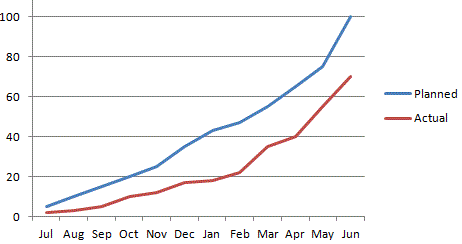
Yes, it is that time of the year when our engineers and accountants become highly creative.   By June 30 they will need to explain whether or not the targeted amount of capital works has been completed. Often the target is expressed as simply as ‘90% capital program completed’. Usually it is a KPI for the CEO and senior managers. That makes it an important target.

So, why the need for such high levels of creativity?

Delivering 90% of the planned capital works is harder than it sounds. Many councils would have averaged around 60% to 70% over the last ten years. This is partially explained by growth in capital expenditure that has exceeded the organisational capacity to deliver. Another part of the explanation is that capital works programs have become more diverse with more people participating in the planning and delivery across the council. As a result, projects have become more complex and people with inadequate project management skills are often involved.   Finally, councillors have become much more involved and the capital works program will now have projects that councillors, sometimes in response to community submissions to the budget process, have included – often at the last minute.

As the capital works program has grown, become more complex, involved more people with less skills, and started to include projects without adequate pre-planning or feasibility analysis, especially if they require community engagement, it has become much more difficult to deliver the whole program. But the target remains.

This is where the creativity occurs. Continue reading

213 – What insight does the capability review of one council and the sacking of another give you into local government culture in Victoria?

Posted by Colin Weatherby                                                                         1500 words

insight light

Two interesting reports have been published in Victoria in the last 12 months – the Organisational Capability Review of Melbourne City Council in May 2015 and the more recent Commission of Inquiry Report into Greater Geelong City Council, released in March 2016. Each report provides an insight into local government culture.

As someone who has worked at three Victorian councils in the last 10 years, and who corresponds regularly with people working at another half a dozen councils, the insight is not surprising.  It reveals a deep malaise in the sector that has root causes in the political system, the ways our leaders are appointed, and general organisational leadership capability.

To begin, what are the discoveries in these two reviews of major Victorian councils? Continue reading

212 – How do you know if you work for (or if you are) a pretend manager?

Posted by Whistler                                                                                                          1200 words

pretend manager

Have you ever wondered if your manager is for real? Have you ever wondered what they do all day? Has their contribution to work been difficult to see? Maybe you have a pretend manager.

No, this is not a manager bashing exercise. As a long-term local government manager, I respect the effort put in by many of my colleagues. But there are some managers who are just not up to it. And they are not always managers.

Lancing Farrell discussed an interesting book in the last post. I also took a trip down memory lane and re-read parts of The Third Principle. Neville Lake is a practical, perceptive and prescient person. I just love alliteration. His chapter on optimising managers, highlighted by Lancing Farrell, reads as though he looked into the future to see the local government of today. In particular, the sections on eliminating pretend managers and pretend managing resonated with me.

To optimise managers, Lake says you need to eliminate pretend managing and pretend managers.

To start with, Lake says to look for the managers who think their job is to go through the motions of managing and just tick off boxes. Continue reading

210 – Is innovation over-rated in local government?

Posted by Colin Weatherby                                                         1100 words

patched road

I was recently reading an article in Aeon magazine entitled ‘Hail the maintainers’. The central idea is that ‘capitalism excels at innovation but is failing at maintenance, and for most lives it is maintenance that matters more’. I think you could replace ‘capitalism’ with ‘local government’, although I am not sure that we are excelling. We are certainly preoccupied with trying to be innovative (or at least being seen to be innovative).

The authors, Lee Vinsell and Andrew Russell, believe that innovation is the dominant ideology of our era. Pursuing innovation has inspired both technologists and capitalists. It has also attracted critics.

“What happens after innovation, they argue, is more important. Maintenance and repair, the building of infrastructures, the mundane labour that goes into sustaining functioning and efficient infrastructures, simply has more impact on people’s daily lives that the vast majority of technological innovations. “

The idea that local government must be more innovative reflects the willing (and often mindless) adoption of populist ideas from the private sector by local government.   After all, being innovative is sexier than doing what we have always done but making sure we do it well. Continue reading

206 – ‘The Outstanding Organisation’ by Karen Martin.

Posted by Colin Weatherby                                                         870 words

the outstanding organisation

This is a forthright and practical book full of inconvenient truths for local government. I suppose its relevance to local government depends on whether or not you believe that becoming an outstanding organisation is either possible or desirable. Karen Martin says that people know excellence when they see it and they know when they are not excellent. But do our leaders in local government?

This is another book (and I am repeating myself here) that everyone reading it who works in local government will wish they had read years ago. The key idea is that it is chaos that prevents organisations from becoming excellent. Martin says that managers and workers often don’t see the chaos or its causes. In many cases the behaviour causing the chaos is habitual and invisible. Typically, she says organisations respond to chaos by:

  • Becoming accustomed to it so that they think it is normal.
  • Recognising it but thinking that there is nothing that can be done about it.
  • Embracing it as a good thing and developing skills in coping with it.

Councils do all three to a greater or lesser extent. Continue reading

198 – Essay No. 5 – Local government and leadership.

Posted by Colin Weatherby                                                                         1300 words

Mark H Moore strategic triangle

Mark H. Moore’s ‘strategic triangle’ – the basis for value-led public sector management

I have been thinking about leadership a lot recently. It has been a recurring theme in posts on this site. Reading Jeffrey Pfeffer’s book has challenged my thinking about how leaders work and what motivates them. It has reinforced some of my scepticism about leaders and why they do what they do. I tend to agree with Peter Drucker’s questioning of the distinction between leadership and management. Ultimately, organisations, particularly in the public sector, have to be managed. The idea that somehow managers aren’t leaders or that leaders aren’t managing doesn’t make sense.

Having said that, I can think of organisational leaders I have known who couldn’t manage. At some point they just ticked the leadership box and assumed the position! Pfeffer explains how and why everyone then goes along with it. Once you are a leader it seems you can get to stay there without any real scrutiny and accountability for your performance. That has definitely been my experience in local government.

I keep imagining myself working in an organisation with an effective leader who manages the organisation for high performance (not career advancement). One that provides clear strategy, direction and goals.  One who coordinates effort to  across the organisation to achieve those goals. In particular, I have been thinking about how they could do that in local government. Continue reading

196 – Making local government organisations simpler to manage – why is it necessary?

Posted by Colin Weatherby                                                                         1700 word

complexity knotted rope

I was at a meeting recently where the team charged with conducting an organisational self assessment (OSA) and preparing an organisational improvement plan (OIP) using the Australian Business Excellence Framework were evaluating progress. It was an interesting meeting of a diverse group of people. By the end of the meeting we had reached a common conclusion – a council organisation is complex and systems need to be disentangled and simplified so that it can be managed effectively.

The OIP actions were developed independently from the outcomes of the OSA. It was only after 12 months of effort to implement the actions that the high level of congruence between them became apparent. Very few actions relating to core organisational systems could be implemented without impacting on each other – they overlapped. Attempting to deal with them one by one wasn’t going to work but joining them all together would create a large and very complicated action.

There is an earlier post on complexity which describes some of the sources of complexity in local government. It helps to know what you are dealing with but that doesn’t make it any easier. This was reinforced by reading former Victorian Premier John Brumby’s excellent memoir ‘The Long Haul – Lessons from Public Life’. In reflecting on the last four years in which he has viewed politics as an outsider, Brumby comments on the lack of trust that ‘permeates almost everything we see and hear about politics today’.

He believes that part of restoring trust and credibility in politics is to give the public a better understanding of the complexity of the issues.

“When I first sat in the federal parliament, an older and wiser member told me: ‘For every complex problem there is a simple solution … and it’s always wrong’. We live in a world where the questions are becoming more complex, while the public appetite is for ever simpler answers: the kind that can be summed up in 140 characters or less”

My question is, do you think that people want to be bothered by the complexity involved in getting what they want through political processes? Continue reading

195 – Leadership connections and disconnections – some thoughts on Jeffrey Pfeffer’s ‘Leadership BS’

Posted by Colin Weatherby                                                                                         950 words

leadership BS

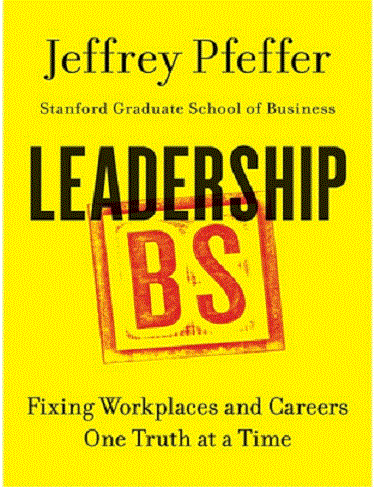
This is a new and interesting book. Promising to ‘pull back the curtain’ to show how leadership really works, Jeffrey Pfeffer (Thomas D. Dee II Professor of Organisational Behaviour at the Stanford Graduate School of Business) argues that ‘much of the oft-repeated wisdom on leadership is based more on hope than reality. This appealed to my pragmatic, rationalist view of the world. Things are not always what they seem (or how people would like them to seem).

It is a provocative book and reading it will challenge those who subscribe to the current leadership orthodoxy. In the Preface, Pfeffer compares management to medicine and highlights the progress modern medicine has made by rooting out the charlatans and quacks, and introducing science into the practice of medicine. He revisits this comparison in Chapter 8 when he provides advice on ‘confronting the reality of organisational life’.

This is where the ‘rubber hits the road’ after an interesting and thought provoking read through the first seven chapters covering why fables cause problems; why leaders aren’t modest; how authenticity is misunderstood and overrated; whether leaders should (or do) tell the truth; where trust has gone; why leaders ‘eat’ first; and how to take care of yourself.

In Chapter 8, Pfeffer starts with a discussion about the difference between management science and medical science. Continue reading