108 – Melbourne City Council: Organisational Capability Review, May 2015.

Posted by Colin Weatherby                                                                         1300 words

Melbourne capability review model

The public release of this critical report has been something of a surprise. Commissioned in March 2015 and released in May, the report prepared by Jude Munro, Dr Bronte Adams and Steve Parker has looked at three key capabilities; leadership, strategy and delivery. Each has been rated on a four point scale for several elements. Out of the ten attributes rated, six were seen as a ’development area’ and one as a ‘serious concern’. The remaining three were seen as ‘well placed’ and none were seen as ‘strong’ (p.14). So what does this mean?

melbourne assessment criteria ratingsThe report states that this is the first time that this review model has been applied to local government in Australia. Its intention is to provide a forward looking, whole of organisation review that assesses an organisation’s ability to meet future objectives and challenges.


“This review provides the opportunity and impetus to take a very good organisation and make it even better.” Ben Rimmer, CEO

Continue reading

79 – The local government reading test. Would you pass it?

Posted by Whistler                                                                                          710 words

books 2

Image from a friend – some books it wouldn’t hurt everyone in local government to read.

I am a reader, as are most people posting on this site. This has been identified as an annoying trait. I can testify to that. I am convinced that, unfortunately, it makes people feel insecure and inferior when you actively read and try to talk to them about what you are learning. Thank goodness for blogs. Over the years I have developed a reading test. This is how it goes.

When I start at a new organisation or someone new starts at the organisation I work at, I make a point of having a chat and saying hello. I am not highly extroverted but I like to make people feel welcome and to build a working relationship as soon as I can. When I get to know them, especially if they are in top management, I try to find out what their interests are and establish an intellectual connection. This is when the test starts. Continue reading

78 – Organisational comfort zones in local government. Where is yours?

Posted by Colin Weatherby                                                                         730 words

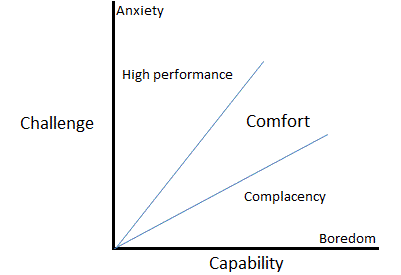
Challenge capability diagram
The idea that people are often in their comfort zones and that learning and improvement occurs when you move out of it has currency in local government today. The concern is that when people find their comfort zone they settle in and thereafter resist change, even beneficial change. Individuals are regularly being asked to leave their comfort zone and accept challenges. Does an organisation also have a comfort zone?

I think many organisations do – and they stay in them. It will usually be the zone that the organisational leaders, the council or the CEO and Executive, allow it to be in. Frequently, it is a place that they understand and there will be a level of challenge and change activity that the leaders are comfortable to support. The question is what is that level at your organisation? Continue reading

76 – Creative ways to make your capital expenditure target. Some ideas.

Posted by Whistler                                                                          570 words

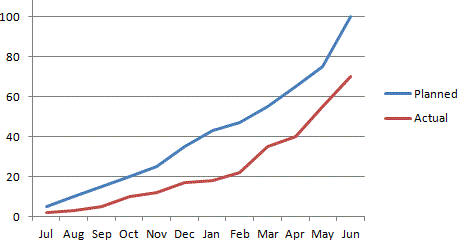
capital expenditure graph

Yes, it is that time of the year when our engineers and accountants become highly creative.   By June 30 they will need to explain whether or not the targeted amount of capital works has been completed. Often the target is expressed as simply as ‘90% capital program completed’. Usually it is a KPI for the CEO and senior managers. That makes it an important target.

So, why the need for such high levels of creativity? Continue reading

72 – Revolutionising local government. How long is it since you were last revolutionised?

Posted by Whistler                                                                          600 words

merry go round

I was talking to an experienced consultant who works with numerous councils recently and she commented about some of the councils currently undergoing ‘revolutionisation’. New CEO’s, in two cases new to the sector, were busily implementing their kitbag of management ideas. They seem to hit the ground running with a program of change. What are some of the features of revolutionisation and how effective is it?

I will start with effectiveness first. It depends on the measure. I can think of a few. Is it delivering on a promise to the councillors who appointed them to shake things up and create change? Is it is improving the performance of the organisation in meeting community needs sustainably in the longer term?

If it is the former, I would think they are mostly successful. Continue reading

71 – ‘Melbourne People’s Panel makes bold decisions where politicians fear to tread’, The Age, 1 April 2015.

Posted by Colin Weatherby                                                                         550 words

Peoples panel

“The public is smart if given the time and information necessary to work through an issue. And this has been demonstrated by a people’s “jury” which has delivered its verdict in a bold experiment in democracy by the Melbourne Town Hall.

The results should give hope to people despairing that Australia has lost its reform mojo, as it provides a new way for government to get hard but necessary things done.”

I read this article by Nicholas Reece, a Principal Fellow at Melbourne University, with some interest. Involving the community in budgeting is not new. Continue reading

63 – ‘The more experienced the managers, the more they trust simple intuition’. Or do they?

Posted by Colin Weatherby                                                                         700 words

intuition

Some time ago I posted on an idea from Richard Farson’s book, Management of the Absurd – Paradoxes in Leadership. This post has been inspired by another chapter in that book.

Farson says that the one quality that top executives say separates them from their less successful colleagues is their intuition. Their ‘immediate visceral reactions’ to people and events are usually accurate, which makes their judgements valuable. Farson defines intuition as the ‘accumulation of many learning experiences that have sensitised them, making them able to read situations quickly’. It is a quality that allows top management to make fast decisions that are effective. However, when top management starts to lack confidence, they start to apply formal processes to make decisions. They replace their immediate visceral reaction with complicated analytical thinking. Continue reading

61 – Public value gap analysis. Some actions.

Posted by Colin Weatherby                                                                         280 words

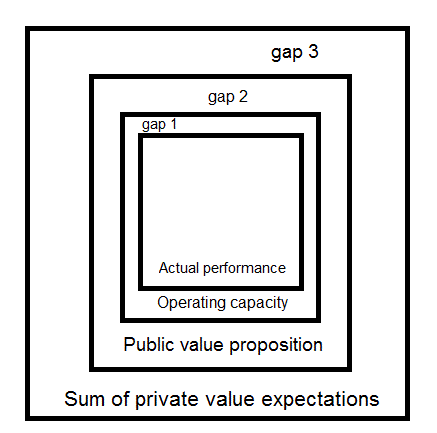
gaps

I posted on a tool that can help to identify gaps in public value creation. This post briefly suggests some actions for each gap.

The first gap between actual performance and operating capacity, or potential performance, is best addressed though organisational processes to improve productivity. Recognising the gap is important and then it is in the hands of the organisation to justify its performance or improve it. Utilising all available operating capacity efficiently is the responsibility of organisational management.

Gap 2 requires something new to happen. It isn’t simply a matter of being more efficient and productive. Continue reading

60 – Public value gap analysis. A tool.

Posted by Colin Weatherby                                                                         790 words

private public operation actual

One of the challenges in local government is understanding public value – what it is for your community and how you can create it. It can  be difficult to separate it from private value expectations and to see the relationship with the operating capacity of the organisation. This post explores a conceptual tool to understand public value and gaps that need to be addressed in achieving it.

Many years ago when asked to be the officer leading a community advisory committee I developed a model to help the group understand what we were talking about and to focus on gaps where we could be most effective in making a difference. It worked very well. At the time I didn’t really understand why. Now I think it was because is identified the public value gap that the group could work on. Here it is. Continue reading