195 – Leadership connections and disconnections – some thoughts on Jeffrey Pfeffer’s ‘Leadership BS’

Posted by Colin Weatherby                                                                                         950 words

leadership BS

This is a new and interesting book. Promising to ‘pull back the curtain’ to show how leadership really works, Jeffrey Pfeffer (Thomas D. Dee II Professor of Organisational Behaviour at the Stanford Graduate School of Business) argues that ‘much of the oft-repeated wisdom on leadership is based more on hope than reality. This appealed to my pragmatic, rationalist view of the world. Things are not always what they seem (or how people would like them to seem).

It is a provocative book and reading it will challenge those who subscribe to the current leadership orthodoxy. In the Preface, Pfeffer compares management to medicine and highlights the progress modern medicine has made by rooting out the charlatans and quacks, and introducing science into the practice of medicine. He revisits this comparison in Chapter 8 when he provides advice on ‘confronting the reality of organisational life’.

This is where the ‘rubber hits the road’ after an interesting and thought provoking read through the first seven chapters covering why fables cause problems; why leaders aren’t modest; how authenticity is misunderstood and overrated; whether leaders should (or do) tell the truth; where trust has gone; why leaders ‘eat’ first; and how to take care of yourself.

In Chapter 8, Pfeffer starts with a discussion about the difference between management science and medical science. Continue reading

194 – Essay No. 4 – Local government and customer service.

Posted by Lancing Farrell                                                                              4500 words

basil fawlty

Customer service is, and should be, a major concern for local government. After all, councils are service organisations. Sometimes there is confusion about exactly what customer service means, how it relates to public service delivery, and what aspects of service are most important to get right in local government.

This essay focuses on three hypotheses:

  1. That ‘customers’ in local government are different to the customers described in most customer service literature and encountered by most service organisations.
  2. There are six main opportunities for local government to improve service to customers.
  3. There are simple tools available that can assist councils in getting service delivery and customer service right.

Continue reading

193 – ‘Losing my importance’ (with apologies to R.E.M).

Posted by Whistler                                                                                          350 words

feather duster

I was talking with a colleague recently about a matter that I believed was important that wasn’t being addressed and my thoughts on why this was happening. He made a salient comment – the longer resolution is delayed, the less important the matter becomes. Over time it will lose its importance. 

How often have you heard people say ‘if it was important, it would have been done by now’. Working in local government is a constant battle between the urgent and the important, and finding out what is really both urgent and important. Social media has injected a definite sense of urgency into political problems, but are they really important?

I have often wondered why managers have such difficulty seeing the difference. The following matrix can be a helpful way to focus your attention.

important and urgent matrix

If a distant fire front is left burning it is understandable if it ceases to become important. Either people become accustomed to it or they don’t see the need for action. Far more attention is generated by the spot fires started by embers from the fire front and generating lots of busy work. They are usually at your feet and visible to everyone and there is immediate heat if they are left unattended.

In comparison, better planning and decision making is always deferred when distractions present themselves. I know many managers whose daily work is driven by the emails that they receive throughout the day – they continually scan their inbox for the next thing to do.  It is easier than getting their minds around the hard stuff of management.

On the flip side, I once had an experience when I was the acting Group Manager and I was unsure of the importance of a document I had received. I asked the Personal Assistant to the Group Manager whether or not she knew if the document was important. Her response was an insight into her 20 years as a personal assistant to Group Managers. She said ‘that’s your job – make it important’. So I walked down the hall and handed it to a manager and asked him to act on it.

Instant importance.

192 – Boundaries, interfaces and thresholds. Why do we love them so much?

Posted by Whistler                                                                                         450 words

stile over fence boundary

I was at a meeting recently where officers were discussing who is responsible for different maintenance activities. They had developed a ‘demarcation information guide’ for the managers of facilities so that they could try and work out who to contact for different maintenance tasks. It told you who looked after fences, paths, lights, floor coverings, broken windows, etc. It started me thinking about local government’s penchant for boundaries (nobody suggested that an alternative could be service integration).

I think we like to set boundaries because it lets us focus on what is special about ourselves as a point of differentiation from other local governments. I once worked at a council where the CEO said that we should act as though the world ended at the municipal boundary. We were different to everyone else. He said to imagine that if you left the municipality you would fall off the edge of the world. As a leadership ‘device’ it certainly focussed attention on the municipality. It was a simple and effective way to differentiate the council – pretend there is nowhere else!

This approach reinforces the view that each council is ‘special and different’, rather than accepting that we have more in common than we have that is different . This view is evident when councils are reluctant to share systems or services. In Victoria we resisted municipal amalgamations and many councils still complain about them. I think it is part of our culture to resist ideas from outside our sector or organisation. This creates a safe and reliable place.

We also like interfaces. If we didn’t, why would we design our organisations around town planners, engineers, social workers and accountants? The functional structure of councils creates lots of interfaces between units, departments and divisions in the processes that actually deliver services. It is these interfaces that result in service failure and the resultant ‘failure demand’ identified by John Seddon. Work flows across interfaces, not up and down within silos.

And thresholds abound. There are the tiered levels of authority delegated by the CEO. The typical council ‘command and control’ structure, so criticised by John Seddon, puts in place lots of hierarchical thresholds. We have entry levels for employment. Anyone unsuccessful in applying for a senior role will be familiar with the response ‘we had other applicants already at the required level’ when you seek feedback.   We like to employ people based on what they have done rather than what they can do. Suppliers and contractors who are new to local government struggle to get a customer. Once you have worked for a council, the others will open their doors. Getting the first council is the hard bit.

I think that the attachment to boundaries, interfaces and thresholds comes from our desire to limit things –  the extent of our responsibilities; the extent of authority; the amount of risk we will take.

191 – Essay No. 3 – Local government and systems thinking.

Posted by Lancing Farrell                                                                              1250 words
 

systems thinking checkland

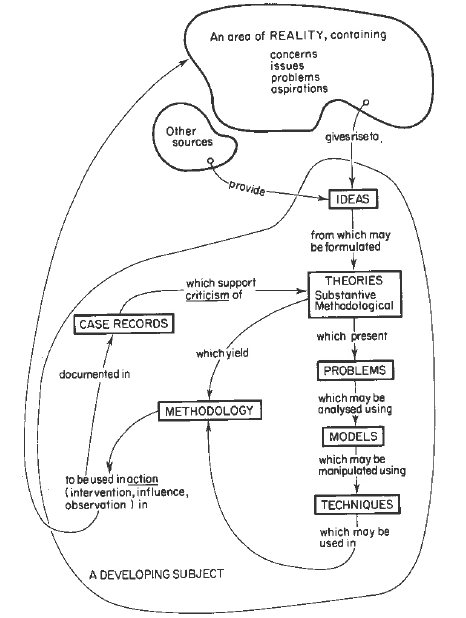
Systems Model, Peter Checkland, 1981.

Systems thinking has featured in a number of posts (see  Some types of thinking observed in local government,  Classic paper: ‘Forget your people – real leaders act on the system’. John SeddonApplying the public value concept using systems thinking in local government). As someone with an interest in systems thinking I felt it deserved some discussion in the context of local government using ideas gathered from Peter Checkland, Alistair Mant and John Seddon.

The cover of Peter Checkland’s book ‘Systems Thinking, Systems Practice’ says that it is about the ‘interaction between theory and practice of problem solving methodology’, as derived from a decade of action research. It is a seminal text on the ‘meta-discipline’ of systems thinking.

Checkland has set out to ‘develop an explicit account of the systems outlook’ and, based on that view, to ‘develop ways of using systems ideas in practical problem situations’. The book is about the ‘use of a particular set of ideas, systems ideas, in trying to understand the world’s complexity’.

“The central concept ‘system’ embodies the idea of a set of elements connected together which form a whole, this showing properties which are properties of the whole, rather than properties of its component parts.”

Systems thinking is centred on the concept of ‘wholeness’. In some ways it is a reaction to the classical scientific method, which emphasises ‘reducing the situation observed in order to increase the chance that experimentally reproducible observations will be obtained’.   Eliminating variables in order to study something to determine cause and effect is useful but ultimately limiting in complex systems where the interactions of all variables matters.

Systems thinkers have called it ‘organised complexity’ to describe the space between ‘organised simplicity’ and ‘chaotic complexity’. In some ways it is seeking to understand the simplicity that exists on the far side of complexity. In a nutshell, systems thinking is concerned with organisation and the principles underlying the existence of any whole entity.

Australian management author, Alistair Mant, describes two types of systems in his book ‘Intelligent Leadership’. He calls them the ‘frog’ and the ‘bicycle’ systems and he believes that leaders need to be able to distinguish between the two systems when applying systems thinking and directing a change and shift in systems. He sees ‘pointing systems in intelligent directions’ as one of the critical leadership responsibilities.

Frogs and bicycles are metaphors for different kinds of systems. The essential difference lies in the relationship of the parts to the whole. A bicycle can be completely disassembled and then reassembled with confidence that it will work as well as before.  This is not possible with a frog. Once you remove a single part the whole system is affected instantaneously and unpredictably. Furthermore, as you continue to remove parts the frog will make a ‘series of subtle, but still unpredictable, adjustments in order to survive’.

“This sort of system, at a level beneath consciousness, wants to survive and will continue for an astonishing length of time to achieve a rough equilibrium as bits are excised – until it can do so no longer. At that point, again quite unpredictably, the whole system will tip over into collapse. The frog is dead and it won’t help to sew the parts back on.”

This is a salient warning for those planning to intervene in a system without due care. Mant believes that most big organisational systems contain bits of frog and bicycle systems.   He says that the bicycle parts can be hived off and reattached in a new way without harming the overall system, but that the frog parts are really the core process.   In a way, he is describing systems at two different levels – the component-level (bicycle) and the system-level (frog).

Checkland says that ‘any system which serves another cannot be modelled until a definition and model of the system served is available’. This approach should prevent action on component ‘bicycle’ systems occurring before the potential implications for the whole ‘frog’ system is understood.

In common with Checkland, Mant holds the view that systems are complex and need to be considered as a whole. The systems model developed by Checkland (shown above) illustrates the process of systems thinking. He says that it starts with a ‘focus of interest’ or set of concerns that exist in the real world. This could be a problem or something about which we have aspirations. This leads to an idea. From that idea two kinds of theory can be formulated:

  1. Substantive – theories about the subject matter.
  2. Methodological – theories about how to go about investigating the subject matter.

Once theories exist, it is possible to state problems not only as they exist in the real world, but also as ‘problems within a discipline’. For example, engineering, chemistry or town planning. All of the resources of the discipline (i.e. previous problems, its paradigms, models and techniques) can then be used in an appropriate methodology to test the theory.

The results of this test, which involves action in the real world (i.e. interventions, influencing and observation), then provides case records of ‘happenings under certain conditions’.   These are the crucial source of criticisms that enable better theories, models, techniques and methodologies to be developed. It is the improvement loop.

For those proponents of the Vanguard Method this might be starting to sound familiar. John Seddon has developed an application of systems thinking in organisations that has demonstrated its value in improving organisational systems. The Vanguard Method has the following steps:

  1. Check
  • What is the purpose of this system?
  • What are the types and frequencies of customer demand?
  • How well does the system respond to demand?
  • What is the ‘flow’ of work?
  • What are the conditions that make the system behave this way?
  1. Plan
  • What needs changing to improve performance?
  • What action could be taken and what would we predict the consequences to be?
  • Against what measures should action be taken?
  1. Do
  • Take the planned action and monitor the consequence in relation to the purpose.

It features systems thinking in the need to understand a concern in the real world (what are the demands?), develop a theory or approach to improvement (what needs to change?), and then seeks to implement that action and monitor consequences (how can the approach be improved?).

“The outcome of studying the work in this way is a system picture that puts together everything that has been learned and which illustrates the dynamics of the particular service.” John Seddon.

Mant says that most complex systems containing and serving people have ‘natural properties’. Effective management aligns itself with the natural flows and processes to help them along – like a leaf floating on water running in a stream that naturally takes it to its destination. Bad or dogmatic management fails to recognise these natural properties and attempts to ‘shoehorn the system into shape’ to meet externally determined priorities. This has been identified as a problem for public sector management in a previous long read post.

Local government has spent too long looking out of the window hoping to see a ’business-like’ way of managing that will solve all of its problems, rather than having the confidence to work out what is needed from first principles. It is vulnerable to the next externally imposed management fad.

Seddon is particularly harsh in his judgement of public service reform for the past 35 years in Britain. He describes the contribution of each Prime Minister in some detail. Overall, he paints a picture of political interference and the projection of a narrative that has primarily focussed on reducing costs, yet costs have increased. This is principally because they have failed to understand the system. The complexity of systems containing and serving people has been overlooked.

Checkland, Peter, 1981. ‘Systems Thinking, Systems Practice’.

Mant, Alistair, 1997. ‘Intelligent Leadership’.

Seddon, John, 2014. ‘The Whitehall Effect’.
190 – Micro managing and macro directing. A local government phenomenon?

Posted by Whistler                                                          600 words

macro manager

I was reading about ‘macro managers’ and the five signs that you could be one when it occurred to me that the divide between the Executive and managers in local government can be partly explained by this idea.

We are all aware of ‘micro managers’ and the problems associated with managers who constantly get right into all the details. Wikipedia describes it as ‘a manager who closely observes or controls the work of subordinates’ and comments that it generally has negative connotations. I agree. But how often do you see it in local government?

Some of the ‘symptoms’ of micro management are low levels of delegation, requests for unnecessary reports, taking credit for others’ results (particularly the more narcissistic micro managers), blaming others, and denying their behaviour by describing themselves as ‘structured’. I would add the disempowering effect it has on people.

In contrast, at the next level up in the organisational hierarchy macro management tends to occur. Continue reading

189 – Essay No. 2 – Local government, effectiveness and efficiency.

Posted by Lancing Farrell                                                                              3300 words

false economy cartoon

Image

People in local government regularly discuss effectiveness and efficiency. Often this happens in relation to pressure on revenues, such as rate capping. Most of the discussion centres on efficiency rather than effectiveness, and opportunities to stop delivering those services that are seen as ‘cost shifting’ from other government. The efficiency discussion is often not well informed. Frequently it focuses on inputs while ignoring outcomes and public value. Any savings are usually equated with cost cutting, not creating the same value at lower cost.

Australian researcher and writer Christopher Stone has published several papers on ‘false economies’. Each addresses a different aspect of productivity and efficiency in the public sector.

“Everyone has the right to know that money is not being wasted; that it is being spent as efficiently as is possible.” Christopher Stone, Decoding Efficiency, April 2013.

So, what is efficiency and how does it differ from effectiveness? Continue reading

188 – The council value proposition – what could it be?

Posted by Colin Weatherby                                                                                         1100 words

Kano model and brand

There have been a number of posts on value. In the context of imminent rate capping in Victoria it is timely to revisit some concepts of value relevant to local government. It is easy to overlook the fact that public service expenditure is about creating public value.  Especially when revenues are being constrained and thinking is turning towards making savings and cutting costs.

In the diagram above I have used the Kano model from Wikipedia and positioned three key council services that many regard as ‘core’ services – the provision of public parks, waste collection from residential properties, and provision of roads. Each has been placed in a different place on the diagram and I will explain why. Continue reading

187 – A high functioning Executive. What would it take?

Posted by Colin Weatherby                                                                                         1100 words

awesome

This is a question I was asked recently by a reader. Having read several posts critical of the behaviour of the Executive (What can a culture survey, an organisational self assessment, and your Executive’s risk appetite tell you?, The Executive. What exactly is their role? , Does your Executive suffer from altitude sickness?, and The Executive: filters, traffic controllers or drivers? ) she wanted to know whether I had a solution. Knowing that it is easier to be critical than creative, I cast my mind to thinking about the nature of the problem and some potential solutions.

I think the starting point is to understand the problem. In a nutshell, I think the following issues illustrate the problem:

  1. The Executive is overloaded with the small stuff handed to them by councillors (not the council). Much of it has to do with the personal idiosyncrasies of councillors and behaviours arising from their inability to work together as a group. It is dysfunctional, urgent and produces little value for the community. There are better ways for potholes to be reported.
  2. The Executive has to deal with high level relations with external organisations and strategic external pressures. These are often CEO to CEO relationships and cannot be readily delegated.
  3. The Executive is not putting enough time and effort into leading the organisation. Their focus on councillors and the external environment takes most of their time and energy. At the same time, they worry about problems 1 and 2 being made worse so they try to control organisational communication and decision making. When this is done ‘efficiently’ by time poor leaders it drives dysfunctional management behaviours.
  4. The Executive operates independently of managers and participates in the Senior Management Team (SMT) episodically. There is frequently no genuine and continuous engagement with the SMT in strategy and decision making. Managers are included in decision making when it suits the Executive – which is usually when they have the time and energy to do it. Managers are effectively isolated from information and the strategy decisions being made continuously by the Executive.

Obviously there are different solutions possible. Continue reading

186 – Essay No. 1 – Local government and accountability.

Posted by Lancing Farrell                                                                              2000 words

rabbit in headlights

This is the first in a series of essays to wrap up the 200 opinions, essays and observations from Local Government Utopia. As such, it attempts to bring together some of the themes that have emerged in the various posts.

Have you ever imagined yourself to be in the office of the CEO?

You have arrived at work to be told that The Ombudsman’s office wants to talk to you about the outcome of an investigation triggered by a Whistleblower. You have a meeting at the Auditor General’s office that morning to discuss the latest report they have released on Council Customer Service. A copy of the Independent Broad-based Anti Corruption Committee (IBAC) report on Council Depot Management is in your in tray along with a complicated Freedom of Information request.

That evening you have a Risk and Audit Committee meeting where you need to explain the lack of action in implementing recommendations from the 10 internal audits completed in the previous year. A councillor has left you a phone message saying they are unhappy with a decision regarding services delivered to an elderly resident. There is an email from the local newspaper wanting comment on an expose they are running on councillor entitlements.

I am sure this is not a usual day. But it also isn’t an entirely unrealistic scenario either. There are lots of sources of accountability for local government. Often, they act on the organisation independently and there is no effort (and sometimes no opportunity) to coordinate the organisational response. As a result, sources of accountability frequently operate at cross purposes and can be counter-productive. Continue reading