1500 words (17 minutes reading time) by Carole Parkinson

The Wigan Value for Money Statement
Lancing Farrell’s post on Wigan and the Deal 2030 explains how a council has successfully decided to make a radical change in the relationship with its community in response to austerity measures imposed by central government. By all accounts the Deal 2030 has been successful in reducing the resources needed for the council to deliver its services, in large part by reducing demand for those services by helping people to do things for themselves or to access services provided by the VCFSE (voluntary, community, faith and social enterprise) and private sectors.
It is 10 years since the Deal 2030 was launched. As with any big organisational change, it is hard to evaluate its success from the outside. To help us, there have been several reviews of the Deal 2030 since it was implemented, including the King’s Fund (2019), the Centre for Policy Impact (2019), and a Corporate Peer Challenge (2017). All have reported favourably on both the success in implementing actions in the Deal, and the impact of those actions on the Wigan community. Therefore, it was with some interest that I saw Wigan Council has recently released a Value for Money Statement.
Perhaps everything is not what it appears?
Wigan Value for Money Statement
The Value for Money Statement and its objective are described in the image above. They make sense. Everyone expects a council to try and ensure the best value for money in delivering services. Disagreement about what constitutes value is commonplace and having some principles to guide decision making to ensure the council achieves value for money is also sensible. Get the community and the council working off the same page. This is where I think it starts to get interesting.
It appears to be a document prepared within Wigan Council and without consultation with the Wigan community. Unfortunately, the document does not actually include the promised principles. Instead, the principles have to be deduced from the discussion about why achieving effective value for money is important; the strategic approach chosen to achieve value for money; and the governance arrangements in place to ensure good value for money. It is an interesting read, although it requires some reading between the lines.
Without going into all the details (please read it for yourself), the statement seems to be all about regaining control of service levels and costs through centralisation of decision making, procurement, and governance. The arrangements being put in place to ensure good value for money rely heavily on Scrutiny Committees (a form of internal audit), risk management and financial controls. You get a sense that despite the great work negotiating a new relationship with the community and empowering frontline staff to make decisions and continuously improve while responding to community demands, that expenses have not been reduced to the extent necessary.
Wigan Financial Plan 2023/24
The Medium Term Financial Plan 2023/24 -2025/26 (Financial Plan 2023/24) provides an insight into what might be driving the thinking behind the Value for Money Statement. It says that despite savings of £185 million in the preceding decade, a further £47 million must be cut between 2023 and 2025, including £20.3 million in 2023/24.
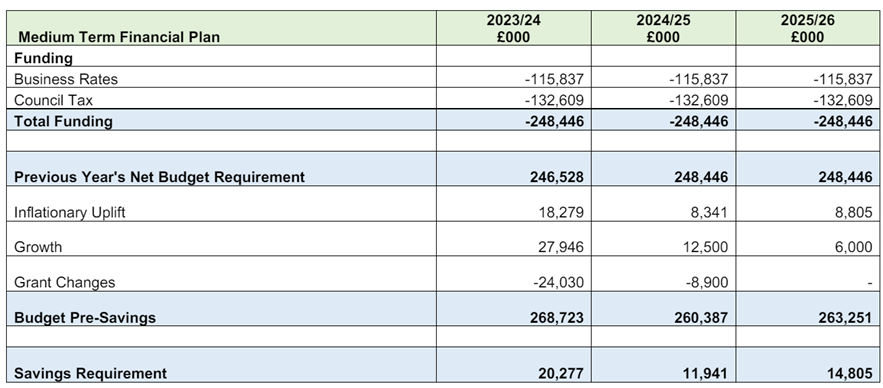
Savings required 2023/24 -2025/26
The Financial Plan 2023/24 goes into some detail about the pressures on the budget, in addition to the need to make the budgeted savings. These include Children’s Services costs, especially childcare, being expected to increase by £17 million. Social Care grants will need a new funding source, which has not been identified. Intergovernmental grants are increasing by less than inflation. High inflation is increasing construction costs, which has resulted in capital projects being delayed and could require the affordability of the whole program to be reviewed. The Financial Plan 2023/24 says it is essential that services are delivered within set budgets and for directorates to make targeted efficiency savings, which has led to the establishment of a Transformation Board to ‘drive through plans and efficiencies.’
Command and control or systems thinking?
At about this point, I started wondering how Wigan ended up in this position. Without wanting to blow John Seddon’s trumpet too loudly, this does seem to be what can happen if conventional command and control thinking is not effectively replaced by systems thinking. Much of what the reviews of the Deal 2030 describe sounds like Wigan set out to adopt a systems thinking approach. The diagram below reproduces Seddon’s view of the difference between command and control and systems thinking.
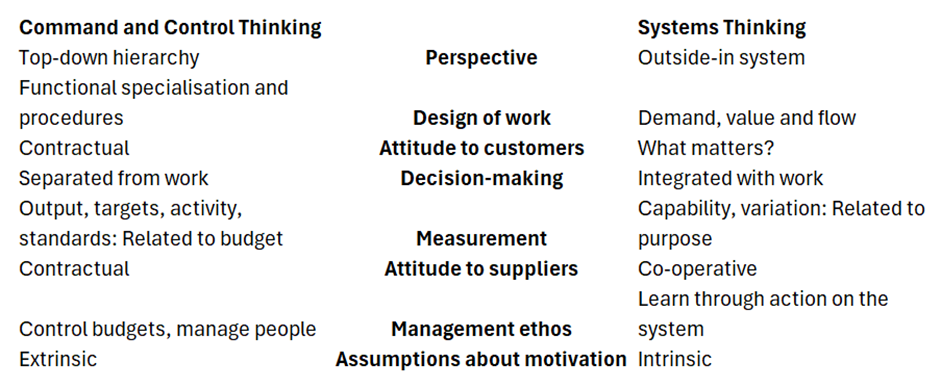
Seddon explains this diagram in each of his books and online. If I was to use this diagram as a checklist of the Value for Money Statement document, I would score Wigan’s management approach like this (shading indicates current focus).
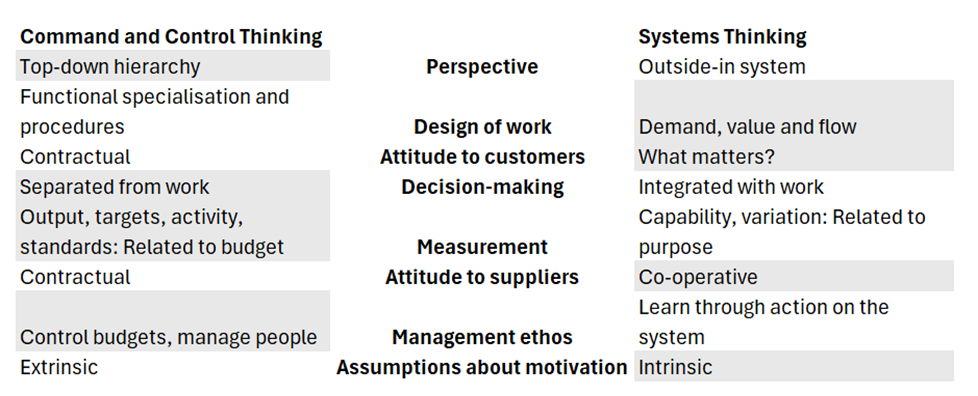
What seems to be happening in the Value for Money Statement is a reversion to many aspects of conventional command and control thinking, or possibly just a strengthening and reinforcement of it, after a period where the focus had been shifted to responding to demand in ways that matter to the community. It is hard to understand why this has happened, other than there has been a change of CEO since the Deal 2030 was put in place and leadership thinking is critical. What is clear is that mixing ways of thinking like this can be confusing for staff and the community and ultimately counterproductive with service delivery partners.
It is hard to see the community and partner organisations keeping to their side of the Deal 2030 if the council starts to unilaterally make decisions to save money by providing what they think is best value for money. Staff will also start to lose confidence in their support to respond to demands if they are being directed to act in standardised ways and their every decision scrutinised against a new risk framework.
The real deal?
I thought it might be useful to write my own version of what I understand Wigan’s value for money statement to be really saying. This is where there is quite a bit of reading between the lines:
- The community doesn’t understand how hard our job is and they keep placing demands on us that cannot be met.
- We know what we can afford to provide to the community and how to make the available money go around, so we will be deciding on who gets what.
- To make sure it is fair, we will be standardising our services within defined service levels to make sure everyone gets their share.
- We are being audited continuously by central government, who expect us to provide the services they direct us to deliver within the budgets they allow us to set, and we can’t achieve that while people keep asking us to do too many other things or for things that are too expensive.
- To ensure external measurement of our performance looks good, we will centralise decision making and subject it to rigorous scrutiny from our accountants and other experts to demonstrate that it is beyond reproach.
- We need to make savings to meet our financial targets, and we can only do that by making sure we are cost efficient and using no more resources than other councils to serve our community, so we will benchmark with them and start copying what they do.
- To ensure that all our employees get the seriousness of the situation we are going to wrap service delivery decision making in a risk management framework to enable scrutiny and review of our decision making in response to community demand.
I could go on.
It seems to me that the initial gains by shifting service demands away from the council have slowed or reversed, and the demands now being placed on the council are increasing. This could include growing amounts of failure demand if service delivery arrangements are starting to break down. It might also simply be that Wigan is the first council to find the limits of organisational improvement without systemic change and now they are struggling.
Another limit that has probably been reached is squeezing more from the local government lemon. Now the living standards people have enjoyed in Britain can no longer be supported by the council and its service partners without a radical renegotiation of the relationship between Wigan (and all councils) and central government. Much like the renegotiation Wigan managed with its community in the Deal 2030. The peak body for financial professionals in Victorian local government (FinPro) has made the call In Victoria that constraints on council revenues imposed by the State government rate cap will result in reduced living standards. Unless councils are supported in making the radical changes in service delivery necessary to cope with reduced revenue they will just be squeezed until they fail.
Whatever the reason, what seems to be happening in Wigan is a predictable and conventional council leadership response – just stop and go back to see if that works. At least then they can’t be blamed for trying something unconventional and failing.
 Local Government Utopia