580 words (7 minutes reading time) by Lancing Farrell

In a thought-provoking post titled ‘OECD Solutions,’ Colin Weatherby examined decision-making by those suffering from OECD, shedding light on the prevalence of single-loop learning over its more nuanced counterpart, double-loop learning. The implications of this choice, as Weatherby suggests, go beyond the surface, hinting at a deliberate oversight of systemic causes.

The Iceberg Metaphor: Seeing Only the Tip
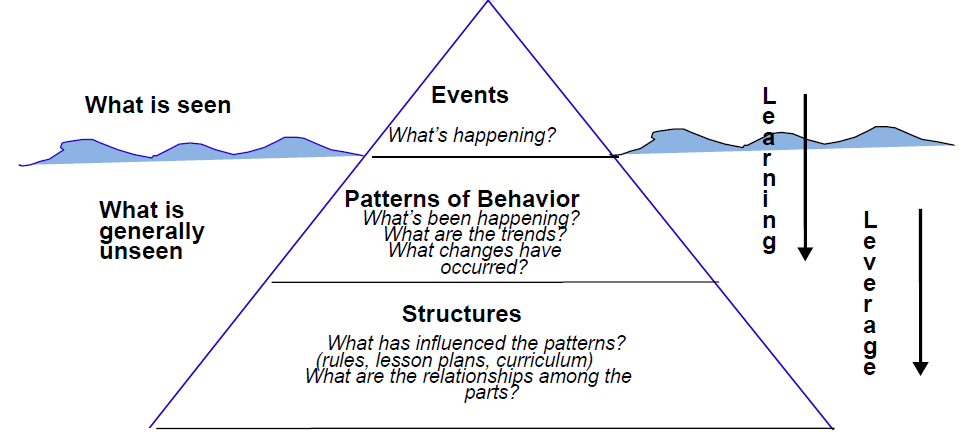
Drawing a parallel with the iceberg metaphor, it is apparent that OECD emphasises the tendency to focus solely on the events above the surface. This selective attention avoids understanding of the behaviour patterns and systems or structures beneath the waterline.
Simplification: The Convenience Trap
Reflecting on a recent article by Aaron Dignan titled ‘Why We Dumb Things Down,’ another layer of insight is uncovered. Dignan explores the consequences of simplifying complex matters, a practice prevalent in OECD decision-making. He introduces the concept of a ‘reductionist loop,’ a cycle that begins with leaders being busy and ends with a craving for a more accurate picture of reality.
“Simplicity! You don’t really understand something until you can explain it to a child, right? True, but your leaders and colleagues are not children. And in a dynamic and complex world, few decisions are truly simple. We need deeper understanding and sense-making in order to innovate and break through.”
Aaron Digman
The Reductionist Loop Unveiled:
- Leaders are busy: Packed schedules leave leaders with limited time for in-depth focus.
- Leaders can’t focus: Overwhelmed leaders struggle to delve deeply into any one subject.
- Leaders can’t handle the detail: Complexity and ambiguity elicit poor reactions from leaders.
- Leaders see the world in bullet points: Brevity becomes a culture, simplifying complex topics.
- Leaders don’t “get it”: Lack of in-depth understanding leads to a superficial grasp of business happenings.
- Leaders crave the truth: Seeking a better picture of reality, leaders demand more meetings, restarting the cycle.
I think the reductionist loop, as Dignan outlines it, is a deliberate choice to live above the waves, avoiding the complexities beneath. However, this intentional approach has long-term repercussions, with leaders skilled at OECD eventually facing the consequences of decisions made without a comprehensive understanding.
The Pitfalls of OECD: Blame and Scapegoats
As leaders caught in the reductionist loop are held accountable for their poor decisions, blame-shifting and the search for scapegoats often follow. The deliberate avoidance of detail comes full circle, revealing the inherent flaws in the OECD approach.
In essence, the reductionist loop is the antithesis of the double loop, representing a conscious choice to react only to events above the water’s surface. Understanding this dynamic is crucial for any leaders deciding to navigate below the waves and enter the depths of decision-making with clarity and effectiveness.
 Local Government Utopia