93 – ‘Cost shifting’, or ‘State services paid for by rates’? It is our choice.

Posted by Colin Weatherby                                                                         670 words
townhall 2

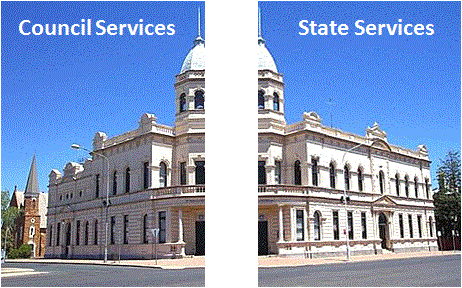
In local government in Victoria middle maangers are often asked to identify ‘cost shifting’ at budget time to identify the portion of the planned rate increase that is needed to cover additional costs in delivering services prescribed by the State government. A little bit of whinging usually goes along with it. Councils often feel as though they are victims being forced to do something against their will. I think it is a mindset problem.

What is really happening is that the State government is choosing to have its services delivered through local councils and for those services to be paid for by the people who receive them through their rates (property tax). Continue reading

82 – Is it a strategic decision?

Posted by Colin Weatherby                                                         500 words

yes no maybe

How to Tell which Decisions are Strategic’ is the title of a paper by Ram Shivakumar published in the California Management Review in 2014. It attracted my attention because I have often asked that question myself. What is it that distinguishes a strategic decision from a non-strategic decision? Well, hopefully you will know more after reading this post.

The essential idea in the paper is that a strategic decision is defined by the degree of commitment involved and the implications for the scope of the business or organisation.   Let me explain. Continue reading

78 – Organisational comfort zones in local government. Where is yours?

Posted by Colin Weatherby                                                                         730 words

Challenge capability diagram
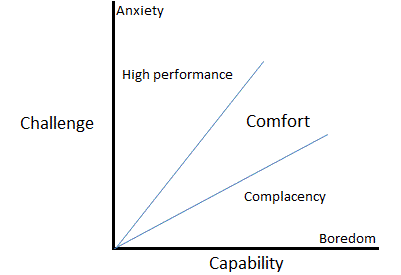
The idea that people are often in their comfort zones and that learning and improvement occurs when you move out of it has currency in local government today. The concern is that when people find their comfort zone they settle in and thereafter resist change, even beneficial change. Individuals are regularly being asked to leave their comfort zone and accept challenges. Does an organisation also have a comfort zone?

I think many organisations do – and they stay in them. It will usually be the zone that the organisational leaders, the council or the CEO and Executive, allow it to be in. Frequently, it is a place that they understand and there will be a level of challenge and change activity that the leaders are comfortable to support. The question is what is that level at your organisation? Continue reading

73 – ‘Social media changes the rules of engagement’ , The Age, 4 April 2015

Posted by Colin Weatherby                                                                         730 words

multi channel

This article contains a healthy warning for local government about the need to design services with the customer in mind, and to look ‘outwards-in’. There have been a number of previous posts on services (see here, here, here and here). Disgruntled customers of councils are just as likely to use social media to vent their anger and concerns.

“Customers want influence over the contents of what they’re buying; they customise the muesli they order online; stream entertainment that is tailored to their interests, and pitch ideas to software companies as they develop new products.”

In this environment, councils that just continue to offer the same old services, or who alter services in ways that make them less responsive to customers, or more responsive but less reliable, are likely to frustrate people using those services. Continue reading

71 – ‘Melbourne People’s Panel makes bold decisions where politicians fear to tread’, The Age, 1 April 2015.

Posted by Colin Weatherby                                                                         550 words

Peoples panel

“The public is smart if given the time and information necessary to work through an issue. And this has been demonstrated by a people’s “jury” which has delivered its verdict in a bold experiment in democracy by the Melbourne Town Hall.

The results should give hope to people despairing that Australia has lost its reform mojo, as it provides a new way for government to get hard but necessary things done.”

I read this article by Nicholas Reece, a Principal Fellow at Melbourne University, with some interest. Involving the community in budgeting is not new. Continue reading

69 – Local government and milk. What do they have in common?

Posted by Colin Weatherby                                                                         660 words

cow

I recently drove past a car sign-written with advertising for milk available direct from the farm. It promoted the virtues of buying milk from the producer. I had earlier heard a radio advertisement for milk available from an inner urban Melbourne dairy where I am sure there are no cows. The advertisement talked about local milk from local people.

There may be some difference in the milk each company is selling. And it is probably different from the milk I can buy at my supermarket. So what is happening with milk and why might it tell us something that is relevant to local government? Continue reading

63 – ‘The more experienced the managers, the more they trust simple intuition’. Or do they?

Posted by Colin Weatherby                                                                         700 words

intuition

Some time ago I posted on an idea from Richard Farson’s book, Management of the Absurd – Paradoxes in Leadership. This post has been inspired by another chapter in that book.

Farson says that the one quality that top executives say separates them from their less successful colleagues is their intuition. Their ‘immediate visceral reactions’ to people and events are usually accurate, which makes their judgements valuable. Farson defines intuition as the ‘accumulation of many learning experiences that have sensitised them, making them able to read situations quickly’. It is a quality that allows top management to make fast decisions that are effective. However, when top management starts to lack confidence, they start to apply formal processes to make decisions. They replace their immediate visceral reaction with complicated analytical thinking. Continue reading

61 – Public value gap analysis. Some actions.

Posted by Colin Weatherby                                                                         280 words

gaps

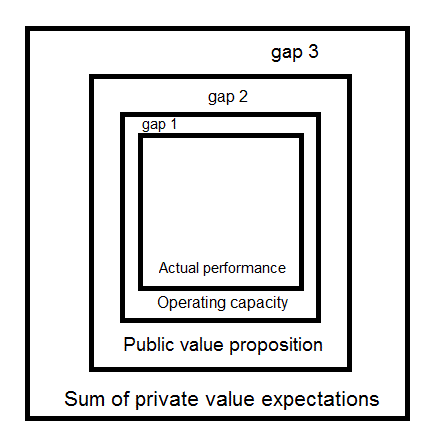
I posted on a tool that can help to identify gaps in public value creation. This post briefly suggests some actions for each gap.

The first gap between actual performance and operating capacity, or potential performance, is best addressed though organisational processes to improve productivity. Recognising the gap is important and then it is in the hands of the organisation to justify its performance or improve it. Utilising all available operating capacity efficiently is the responsibility of organisational management.

Gap 2 requires something new to happen. It isn’t simply a matter of being more efficient and productive. Continue reading

60 – Public value gap analysis. A tool.

Posted by Colin Weatherby                                                                         790 words

private public operation actual

One of the challenges in local government is understanding public value – what it is for your community and how you can create it. It can  be difficult to separate it from private value expectations and to see the relationship with the operating capacity of the organisation. This post explores a conceptual tool to understand public value and gaps that need to be addressed in achieving it.

Many years ago when asked to be the officer leading a community advisory committee I developed a model to help the group understand what we were talking about and to focus on gaps where we could be most effective in making a difference. It worked very well. At the time I didn’t really understand why. Now I think it was because is identified the public value gap that the group could work on. Here it is. Continue reading

53 – Coffee, basketball and privatisation. What significance could they have for Australian local government?

Posted by Colin Weatherby                                                                                    1000 words

the barista economy

Image from The Age, 11 March 2015

On the 11 March 2015 there were three articles in the Melbourne Age newspaper on different topics that each held a message of potential relevance for local government.

The first was ‘Welcome to the barista economy. The article is based on a speech by Christopher Kent from the Reserve Bank of Australia (RBA) who looked at changes in household expenditure patterns over the past 30 years.

One thing is clear: we are spending a lot more on ‘services’ than we are on ‘stuff’. The share of household spending on services is up from 53 per cent to 65 per cent of household consumption.

The RBA explains the increased spending on services as a result of cheaper goods because of better productivity and more goods coming from ‘emerging economies’. The world has become better at producing goods and people now have more money to buy services, which in effect is buying time. We can afford to employ someone to perform tasks when our time is better spent on other activities, we don’t have the skills, or it improves our quality of life (e.g. leisure).

The barista connection highlights the growth in service industry jobs. Coffee shops are everywhere. Having a coffee has become part of every outing.

I think that the significance for local government is twofold. Continue reading