281 – Reframing the reframing…

800 words (8 minutes reading time) by Tim Whistler

Whilst Lancing Farrell has penned an interesting , and no doubt useful, piece on reframing, I think it doesn’t go nearly far enough. Councils are going to remain on a downward trajectory to crisis while they fail to make major changes in the way they think and act.

I have a much shorter list of changes that councils could make and should make. If they don’t, I fear that there will be massive financial failure and the sacking of councils and their CEOs, mainly because they are unable to make decisions where there are no winners, followed by the imposition of State control through the appointment of administrators and forced amalgamations.

Continue reading

274 – The Wigan Deal and Value for Money

1500 words (17 minutes reading time) by Carole Parkinson

The Wigan Value for Money Statement

Lancing Farrell’s post on Wigan and the Deal 2030 explains how a council has successfully decided to make a radical change in the relationship with its community in response to austerity measures imposed by central government. By all accounts the Deal 2030 has been successful in reducing the resources needed for the council to deliver its services, in large part by reducing demand for those services by helping people to do things for themselves or to access services provided by the VCFSE (voluntary, community, faith and social enterprise) and private sectors.

It is 10 years since the Deal 2030 was launched. As with any big organisational change, it is hard to evaluate its success from the outside. To help us, there have been several reviews of the Deal 2030 since it was implemented, including the King’s Fund (2019), the Centre for Policy Impact (2019), and a Corporate Peer Challenge (2017). All have reported favourably on both the success in implementing actions in the Deal, and the impact of those actions on the Wigan community. Therefore, it was with some interest that I saw Wigan Council has recently released a Value for Money Statement.

Perhaps everything is not what it appears?

Continue reading

273 – Can councils learn from the local football club?

1300 words (14 minutes reading time) by Colin Weatherby

 Great Coach 2.0

Some time ago I wrote a post about council performance measurement being like a dashboard on a car. I used the image of a dashboard like the one on my 1962 Morris Mini to keep it very simple. I noted that the car dashboard had evolved over many years and been refined to be a distillation of information to the minimum required for a driver to be in control of their car. It didn’t tell the driver where they were going or if they were on track to get there. I was hoping it would be an example councils could follow. Lately, I have turned my attention to sport.

Australian rules football and statistics

It is football season in Australia, and I was reading about how footy clubs, professional and amateur, are using data and statistics to measure and improve their performance. It started me thinking. Every council in Australia must have a local footy club. Perhaps they can learn something from them?

Continue reading

269 – Unrestricted cash: are councils hopeless or helpless (or both)?

630 words (7 minutes reading time) by Lancing Farrell

Professor Joseph Drew has posted another of his valuable and prescient videos for local government leaders. His analysis of the financial sustainability of councils in NSW heralds a warning across Australia for councils experiencing rapid increases in expenditure that are not being matched by revenue increases – especially those subject to a rate capping regime. NSW councils are running out of cash to fund operations. The FinPro/Municipal Association of Victoria report in 2022 showed that all Victorian councils except those in metropolitan areas are experiencing underlying deficits and the problem is getting worse.

Professor Drew’s warnings should really be a headline on the agenda papers for every council meeting!

I think part of the challenge for councils in acting on his warnings and advice is the prevalent sense that there is nothing that can be done – councils are at the mercy of forces greater than any they could hope to overcome. In discussions with Professor Drew I have likened it to a movie where a meteorite is expected to hit Earth and no one thinks it can be stopped or deflected.  Half the population are resigned to their fate and having a party, and the other half are sitting in the dark with their fingers crossed hoping it will miss.

Maybe a better explanation is that hopelessness is the feeling that nothing can be done by anyone to make the situation better. People may accept that a threat is real, but that threat looms so large that they feel the situation is hopeless. Helplessness is the feeling that they have no power to improve the situation. I think councils have a strong sense of both.

Well, for those with greater confidence that something can be done (and should be done to protect community interests), here is a list based on the initial advice Professor Drew provides (he is prepared to offer more detailed and specific advice to councils that ask):

Continue reading

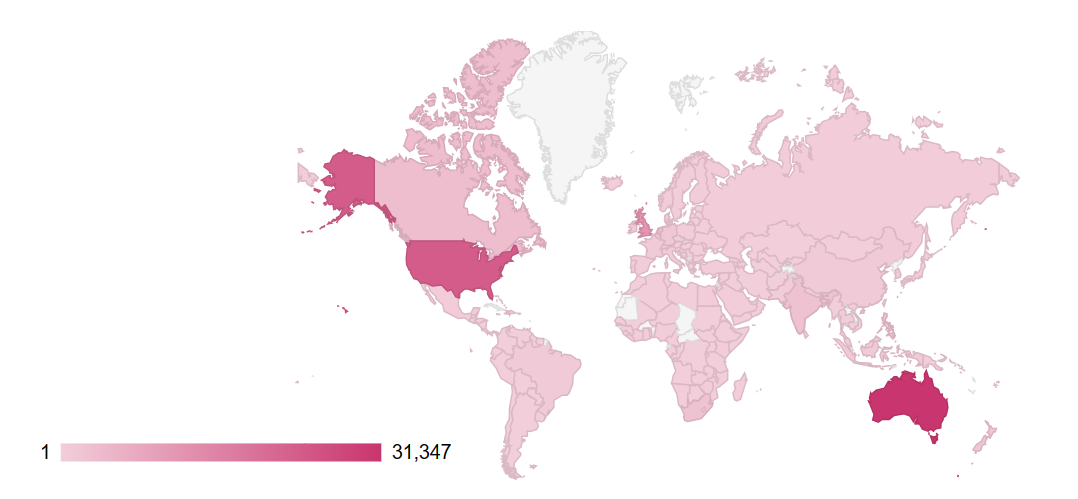
246 – Local Government Utopia: 100,000 views by 57,000 readers in 187 countries.  

600 words (7 minutes reading time) by Lancing Farrell 

It is 8 years since Local Government Utopia started and this post looks back at what has happened.

A lot has been written on the blog covering a wide range of topics. People often suggest to me that the blog would make a good book. There are over 250,000 words in the posts so far. Enough for 25 books. Publishing a book is likely to be less effective than a blog. A non-fiction book is considered successful when 10,000 copies are sold – that’s only 10,000 readers! 

Plus, a blog makes reading cheap and easy.  

I have done some basic analysis of the most popular posts and where readers live in the world. 

Continue reading

228 – Frog or bike. Does it matter?

1720 words (6 minutes reading time)                                                                Lancing Farrell

thinking frog

Colin Weatherby and Tim Whistler have made some interesting points in their contributions to the discussion about the Vanguard Method. Clearly, Colin’s colleague has had some success in using it and has been able to identify unique features of the Vanguard Method. In contrast, Tim has raised some legitimate concerns, especially from a local government perspective. I have spent some time thinking about both points of view and reading some of the material mentioned. Here are my thoughts for what they are worth.

Services are complicated and the interactions between the parts, especially when people are involved, is important. Experience says that changing one part of a system does often have unintended consequences elsewhere. Continue reading

224 – Risk taking in local government

By Colin Weatherby                                                                                               900 words

opportunity.png

Image

Lancing Farrell raised several important issues in providing advice to a colleague regarding risk management. How does a council balance the pressure not to take risks and fail, with the competing pressure (often from the same sources) to take risks and meet demands to create new value?  

Risk is an interesting concept and there are various definitions. I like to think of it simply as the uncertainties related to achieving your goals. It is about the hazards along the pathway as you make your way towards your destination.

Businesses that don’t take risks will fail. They become uncompetitive or customer satisfaction drops. Either way, they lose business to competitors taking risks to create value that customers want and will pay for. We can all think of the companies that have taken big risks in redefining a service or product to create a new market.

You are probably wondering what this might have to do with local government. Aren’t we just doing what we have always done?

Many councils are. Whether they should be, or whether they will be able to continue to do so, should be questioned. We now live in the ‘age of the customer’ – residents want personalisation, mobility, self-service, rapid response, and efficiency (efficiency for them, not the council). The variability introduced by customers must be quickly and effectively absorbed by the organisation. Complexity, by its very nature, creates risks.

In conjunction with mandated limits on prices (the rate cap) and growing numbers of customers (as Lancing points out, Melbourne is growing rapidly), the rising expectations of residents means that councils must do things differently. Different usually involves risk taking.

I recently attended a training session on developing an organisational risk appetite. It showed me how councils could identify hazards and manage risks differently, yet still satisfy the pressure to stop things going wrong while meeting the demand to create new value. It needs a re-think and a more sophisticated approach to risk and compliance. Continue reading

202 – Essay No. 6 – Local government and public value.

Posted by Lancing Farrell                                                                                              6500 words

bureacracy

Value is often mentioned in local government when talking about services, particularly ‘best value’. However, there is often inadequate understanding about the different types of value, the difference between private and public value, and how value is actually created and managed by an organisation. Sometimes there is the assumption that because we have been busy, that we must have created something worthwhile.

This essay brings together ideas from several earlier posts and is constructed around four hypotheses:

  1. That there are different types of value created by organisations and for local government public value is the most important.
  2. Public value is the primary value that must be understood and delivered if councils are to deliver what is expected by the community.
  3. Value-led management is a way of managing that could transform local government and make it more responsive and effective in serving the community.
  4. There are simple and effective tools that can be used to improve value creation in local government.

Hypothesis 1: There are different types of value and public value is the most important for local government.

Private value

In a metaphorical sense the value that you add is what you ‘bring to the party’. This is determined by what other people think you have contributed and by thinking about what the party would have been like if you hadn’t arrived.

There are different types of value and it is worth briefly considering the difference between private value and public value. Public value is the collective view of the public or community about what they regard as valuable, especially with regard to the use of public money and authority. Moore describes this as occurring along a spectrum from value that is obtained from public services that is essentially private value, similar to the concept of customer value, to public value that reflects the aggregate value expectations of citizens.

Moore degrees of publicness

At the private value end of the spectrum, the focus is on the individual service recipient and delivering value that satisfies their expectations.   At the public value end of the continuum, the focus is on achieving the social outcomes sought by the community or public. Continue reading

198 – Essay No. 5 – Local government and leadership.

Posted by Colin Weatherby                                                                         1300 words

Mark H Moore strategic triangle

Mark H. Moore’s ‘strategic triangle’ – the basis for value-led public sector management

I have been thinking about leadership a lot recently. It has been a recurring theme in posts on this site. Reading Jeffrey Pfeffer’s book has challenged my thinking about how leaders work and what motivates them. It has reinforced some of my scepticism about leaders and why they do what they do. I tend to agree with Peter Drucker’s questioning of the distinction between leadership and management. Ultimately, organisations, particularly in the public sector, have to be managed. The idea that somehow managers aren’t leaders or that leaders aren’t managing doesn’t make sense.

Having said that, I can think of organisational leaders I have known who couldn’t manage. At some point they just ticked the leadership box and assumed the position! Pfeffer explains how and why everyone then goes along with it. Once you are a leader it seems you can get to stay there without any real scrutiny and accountability for your performance. That has definitely been my experience in local government.

I keep imagining myself working in an organisation with an effective leader who manages the organisation for high performance (not career advancement). One that provides clear strategy, direction and goals.  One who coordinates effort to  across the organisation to achieve those goals. In particular, I have been thinking about how they could do that in local government. Continue reading

194 – Essay No. 4 – Local government and customer service.

Posted by Lancing Farrell                                                                              4500 words

basil fawlty

Customer service is, and should be, a major concern for local government. After all, councils are service organisations. Sometimes there is confusion about exactly what customer service means, how it relates to public service delivery, and what aspects of service are most important to get right in local government.

This essay focuses on three hypotheses:

  1. That ‘customers’ in local government are different to the customers described in most customer service literature and encountered by most service organisations.
  2. There are six main opportunities for local government to improve service to customers.
  3. There are simple tools available that can assist councils in getting service delivery and customer service right.

Continue reading