140 – Developing a dashboard for performance measurement. A case study – Part 2.

Posted by Colin Weatherby                                                                         810 words

aircraft cockpit

Some time ago I posted on my approach to developing a dashboard for my unit. I set out the ‘performance questions’ that I could need to answer at any point in time as I ‘drive’ my unit. In this post I apply the ideas of Geary Rummler, Alan Brache, Mark Moore and Christopher Stone to determine measures and lead indicators.

The performance questions identified in my first post are intended to get to the heart of the ‘performance logic’ underpinning performance management of the unit. Understanding the performance logic is an idea from Rummler and Brache. Seeing the performance logic as a series of ‘performance questions’ comes from a handy paper by Bernard Marr on the Advanced Performance Institute website, ‘What are key performance questions’  and how they can be used to engage people in dialogue about performance and guide the design of meaningful performance indicators. Continue reading

132 – ‘A new theory of value creation for local government’. Do we need one? Part 3 – operations strategy.

Posted by Lancing Farrell

Slack operations strategy

Image from Operations Management, 6th Edition, Slack, Chambers and Johnston.

In this third post in this series, I look at the concept of the operations strategy. Every organisation has one. Your organisation does, but do you know why or what it is? And how does it relate to the business model?

This series of posts is intended to make the case that local government needs a theory of value creation – a clear explanation of what local government does to create public value. That theory will require a reappraisal of the operations strategy and the role that operational capability can play in supporting the business model and strategy execution.

Hayes and Wheelwright describe operations strategy as guiding decisions about vertical integration (i.e. the extent to which the council owns the value chain), capacity planning (i.e. how variation in demands will be met), facilities planning (i.e. the facilities needed to deliver services), services technologies (e.g. information systems) and process technologies (e.g. batch or make-to-order).

The academics Nigel Slack, Stuart Chambers and Robert Johnston in their text Operations Management talk about strategy and the connection to operations Continue reading

126 – ‘A new theory of value creation for local government’. Do we need one? Part 1 – Strategy.

Posted by Lancing Farrell                                                                              850 words
value diagram shaded

This is the first post in a series  exploring the relationship between business strategy, the business model and operations strategy. It is an attempt to pick up on the ideas in Colin Weatherby’s previous post discussing Henry Mintzberg’s ideas about different models for government organisations. Hopefully the series of posts will make my case for a local government theory of value creation.

I will begin with business strategy. To set the scene, I have chosen the following quotations from management consultant and academic David Maister  to highlight the strategy problem for local government.

“A strategy is not just choosing a target market, but is about actually designing an operation that will consistently deliver the superior client benefits you claim to provide.

However, each decision you make to be more effective at delivering the preferences of those you target will (inevitable, inescapably, unavoidably) make you less attractive to clients or market segments that look for different benefits.

You could try to design your operations to meet a wide variety of preferences and needs, serving each client or customer group differently, according to their individual wishes.

Your market appeal will then come down to ‘tell us what you want us to do for you and we’ll do that. We’ll do something different for other people tomorrow!’

The very essence of having a strategy is being selective about choosing the criteria on which a firm wishes to compete, and then being creative and disciplined in designing an operation that is finely tuned to deliver those particular virtues.

An operation designed to provide the highest quality is unlikely to be the one that achieves the lowest cost, and one that can respond to a wide variety of customized requests will be unlikely to provide fast response and turnaround. Any business that tried to deliver all four virtues of quality, cost, variety and speed would be doomed to failure.”

Maister may not have had local government in mind when he wrote this piece, but he provides an insight into the challenges in determining what provides value to people receiving services. He calls it ‘superior client benefits’. In the public service context, academic Mark H. Moore has called it public value. It is the same idea Continue reading

121 – Squire to the giants. Who are the giants in common?

Posted by Colin Weatherby                                                                                                 830 words

squire

I recently found a new and interesting blog called ‘Squire to the Giants’. Much like thinkpurpose.com this blog site is aimed at people who have an interest in improving their organisation through systems thinking. A recent post talks about the ‘giants’ that have influenced the Squire’s thinking. I am familiar with some of the ‘giants’ and have others of my own.

The Squire lists the following giants:

Regular readers of this blog will be familiar with the work of Peter Scholtes  and John Seddon. Both have influenced the thinking of writers. The biographical pieces written by the Squire  are worth a look.

I have decided to produce a blog on one of my giants.


mark h moore picProfessor Mark H. Moore

First some background. Mark H. Moore is the Hauser Professor of Nonprofit Organisations and director of the Hauser Centre for Nonprofit Organisations, at the John F. Kennedy School of Government at Harvard University.

His research interests include public management and leadership, civil society and community mobilization, and criminal justice policy and management. Continue reading

105 – Some characteristics of services demands that are important.

Posted by Lancing Farrell                                                              1100 words

operations typology 2

Image from Operations Management, 1998.

Some time ago I posted on high performance job design using four characteristics or spans; control, accountability, influence and support. At the time I linked the concept to the operations typology describing four characteristics of design of operations for high performance. This post picks up that discussion to look at the characteristics of demands that it is essential to understand if you want to design and manage your operations for high performance or excellence in local government.

A number of recent books on public sector management have discussed demands and how it is essential to understand them in public services because payment is not made at the time of service consumption and, therefore, price does not directly influence the amount and nature of demands placed on the system.

In his Vanguard Method John Seddon describes the importance of fulfilling purpose if failure demand is to be avoided. He also talks about understanding flow in relation to how work enters a system. Both of these ideas relate to demands. If purpose (i.e. the value sought by someone or their demand on the system) is not correctly understood the work system will not meet their need. They will come back.

Mark H. Moore includes operational capacity in his ‘strategic triangle’ concept linking decisions from the authorising environment to the public value provided. An organisation must have the operating capacity (or capability as Moore describes it in his earlier book Creating Public Value) to deliver on the political commitment to create particular public value. Continue reading

77 – Operational excellence in local government. Does it matter?

Posted by Lancing Farrell                                                                        600 words

operational capability

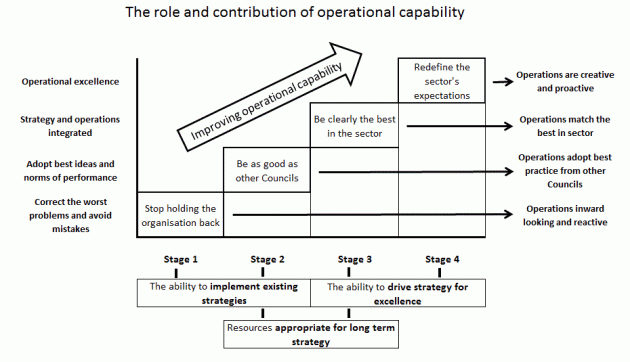
In a recent discussion with a colleague she mentioned that in her previous employment outside local government they had set organisational performance goals for leadership, finances, relationships, safety and operational excellence.   Each area of performance was rated equally. It started me thinking about how little you hear about operational excellence in local government. Is that because it doesn’t matter?

I am sure that operational performance matters. Whether councils want to be excellent or not, I am less sure. I think that the reason it is seldom discussed is that few people have a real understanding of operations management or what excellence would look like or how to achieve it. Continue reading

60 – Public value gap analysis. A tool.

Posted by Colin Weatherby                                                                         790 words

private public operation actual

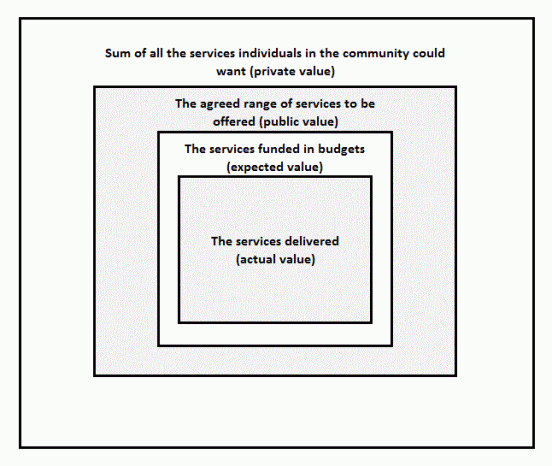
One of the challenges in local government is understanding public value – what it is for your community and how you can create it. It can  be difficult to separate it from private value expectations and to see the relationship with the operating capacity of the organisation. This post explores a conceptual tool to understand public value and gaps that need to be addressed in achieving it.

Many years ago when asked to be the officer leading a community advisory committee I developed a model to help the group understand what we were talking about and to focus on gaps where we could be most effective in making a difference. It worked very well. At the time I didn’t really understand why. Now I think it was because is identified the public value gap that the group could work on. Here it is. Continue reading

39 – Applying the public value scorecard in local government services. Part 2.

Posted by Lancing Farrell                                                                                             780 words

This post continues discussion of the Public Value Scorecard by looking at the scorecards for legitimacy and support and the operational capacity.

Legitimacy and support scorecard

This scorecard links the external demands accountability in the authorising environment of the organisation, with ongoing public discourse on public value. The demands for accountability in the public sector are continuous and come from several sources. Individuals complain or join forces with others to form interest groups. The media amplifies the complaints of individuals and groups. Councillors represent their constituents and demand accountability. The Ombudsman, Auditor General and Local Government Inspector are powerful external sources of accountability. The real problem is that demands for accountability come from many different places and focus on different aspects of performance. Some are more disciplined and consistent than others. Continue reading

38 – Applying the public value scorecard in local government services. Part 1.

Posted by Lancing Farrell                                                                                              700 words

There have been a number of posts on public value (use the theme ‘public value’ to find them).  The idea that is is important and how it relates to private value has been discussed.  This post looks at how public value can be measured using the Public Value Scorecard. 

According to Mark H. Moore, public managers can improve the performance of public organisations by committing to the discipline of a public value ‘bottom line’. In the private sector, the ‘bottom line’ is a compelling and effective business concept. This post discusses the practical application of Moore’s public value scorecard in local government. Continue reading