290 – The Capability Trap: How Budget Cuts Damage Councils Long Before Anyone Notices.

3100 words (15 minutes reading time) by Colin Weatherby

Podcast option:
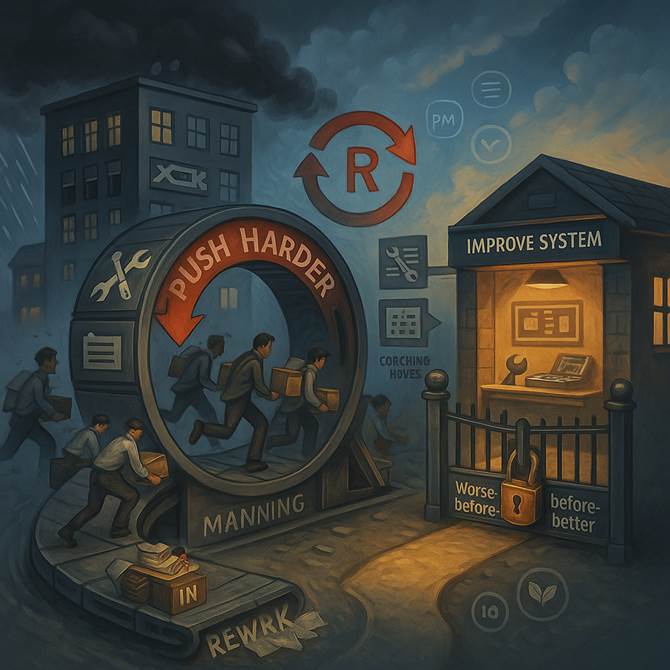
Credit: ChatGPT

Summary

  • Councils under rate caps are being pushed into a capability trap: cutting investment in how work is done, while demanding the same (or more) output.
  • Doing more with less works for a while, then it quietly destroys the ability to deliver safe, reliable services.
  • Escaping the trap means shifting from “work harder” to “work smarter” – investing in process capability, not just pushing people to do more.
  • This piece explains the trap in plain language and offers advice to avoid it.

Introduction

After ten years of “doing more with less”, many council roads managers describe their world like this:

“Today, I barely recognise our roads program. Every budget cycle we cop another efficiency dividend, another round of ‘temporary’ cuts to inspections, reseals, heavy patches and drainage repairs. On paper the program still looks coherent thanks to some clever rephasing and optimistic assumptions, but out on the network the cracks are literal.

We’ve gone from renewing assets at the right time to stretching them well past their use-by date. Crews that used to do planned maintenance now spend most of their time chasing potholes and complaints. We’ve sweated the plant so hard that breakdowns are normal, and cut training and supervision to the point where we’re relying on a few old hands to hold everything together.

What hurts most is knowing this was avoidable. Every ‘saving’ we booked was borrowed against the future condition of the network. We’ve lost capability in quiet ways – trainees we didn’t take on, engineers who left and weren’t replaced, inspectors who no longer have time to inspect, relationships with contractors hollowed out by always taking the lowest price.

The community still expects the same level of service, but we’re no longer set up to deliver it. We’ve traded investment in capability for short-term budget wins, and now the bill is arriving as risk, backlog and a network that’s deteriorating faster than we can look after it.”

This isn’t a story about lazy workers or bad managers. It’s what it looks like when a council slides into what Repenning and Sterman call the capability trap – without realising it.

Continue reading

219 – Do we value competent management in local government?

By Lancing Farrell                                                                                                        1200 words

Image result for Why do we undervalue competent management hARVARD BUSINESS REVIEW

Raffaella Sadun, Nicholas Bloom and John Van Reenen have written an interesting article (Why Do We Undervalue Competent Management?) that explores a deep and persistent problem in organisations across the world.  This problem also manifests itself in local government.

The article is based on research over the past 16 years in 34 countries involving 12,000 organisations and 20,000 interviews (see more at http://worldmanagementsurvey.org). A strong evidence base is used in providing some clear insights into a problem that is disturbingly common.

The fundamental premise is that competent management practices make a difference to the productivity, profitability, growth and longevity of organisations.

This seems like such an obvious thing to say or write. Of course, the quality of management is critical to the performance of an organisation. After all, aren’t we are all managers and doing something that makes a positive contribution? This is where the story starts to get interesting. Continue reading

214 – Worried about pretend managing? More importantly, are you dealing with real or imagined work?

Posted by Whistler                                                                                                          300 words

imagined work

Colin Weatherby has made some interesting points in writing about pretend managing. A colleague recently reminded me of another important idea – there are two kinds of work in any workplace: the imagined and the real.

He was discussing his work in injury prevention in the workplace. In his interactions with injured workers and their managers he has observed that there are two types of work. The imagined work exists in the minds of the managers making decisions about what and how workers will do their work.

When discussing worker’s injuries with managers, the managers frequently describe their understanding of the work and how it happens. This is imaginary work because usually they have not done the work. Some have not even studied the work. They are in charge of the work being performed and believe they know what is going on.

In comparison, the real work is what injured workers describe. It is how they actually do the work. It includes the short cuts and workarounds that are not in any Safe Work Method Statements. It is what they know from doing the work every day.

It is important for managers to know that there are two types of work and that there is a difference.

If managers operate as though their understanding of work is accurate and complete they will make mistakes. And, according to my colleague, workers will continue to be injured. Recognising that there is real work, and that it is important to understand exactly how it operates, is essential. Organisations need ways for the two types of work to come together. The Service Action Plans described in an earlier post is one way for this to happen.

There is no doubt that pretend managers are a problem. But a pretend manager dealing with imagined work is potentially a much bigger one.