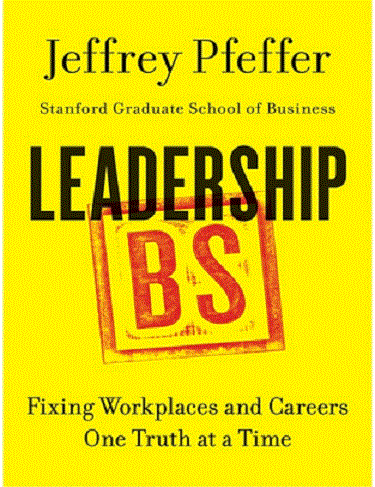
195 – Leadership connections and disconnections – some thoughts on Jeffrey Pfeffer’s ‘Leadership BS’

Posted by Colin Weatherby                                                                                         950 words

leadership BS

This is a new and interesting book. Promising to ‘pull back the curtain’ to show how leadership really works, Jeffrey Pfeffer (Thomas D. Dee II Professor of Organisational Behaviour at the Stanford Graduate School of Business) argues that ‘much of the oft-repeated wisdom on leadership is based more on hope than reality. This appealed to my pragmatic, rationalist view of the world. Things are not always what they seem (or how people would like them to seem).

It is a provocative book and reading it will challenge those who subscribe to the current leadership orthodoxy. In the Preface, Pfeffer compares management to medicine and highlights the progress modern medicine has made by rooting out the charlatans and quacks, and introducing science into the practice of medicine. He revisits this comparison in Chapter 8 when he provides advice on ‘confronting the reality of organisational life’.

This is where the ‘rubber hits the road’ after an interesting and thought provoking read through the first seven chapters covering why fables cause problems; why leaders aren’t modest; how authenticity is misunderstood and overrated; whether leaders should (or do) tell the truth; where trust has gone; why leaders ‘eat’ first; and how to take care of yourself.

In Chapter 8, Pfeffer starts with a discussion about the difference between management science and medical science. Continue reading

193 – ‘Losing my importance’ (with apologies to R.E.M).

Posted by Whistler                                                                                          350 words

feather duster

I was talking with a colleague recently about a matter that I believed was important that wasn’t being addressed and my thoughts on why this was happening. He made a salient comment – the longer resolution is delayed, the less important the matter becomes. Over time it will lose its importance. 

How often have you heard people say ‘if it was important, it would have been done by now’. Working in local government is a constant battle between the urgent and the important, and finding out what is really both urgent and important. Social media has injected a definite sense of urgency into political problems, but are they really important?

I have often wondered why managers have such difficulty seeing the difference. The following matrix can be a helpful way to focus your attention.

important and urgent matrix

If a distant fire front is left burning it is understandable if it ceases to become important. Either people become accustomed to it or they don’t see the need for action. Far more attention is generated by the spot fires started by embers from the fire front and generating lots of busy work. They are usually at your feet and visible to everyone and there is immediate heat if they are left unattended.

In comparison, better planning and decision making is always deferred when distractions present themselves. I know many managers whose daily work is driven by the emails that they receive throughout the day – they continually scan their inbox for the next thing to do.  It is easier than getting their minds around the hard stuff of management.

On the flip side, I once had an experience when I was the acting Group Manager and I was unsure of the importance of a document I had received. I asked the Personal Assistant to the Group Manager whether or not she knew if the document was important. Her response was an insight into her 20 years as a personal assistant to Group Managers. She said ‘that’s your job – make it important’. So I walked down the hall and handed it to a manager and asked him to act on it.

Instant importance.

187 – A high functioning Executive. What would it take?

Posted by Colin Weatherby                                                                                         1100 words

awesome

This is a question I was asked recently by a reader. Having read several posts critical of the behaviour of the Executive (What can a culture survey, an organisational self assessment, and your Executive’s risk appetite tell you?, The Executive. What exactly is their role? , Does your Executive suffer from altitude sickness?, and The Executive: filters, traffic controllers or drivers? ) she wanted to know whether I had a solution. Knowing that it is easier to be critical than creative, I cast my mind to thinking about the nature of the problem and some potential solutions.

I think the starting point is to understand the problem. In a nutshell, I think the following issues illustrate the problem:

  1. The Executive is overloaded with the small stuff handed to them by councillors (not the council). Much of it has to do with the personal idiosyncrasies of councillors and behaviours arising from their inability to work together as a group. It is dysfunctional, urgent and produces little value for the community. There are better ways for potholes to be reported.
  2. The Executive has to deal with high level relations with external organisations and strategic external pressures. These are often CEO to CEO relationships and cannot be readily delegated.
  3. The Executive is not putting enough time and effort into leading the organisation. Their focus on councillors and the external environment takes most of their time and energy. At the same time, they worry about problems 1 and 2 being made worse so they try to control organisational communication and decision making. When this is done ‘efficiently’ by time poor leaders it drives dysfunctional management behaviours.
  4. The Executive operates independently of managers and participates in the Senior Management Team (SMT) episodically. There is frequently no genuine and continuous engagement with the SMT in strategy and decision making. Managers are included in decision making when it suits the Executive – which is usually when they have the time and energy to do it. Managers are effectively isolated from information and the strategy decisions being made continuously by the Executive.

Obviously there are different solutions possible. Continue reading

186 – Essay No. 1 – Local government and accountability.

Posted by Lancing Farrell                                                                              2000 words

rabbit in headlights

This is the first in a series of essays to wrap up the 200 opinions, essays and observations from Local Government Utopia. As such, it attempts to bring together some of the themes that have emerged in the various posts.

Have you ever imagined yourself to be in the office of the CEO?

You have arrived at work to be told that The Ombudsman’s office wants to talk to you about the outcome of an investigation triggered by a Whistleblower. You have a meeting at the Auditor General’s office that morning to discuss the latest report they have released on Council Customer Service. A copy of the Independent Broad-based Anti Corruption Committee (IBAC) report on Council Depot Management is in your in tray along with a complicated Freedom of Information request.

That evening you have a Risk and Audit Committee meeting where you need to explain the lack of action in implementing recommendations from the 10 internal audits completed in the previous year. A councillor has left you a phone message saying they are unhappy with a decision regarding services delivered to an elderly resident. There is an email from the local newspaper wanting comment on an expose they are running on councillor entitlements.

I am sure this is not a usual day. But it also isn’t an entirely unrealistic scenario either. There are lots of sources of accountability for local government. Often, they act on the organisation independently and there is no effort (and sometimes no opportunity) to coordinate the organisational response. As a result, sources of accountability frequently operate at cross purposes and can be counter-productive. Continue reading

178 – The Prime Minister’s mini summit – is there a lesson for local government leaders?

Posted by Colin Weatherby                                                                                                         500 words

malcolm turnbull

Image

Some time ago, I posted on what I would do if I was the CEO. This post is in a similar vein.

The new Australian Prime Minister Malcolm Turnbull called a mini summit last week and invited leaders from the worlds of business, unions, community organisations and think tanks to discuss the state of the economy and the best way forward for economic reforms.

Reporting about the planned summit reflected the openness of the new national leader to discussing ideas other than his own. It was a move that his predecessor failed to make. The Sydney Morning Herald described the summit as suggesting that the new Prime Minister is keen to discuss big ideas and ‘send a message of creative optimism’ to the leaders invited. The Prime Minister is quoted as saying that the summit is a ‘rare opportunity to achieve consensus on the most pressing economic and social issues’ facing the country.

I am not sure whether the summit reached consensus or whether it will really influence government thinking and action. It has certainly signalled a new approach by Malcolm Turnbull.

It occurred to me that local government leaders could take a similar approach. Continue reading

174 – The Executive: filters and traffic controllers or drivers?

Posted by Whistler                                                          760 words

filter

There have been a number of posts about the Executive over the past 6 months (see What can a culture survey, an organisational self assessment, and your Executive’s risk appetite tell you?; Risk farming or good governance? How some executives avoid accountability; The Executive. What exactly is their role?;Does your Executive suffer from altitude sickness?; and The deep web and local government recruitment. ). Each has explored a different dimension of the Executive in local government – their comfort with risk, their role, how they support service delivery and make decisions, and how they are appointed.

This may be the last post on the topic (it now seems to have been a bit of a collective whinge) and it looks at what they really do or can do given the way councils operate.

One way of looking at the Executive from an organisational viewpoint is as a filter. Continue reading

151 – If local government was a car, what sort of car would it be? Part 5– the Tesla Model S.

Posted by Whistler                                                                                          700words

tesla

This is the final post in a series of five. The first review was for the Hyundai Excel Sprint council, the second was the Leyland P76 council, the third was the Volvo 240 series council, and the fourth was the Alfa Romeo 1750 GT council.

The last choice is the Tesla Model S. Futuristic, sustainable and unattainable.   This is really the only electric car that anyone talks about as if they would like to own one. With accelerations times equal to a Holden muscle car, or any other sporty fuel guzzler, they are attractive to the environmentalist car enthusiast. Put on your hessian pants, get in and floor it! Continue reading

150 – ‘Muzzle on council rates’. The Age, 31 July 2015.

Posted by Colin Weatherby                                                                         800 words

muzzle

The pressure is on. The Essential Services Commission has released its draft report on the proposed rate capping for councils in Victoria. It has a number of interesting elements and some significant implications for local government. The report sets out which revenues are proposed to be capped, how the rate cap could be calculated, the current forecast for rate increases to 2018/19 under the proposed system (see below), and the impact of the application of an ‘efficiency factor’ to provide an incentive to pursue efficiencies.

The article in The Age describes the major impacts.

“Victoria’s 79 councils had an average rate increase of 3.8 per cent this year. Several councils increased their rates by more than 6 per cent.

The draft report includes indicative forecasts for an annual rate cap of 3.05 per cent in 2016-17, dropping to 2.85 per cent in 2017-18 and 2.8 per cent in 2018-19.

In addition to the cap, the review calls for a new “efficiency” deduction to be introduced from 2017-18 where councils would need to reduce their rates bill by 0.05 per cent because of efficiencies (increasing by 0.05 percentage points each year). Jason Dowling, The Age, 31 July 2015.

So, what are the likely implications for councils?

There have been some previous posts on this topic (see  Council rates capped from mid-2016’, The Age, 21 January 2015 and Labor’s rate cap to hurt services and infrastructure, ratings agency warns’, The Age, 27 February 2015.). That thinking still stands. Councils will have to say ‘no’ louder and more often. Difficult choices will need to be made about what services to offer or not offer, and what the levels of service will be. Some people will no longer be eligible for services as councils start to distinguish more strongly between those who are or are not customers. Expect much more customer segmentation for services delivery. All of this will be difficult for our politicians who succeed by pleasing their constituents.

In many ways this is the easy bit Continue reading