191 – Essay No. 3 – Local government and systems thinking.

Posted by Lancing Farrell                                                                              1250 words


systems thinking checkland

Systems Model, Peter Checkland, 1981.

Systems thinking has featured in a number of posts (see  Some types of thinking observed in local government,  Classic paper: ‘Forget your people – real leaders act on the system’. John SeddonApplying the public value concept using systems thinking in local government). As someone with an interest in systems thinking I felt it deserved some discussion in the context of local government using ideas gathered from Peter Checkland, Alistair Mant and John Seddon.

The cover of Peter Checkland’s book ‘Systems Thinking, Systems Practice’ says that it is about the ‘interaction between theory and practice of problem solving methodology’, as derived from a decade of action research. It is a seminal text on the ‘meta-discipline’ of systems thinking.

Checkland has set out to ‘develop an explicit account of the systems outlook’ and, based on that view, to ‘develop ways of using systems ideas in practical problem situations’. The book is about the ‘use of a particular set of ideas, systems ideas, in trying to understand the world’s complexity’.

“The central concept ‘system’ embodies the idea of a set of elements connected together which form a whole, this showing properties which are properties of the whole, rather than properties of its component parts.”

Systems thinking is centred on the concept of ‘wholeness’. In some ways it is a reaction to the classical scientific method, which emphasises ‘reducing the situation observed in order to increase the chance that experimentally reproducible observations will be obtained’.   Eliminating variables in order to study something to determine cause and effect is useful but ultimately limiting in complex systems where the interactions of all variables matters.

Systems thinkers have called it ‘organised complexity’ to describe the space between ‘organised simplicity’ and ‘chaotic complexity’. In some ways it is seeking to understand the simplicity that exists on the far side of complexity. In a nutshell, systems thinking is concerned with organisation and the principles underlying the existence of any whole entity.

Australian management author, Alistair Mant, describes two types of systems in his book ‘Intelligent Leadership’. He calls them the ‘frog’ and the ‘bicycle’ systems and he believes that leaders need to be able to distinguish between the two systems when applying systems thinking and directing a change and shift in systems. He sees ‘pointing systems in intelligent directions’ as one of the critical leadership responsibilities.

Frogs and bicycles are metaphors for different kinds of systems. The essential difference lies in the relationship of the parts to the whole. A bicycle can be completely disassembled and then reassembled with confidence that it will work as well as before.  This is not possible with a frog. Once you remove a single part the whole system is affected instantaneously and unpredictably. Furthermore, as you continue to remove parts the frog will make a ‘series of subtle, but still unpredictable, adjustments in order to survive’.

“This sort of system, at a level beneath consciousness, wants to survive and will continue for an astonishing length of time to achieve a rough equilibrium as bits are excised – until it can do so no longer. At that point, again quite unpredictably, the whole system will tip over into collapse. The frog is dead and it won’t help to sew the parts back on.”

This is a salient warning for those planning to intervene in a system without due care. Mant believes that most big organisational systems contain bits of frog and bicycle systems.   He says that the bicycle parts can be hived off and reattached in a new way without harming the overall system, but that the frog parts are really the core process.   In a way, he is describing systems at two different levels – the component-level (bicycle) and the system-level (frog).

Checkland says that ‘any system which serves another cannot be modelled until a definition and model of the system served is available’. This approach should prevent action on component ‘bicycle’ systems occurring before the potential implications for the whole ‘frog’ system is understood.

In common with Checkland, Mant holds the view that systems are complex and need to be considered as a whole. The systems model developed by Checkland (shown above) illustrates the process of systems thinking. He says that it starts with a ‘focus of interest’ or set of concerns that exist in the real world. This could be a problem or something about which we have aspirations. This leads to an idea. From that idea two kinds of theory can be formulated:

  1. Substantive – theories about the subject matter.
  2. Methodological – theories about how to go about investigating the subject matter.

Once theories exist, it is possible to state problems not only as they exist in the real world, but also as ‘problems within a discipline’. For example, engineering, chemistry or town planning. All of the resources of the discipline (i.e. previous problems, its paradigms, models and techniques) can then be used in an appropriate methodology to test the theory.

The results of this test, which involves action in the real world (i.e. interventions, influencing and observation), then provides case records of ‘happenings under certain conditions’.   These are the crucial source of criticisms that enable better theories, models, techniques and methodologies to be developed. It is the improvement loop.

For those proponents of the Vanguard Method this might be starting to sound familiar. John Seddon has developed an application of systems thinking in organisations that has demonstrated its value in improving organisational systems. The Vanguard Method has the following steps:

  1. Check
  • What is the purpose of this system?
  • What are the types and frequencies of customer demand?
  • How well does the system respond to demand?
  • What is the ‘flow’ of work?
  • What are the conditions that make the system behave this way?
  1. Plan
  • What needs changing to improve performance?
  • What action could be taken and what would we predict the consequences to be?
  • Against what measures should action be taken?
  1. Do
  • Take the planned action and monitor the consequence in relation to the purpose.

It features systems thinking in the need to understand a concern in the real world (what are the demands?), develop a theory or approach to improvement (what needs to change?), and then seeks to implement that action and monitor consequences (how can the approach be improved?).

“The outcome of studying the work in this way is a system picture that puts together everything that has been learned and which illustrates the dynamics of the particular service.” John Seddon.

Mant says that most complex systems containing and serving people have ‘natural properties’. Effective management aligns itself with the natural flows and processes to help them along – like a leaf floating on water running in a stream that naturally takes it to its destination. Bad or dogmatic management fails to recognise these natural properties and attempts to ‘shoehorn the system into shape’ to meet externally determined priorities. This has been identified as a problem for public sector management in a previous long read post.

Local government has spent too long looking out of the window hoping to see a ’business-like’ way of managing that will solve all of its problems, rather than having the confidence to work out what is needed from first principles. It is vulnerable to the next externally imposed management fad.

Seddon is particularly harsh in his judgement of public service reform for the past 35 years in Britain. He describes the contribution of each Prime Minister in some detail. Overall, he paints a picture of political interference and the projection of a narrative that has primarily focussed on reducing costs, yet costs have increased. This is principally because they have failed to understand the system. The complexity of systems containing and serving people has been overlooked.

Checkland, Peter, 1981. ‘Systems Thinking, Systems Practice’.

Mant, Alistair, 1997. ‘Intelligent Leadership’.

Seddon, John, 2014. ‘The Whitehall Effect’.
181 – Applying the public value concept in local government using systems thinking

Posted by Colin Weatherby                                                                                         1100 words

dominoes

Image

Systems thinking is potentially a great lever for improvements in the design and delivery of local government services. However, it will require a major shift in thinking about how work is designed and managed because the systems thinker is focussed on the purpose of a service from the customer’s point of view.   This is a change from the needs of the organisation and the people working in it driving the design of work and delivery of services. Here are some thoughts building on the earlier post by Parkinson.

Local government needs to work harder to put the needs of customers first despite the realities of multiple and conflicting accountabilities, limited potential for increased income from rates, difficulty defining who the customer is, and increasing expectations of service levels, reliability and speed.

The principal focus of systems thinking is designing and managing the organisation with the customer mind. Continue reading

173 – A series: Managers as designers in local government. Part 4.

Posted by Lancing Farrell                                                                                              1000 words

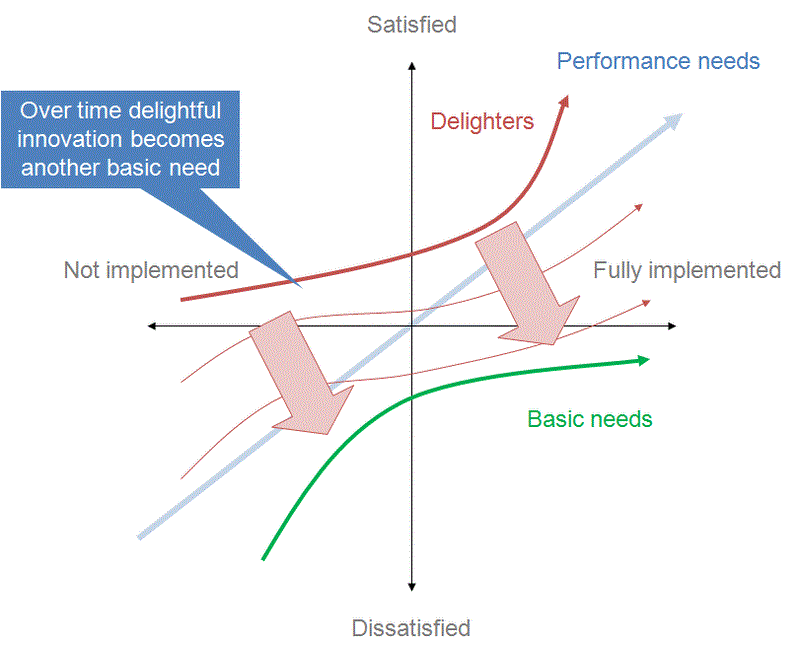
Kano model Wikipedia

Kano’s model

This is the last post in this series. It looks at how design can be used for new services and their implementation in local government.

Roger Martin and Tim Brown provide a related but different view of design in organisations. They see it as helping stakeholders and organisations work better together as a system. This is a systems-thinking approach as much as it involves design-thinking.

They describe the evolution of use of design in organisations as the ‘classic path of intellectual process’ as each design process is more sophisticated than the one before it because it was enabled by learning from that preceding stage. As designers have become more skilled in applying design to shape user experiences of products, they have turned to ‘user interfaces’ and other experiences. Continue reading

166 – Long read: Understanding the customer experience in local government.

Posted by Colin Weatherby                                                                                         260 words

service guarantee

There have been a number of posts on services and customer service, with the most recent by Lancing Farrell . Each post has explored a different aspect of service or customer service. This post looks at customer experience using two excellent articles from the Harvard Business Review as a guide; the first is ‘Understanding Customer Experience’ by Christopher Meyer and Andre Schwager, and the second is ‘Lean consumption’ by James Womack and Daniel Jones.

In their article, Meyer and Schwager describe the customer experience as encompassing

“… every aspect of a company’s offering the quality of customer care, of course, but also advertising, packaging, product and service features, ease of use, and reliability.’

They make the point that in many organisations few of the people responsible for each of these activities have thought about how their separate decisions contribute to the overall customer experience. Worse still, if they do think about it, they all have different ideas and there is no one senior who oversees everyone’s efforts to bring agreement on what needs to be done.   This is local government’s problem with service delivery in a nutshell.

Womack and Jones define ‘lean consumption’ as ‘minimising customers’ time and effort and delivering exactly what they want when and where they want it’. They see it as transforming consumption in the same way that lean production transformed manufacturing. It involves customers and service providers collaborating to ‘reduce total cost and wasted time and create new value’.

How are these two ideas relevant to the local government customer experience? Read on …

121 – Squire to the giants. Who are the giants in common?

Posted by Colin Weatherby                                                                                                 830 words

squire

I recently found a new and interesting blog called ‘Squire to the Giants’. Much like thinkpurpose.com this blog site is aimed at people who have an interest in improving their organisation through systems thinking. A recent post talks about the ‘giants’ that have influenced the Squire’s thinking. I am familiar with some of the ‘giants’ and have others of my own.

The Squire lists the following giants:

Regular readers of this blog will be familiar with the work of Peter Scholtes  and John Seddon. Both have influenced the thinking of writers. The biographical pieces written by the Squire  are worth a look.

I have decided to produce a blog on one of my giants.


mark h moore picProfessor Mark H. Moore

First some background. Mark H. Moore is the Hauser Professor of Nonprofit Organisations and director of the Hauser Centre for Nonprofit Organisations, at the John F. Kennedy School of Government at Harvard University.

His research interests include public management and leadership, civil society and community mobilization, and criminal justice policy and management. Continue reading

114 – Classic paper: ‘Forget your people – real leaders act on the system’. John Seddon.

Posted by Colin Weatherby                                                                         2200 words

john seddon

John Seddon won the first Harvard Business Review/ McKinsey Management Innovation Prize for ‘Reinventing Leadership’ in 2010 for this paper. The prize was awarded for:

“ … the best story (a real-world case study of management innovation) or hack (a bold idea for tackling a critical management challenge) around … redefining the work of leadership, increasing trust (reducing fear), and taking the work out of work.”

As the title suggests it is a provocative paper. In his usual way, Seddon provides challenging ideas supported by practical evidence.

The context for the story is Owen Buckwell, the head of housing at Portsmouth City Council in England. Over 40,000 people rely on him for warm, safe and comfortable homes. Each year he is responsible for dealing with 17,000 blocked toilets and 100,000 dripping taps in the 17,000 council houses.

Owen has been managing housing for 6 years. Seddon describes him as a curious man who likes to get to the bottom of things.

What does Owen do?

105 – Some characteristics of services demands that are important.

Posted by Lancing Farrell                                                              1100 words

operations typology 2

Image from Operations Management, 1998.

Some time ago I posted on high performance job design using four characteristics or spans; control, accountability, influence and support. At the time I linked the concept to the operations typology describing four characteristics of design of operations for high performance. This post picks up that discussion to look at the characteristics of demands that it is essential to understand if you want to design and manage your operations for high performance or excellence in local government.

A number of recent books on public sector management have discussed demands and how it is essential to understand them in public services because payment is not made at the time of service consumption and, therefore, price does not directly influence the amount and nature of demands placed on the system.

In his Vanguard Method John Seddon describes the importance of fulfilling purpose if failure demand is to be avoided. He also talks about understanding flow in relation to how work enters a system. Both of these ideas relate to demands. If purpose (i.e. the value sought by someone or their demand on the system) is not correctly understood the work system will not meet their need. They will come back.

Mark H. Moore includes operational capacity in his ‘strategic triangle’ concept linking decisions from the authorising environment to the public value provided. An organisation must have the operating capacity (or capability as Moore describes it in his earlier book Creating Public Value) to deliver on the political commitment to create particular public value. Continue reading

41 – ‘Where does the customer fit into a service operation?’ A brief discussion of the work of Richard B. Chase.

Posted by Lancing Farrell                                                                                                     1200 words

In 1978 Richard B. Chase published his paper Where does the customer fit into a service operation? John Seddon says this article began the separation of front and back office operations; something that he believes has created many problems in public sector service delivery today. Maybe he is right. But when you read the article, what Chase is advocating makes sense and I can’t help thinking that it isn’t necessarily a bad idea, rather it is an idea that has been used badly.

Chase is an operations manager. By 1978 he had already co-authored a popular operations management text. He starts his paper stating that a manager needs to understand the ‘operating characteristics that set one service system apart from another’ in order to make improvements. Continue reading

33 – Developing an organisational performance measurement system. Some ideas.

Posted by Lancing Farrell                                                                                     820 words

I have been thumbing through ‘Improving Performance – How to Manage the White Space on the Organisation Chart’ by Geary A. Rummler and Alan P. Brache, in particular the chapter about performance measurement. In it they describe measurement is the single greatest determinant of an organisation’s effectiveness as a system, and as the primary tool for ‘communicating direction, establishing accountability, defining roles, allocating resources, monitoring/evaluating performance, and taking improvement action’.

I haven’t seen a local government that has actively used performance measurement this way. Instead, it tends to be driven by external accountability requirements. We use the performance measurement that we do to convince others that we are doing what we should. Continue reading