247 – The New Human Movement – Bill Anderson.

1250 words (12 minutes reading time) by Lancing Farrell
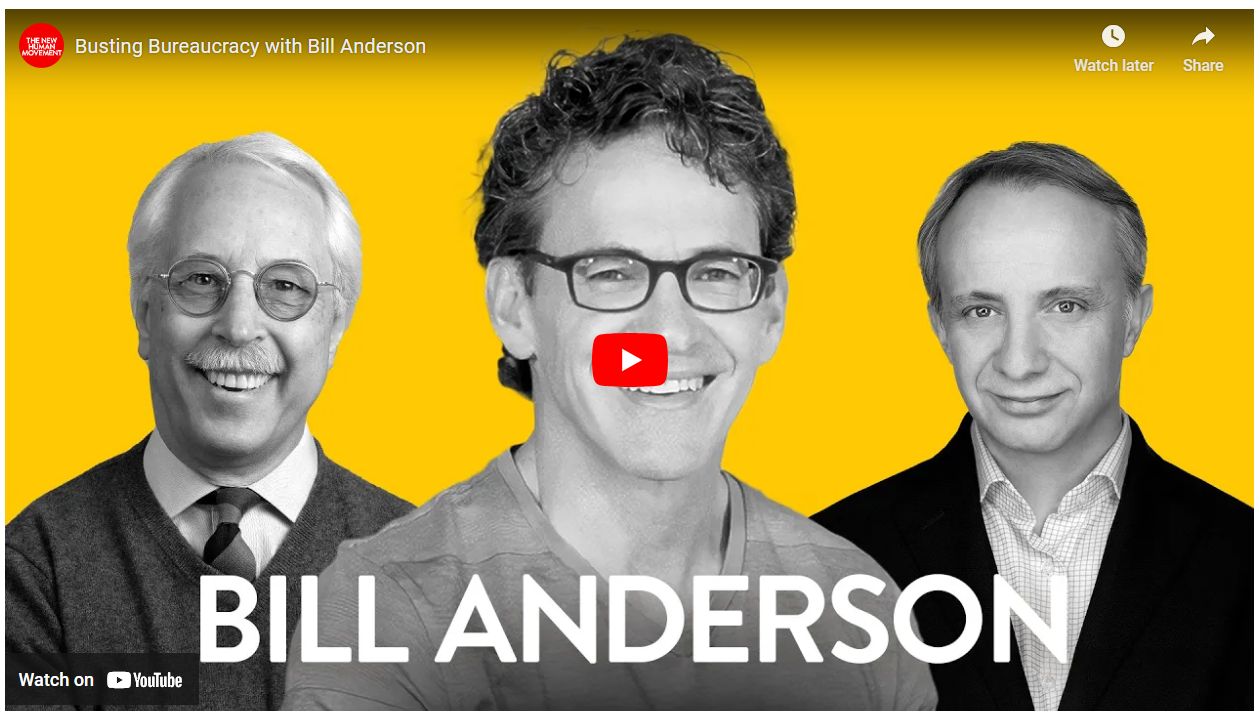
Gary Hamel and Michele Zanini wrote Humanocracy – Creating organisations as amazing as the people inside them in 2020. It examined the way organisations have become over-burdened with bureaucracy, which stops workers learning and contributing, and destroys productivity. In it they produced a blueprint for creating organisations that are more resilient, and improve worker’s jobs and productivity at the same time.

Hamel and Zanini describe the legacy of bureaucracy as ‘top-heavy power structures and rule-choked processes that make organisations timid, inertial and incremental’ in the face of disruptive change. This triggered my interest because of the problems facing councils in Victoria who are starting to deal with the spending gap arising from the State imposed rate cap.

The book followed an influential essay in the Harvard Business Review by Hamel and Zanini in 2016 that estimated bureaucracy in the US costs $3 trillion each year, or 17% of GDP. 

From this thinking, the New Human Movement was born through a Youtube channel, where Hamel and Zanini speak to the ‘bold thinkers and radical doers who are reimagining work, leadership and organization for a new age.’ There are now 29 episodes online and they are all worth watching.

I have selected one episode to discuss because I think it has particular relevance to local government in Victoria. It provides a transformation example all councils could follow.

Continue reading

198 – Essay No. 5 – Local government and leadership.

Posted by Colin Weatherby                                                                         1300 words

Mark H Moore strategic triangle

Mark H. Moore’s ‘strategic triangle’ – the basis for value-led public sector management

I have been thinking about leadership a lot recently. It has been a recurring theme in posts on this site. Reading Jeffrey Pfeffer’s book has challenged my thinking about how leaders work and what motivates them. It has reinforced some of my scepticism about leaders and why they do what they do. I tend to agree with Peter Drucker’s questioning of the distinction between leadership and management. Ultimately, organisations, particularly in the public sector, have to be managed. The idea that somehow managers aren’t leaders or that leaders aren’t managing doesn’t make sense.

Having said that, I can think of organisational leaders I have known who couldn’t manage. At some point they just ticked the leadership box and assumed the position! Pfeffer explains how and why everyone then goes along with it. Once you are a leader it seems you can get to stay there without any real scrutiny and accountability for your performance. That has definitely been my experience in local government.

I keep imagining myself working in an organisation with an effective leader who manages the organisation for high performance (not career advancement). One that provides clear strategy, direction and goals.  One who coordinates effort to  across the organisation to achieve those goals. In particular, I have been thinking about how they could do that in local government. Continue reading

123 – Reinventing Management – Architecture and Ideology. Gary Hamel.

Posted by Colin Weatherby                                                                         1300 words

inertial incremental insipid

Gary Hamel starts his dissection of large organisations with a series of descriptors; inertial, incremental, and insipid. Reading his paper made me feel like returning to small business. I once heard the Chief Executive Officer of the Australian Industry Group talking about a poll of his members. He asked them what they would like from government and they said that they wanted government to be positive, intelligent, and credible – the antidote to the inertial, incremental and insipid.

Hamel is describing what he calls the congenital disabilities of large organisations. By inertial, Hamel means that they are ‘frequently caught out by the future and seldom change in the absence of a crisis’.

 “Deep change, when it happens, is belated and convulsive, and typically requires an overhaul of the leadership team.”

By incremental, Hamel means that despite their resource advantages, incumbents are seldom the authors of game-changing innovation.

“It’s not that veteran CEOs discount the value of innovation; rather, they’ve inherited organizational structures and processes that are inherently toxic to break-out thinking and relentless experimentation. Strangely, most CEOs seem resigned to this fact, since few, if any, have tackled the challenge of innovation with the sort of zeal and persistence they’ve devoted to the pursuit operational efficiency.”

By insipid, Hamel means they are emotionally sterile. He says that managers know how to command obedience and diligence, but initiative, imagination and passion can’t be commanded—they are gifts.

“Every day, employees choose whether to bring those gifts to work or not, and the evidence suggests they usually leave them at home. In Gallup’s latest 142-country survey on the State of the Global Workplace, only 13% of employees were truly engaged in their work. Imagine, if you will, a car engine so woefully inefficient that only 13% of the gas it consumes actually combusts. That’s the sort of waste we’re talking about. Large organisations squander more human capability than they use.”

Hamel is excoriating in his examination of the supposed ‘remedies’ advanced over the years Continue reading