151 – If local government was a car, what sort of car would it be? Part 5– the Tesla Model S.

Posted by Whistler                                                                                          700words

tesla

This is the final post in a series of five. The first review was for the Hyundai Excel Sprint council, the second was the Leyland P76 council, the third was the Volvo 240 series council, and the fourth was the Alfa Romeo 1750 GT council.

The last choice is the Tesla Model S. Futuristic, sustainable and unattainable.   This is really the only electric car that anyone talks about as if they would like to own one. With accelerations times equal to a Holden muscle car, or any other sporty fuel guzzler, they are attractive to the environmentalist car enthusiast. Put on your hessian pants, get in and floor it! Continue reading

150 – ‘Muzzle on council rates’. The Age, 31 July 2015.

Posted by Colin Weatherby                                                                         800 words

muzzle

The pressure is on. The Essential Services Commission has released its draft report on the proposed rate capping for councils in Victoria. It has a number of interesting elements and some significant implications for local government. The report sets out which revenues are proposed to be capped, how the rate cap could be calculated, the current forecast for rate increases to 2018/19 under the proposed system (see below), and the impact of the application of an ‘efficiency factor’ to provide an incentive to pursue efficiencies.

The article in The Age describes the major impacts.

“Victoria’s 79 councils had an average rate increase of 3.8 per cent this year. Several councils increased their rates by more than 6 per cent.

The draft report includes indicative forecasts for an annual rate cap of 3.05 per cent in 2016-17, dropping to 2.85 per cent in 2017-18 and 2.8 per cent in 2018-19.

In addition to the cap, the review calls for a new “efficiency” deduction to be introduced from 2017-18 where councils would need to reduce their rates bill by 0.05 per cent because of efficiencies (increasing by 0.05 percentage points each year). Jason Dowling, The Age, 31 July 2015.

So, what are the likely implications for councils?

There have been some previous posts on this topic (see  Council rates capped from mid-2016’, The Age, 21 January 2015 and Labor’s rate cap to hurt services and infrastructure, ratings agency warns’, The Age, 27 February 2015.). That thinking still stands. Councils will have to say ‘no’ louder and more often. Difficult choices will need to be made about what services to offer or not offer, and what the levels of service will be. Some people will no longer be eligible for services as councils start to distinguish more strongly between those who are or are not customers. Expect much more customer segmentation for services delivery. All of this will be difficult for our politicians who succeed by pleasing their constituents.

In many ways this is the easy bit Continue reading

149 – Decision making: Making good decisions quickly in local government.

Posted by Lancing Farrell                                                                              650 words

RAPID decision image

This is the second post in a series. Have you ever felt that there were too many opinions being aired and not enough decisions being made?  Making good decisions quickly is the hallmark of a high performing organisation. This includes major strategic decisions and operating decisions. It is important to know which decisions are really matter and then ensure that they don’t stall because decision making roles and responsibilities are not clear. This is the first challenge for local government.

Good decision makers think through who should recommend a particular direction, who needs to agree, who should have input, who has ultimate responsibility for making the decision, and who is accountable for follow through, and then they set a process up to make decisions.

Good decision processes then become routine and are known to everyone, which provides better coordination and faster response times. Continue reading

148 – Decision making in local government. A series.

Posted by Lancing Farrell                                                                              400 words

HBR january 2006 cover

This series of posts explores decision making in local government and the connection to planning and strategy. I have postulated for some time that the inability of council’s to make difficult decisions leads to failure to decide on strategy which prevents prioritisation of action. See what you think.

Decision making processes in local government can be episodic, slow, disempowering, inconsistent and frequently disconnected from either strategy or operational needs. Continue reading

147 – ‘The Voice’ for local government. An alternative recruitment approach?

Posted by Whistler                                                                                          600 words

the voice

Image

Did any of the judges in The Voice Italy expect to see a Nun when they turned around?   Watch the linked video. My guess is, no. Would a Nun have won through normal auditions? Maybe in Italy (she won by The Voice by the way). I am not saying that she wasn’t a good singer. The question is, would she (and other winning contestants) have found their way through the first round of auditions if they could be seen by the judges as they performed?

Blind auditioning removes some of the obvious prejudices that hamper institutionalised selection processes, like television pop music. You might ask why it is potentially useful to local government. Continue reading

146 – If local government was a car, what sort of car would it be? Part 4 – the Alfa Romeo 1750 GT.

Posted by Whistler                                                                                          600 words

alfa romeo

This is the fourth post in a series of five. The first review was for the Hyundai Excel Sprint council, the second was the Leyland P76, the third was the Volvo 240 series.

The fourth possibility is the Alfa Romeo 1750 GT. Stylish and fancy (and often seen with the bonnet up).   Plenty of glamour here for the ‘Alfisti’. The choice of Romeos worldwide, it was a real eye catcher that brought lots of attention. They came in bright and classical Italian automotive colours and have a great exhaust note. You wouldn’t own one to cart around your family or as your main transport to work (you needed a Hyundai or Volvo for that) but there were many weekend warriors with a 1750 in the garage. Continue reading

142 – A question. If I was the CEO what would I do? Answer: Focus the change effort.

Posted by Colin Weatherby                                                                                            740 words

boat builder CEO

I am sure being a CEO isn’t easy. The political environment in Australia is difficult and even more so in local government where the politicians are unpaid and not supported by political parties. There are many other pressures from the external environment – i.e. changing State government legislated responsibilities and increasing oversight of council operations; contentious urban growth and renewal planning decisions; inadequate State services for transport, education and health; and changing community expectations of service. So, if it was me, what would I do?

To begin I would not let the limitations and problems of the political and external environments dominate my management of the organisation. They are both urgent and sometimes important. However, they are not easily influenced and can take all of top management’s time and energy for little return. By all means be engaged and influence where you can but my approach would be to put my effort where no one else can and where I will get the best return.

By doing this, I think there would also be an improvement in the political environment and a stronger position to tackle the external pressures.

What do I mean? I would get my house in order. I would ensure that the resources at my disposal are used to create the maximum value for the community that has provided them. My goal would be for every ratepayer and resident to love living in my municipality. They would love it so much that they would tell all of their friends about it. They would offer to pay more for the services that they or their neighbours need. Every day social media would have stories of the great experiences people have had dealing with the council and the surprisingly good value they received.

Expectations would be met for basic service and exceeded where the value is visible and appreciated. This is the value capture that Sayan Chatterjee  talks about – councils don’t want people to value the services they provide and to offer to pay more so that the council can make a profit. Councils are not in that business. Instead, councils want them to be loyal customers who enjoy the value they get from paying their taxes. That enjoyment and loyalty is the value capture.

I wouldn’t ignore the outside world but I would want to be leading an organisation that redefines community expectations and delivers outstanding value. Here is how I would do that in order.

  1. Provide a more inclusive and less autocratic management style that suits local government culture and organisations expected to work that way with their customers.
  2. Set clear strategy – who are/are not customers; what service will/will not be provided to them; and how will it be done efficiently using available resources.
  3. Improve the customer focus by putting customers first (I mean really putting them first, not just saying it) through understanding the value they expect and designing services to provide it within available resources, now and in the long-term.
  4. Create better processes to make decisions and delegate more decision making and empower staff throughout the organisation so that more decisions are made and faster.
  5. Establish greater accountability by setting expectations and measuring performance so that feedback is provided to support achievement and create a performance-orientated culture.
  6. Focus innovation on areas of the organisation where significant change is required and set up systems to so that everyone continuously improves.
  7. Simplify the complexity inherent in local government by identifying and eliminating process constraints that have developed over time.
  8. Focus on productivity by ‘unlocking’ the capacity of people and resources to ensure that the required services are being provided as efficiently as possible.

I have been told (by a CEO) that a world where ratepayers and residents enjoy the value they get for the taxes is unrealistic and unachievable.  If that is what our leaders think, what hope is there?

I have used an image of a boat builder for a reason. I have a relative who owns and builds wooden sailing boats. After talking to him, I think that leading an organisation is a lot like building a boat. You need to design the boat to optimise the performance required – does it have to be safe in all conditions, will it have to make fast passages, or will it carry burdensome loads? One boat can’t do them all.

Then materials must be selected and the builder needs to understand the properties of those materials – how they are worked to make the boat, how they will perform under load, how they will fail, and how they can be repaired.

A boat must be made with care. There is a right and a wrong way to do it, and doing it the wrong way could lead to failure and loss of life. Finally, the boat needs to be beautiful.

This is an important point for local government.  In the same way that there is no joy in building or owning an ugly boat, success in local government must also include a sense of pride and achievement in having contributed to something worthwhile.

Chatterjee, Sayan 2013. Simple Rules for Designing Business Models, California Management Review, Winter.

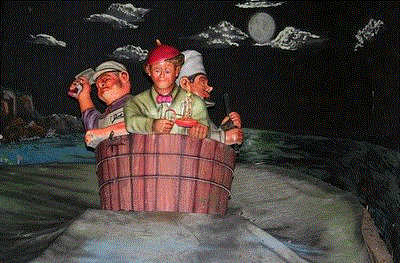
124 – The butcher, the baker and the candlestick maker. Our councillors?

Posted by Whistler                                                                                          800 words

butcher baker candlestick maker

Image

The original version of the rhyme ‘rub-a-dub-dub’ supposedly tells of three townsfolk watching a dubious sideshow at a fair. Later versions talk of them being ‘all put out to sea’, perhaps a reference to being ‘at sea’ or puzzled or bewildered (thanks Wikipedia). I think either version could work for some of our councillors today.

Councils usually have greater gender balance and occupational representation than in the rhyme. My question is, who are the people who become councillors? What attracts them to the role? Why do they do it? What do they offer? Do they really reflect the communities they represent? Continue reading

120 – Captain Council discovers a superpower – BFV.

Posted by Linda Perkin                                                                                                  750 words

Captain Council flying

In the first instalment, Captain Council cast the management alchemy spell, only to immediately fall unconscious to the ground. Awakening some time later, he rushes to that evening’s council meeting ….

Taking his seat, Captain Council looked around the chamber. The usual crew were present. All of the councillors were in their usual positions, watching each other warily. The CEO and officers were sitting nervously waiting for business to commence.   Perched on chairs at the front of the auditorium were the two regular attendees – like Statler and Waldorf. Continue reading

38 – Applying the public value scorecard in local government services. Part 1.

Posted by Lancing Farrell                                                                                              700 words

There have been a number of posts on public value (use the theme ‘public value’ to find them).  The idea that is is important and how it relates to private value has been discussed.  This post looks at how public value can be measured using the Public Value Scorecard. 

According to Mark H. Moore, public managers can improve the performance of public organisations by committing to the discipline of a public value ‘bottom line’. In the private sector, the ‘bottom line’ is a compelling and effective business concept. This post discusses the practical application of Moore’s public value scorecard in local government. Continue reading