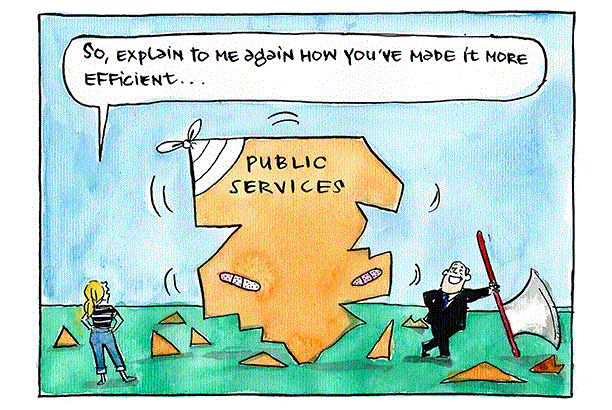
205 – ‘We don’t need to be clever – just less stupid’, The Age 23 February 2016.

Posted by Colin Weatherby                                                                         700 words

Dont need to be clever just less stupid image

Image

I read this article and though it was fortunate that the writer, author and polymath Satyajit Das, hadn’t been dealing with his council. No doubt a greater attempt would have been made to feign ‘one stop’ service but if it was anything but a simple matter, he would have come across the same dysfunction. His acuity is evident in his analysis.

Das’s dealings with his bank highlighted how the quest for efficiency and lower costs has achieved the opposite result. This is a recurring theme in the writings of John Seddon about the public sector. Das lists six sources of ‘unproductive and inefficient’ failures that he believes are now common in many organisations.

  1. Tasks have been fragmented across different locations and the simplest activity is now complicated.
  2. There is no continuity. ‘One person is not accountable for the complete activity. Workers lack any idea of how what they are doing, or not doing, affects the whole process overall’.
  3. Staff lack the skills and knowledge required.
  4. Performance measurement has lowered, rather than improved, performance. Staff actions detract from results instead of helping achieve them.
  5. Leadership is lacking in ‘domain knowledge’ (i.e. valid knowledge in a particular area).
  6. There is a tendency to see history as old and irrelevant. The latest technological wizardry is the best solution to any problem. Valuable lessons from the past are routinely ignored.

There have been a number of posts on these very topics. Continue reading

202 – Essay No. 6 – Local government and public value.

Posted by Lancing Farrell                                                                                              6500 words

bureacracy

Value is often mentioned in local government when talking about services, particularly ‘best value’. However, there is often inadequate understanding about the different types of value, the difference between private and public value, and how value is actually created and managed by an organisation. Sometimes there is the assumption that because we have been busy, that we must have created something worthwhile.

This essay brings together ideas from several earlier posts and is constructed around four hypotheses:

  1. That there are different types of value created by organisations and for local government public value is the most important.
  2. Public value is the primary value that must be understood and delivered if councils are to deliver what is expected by the community.
  3. Value-led management is a way of managing that could transform local government and make it more responsive and effective in serving the community.
  4. There are simple and effective tools that can be used to improve value creation in local government.

Hypothesis 1: There are different types of value and public value is the most important for local government.

Private value

In a metaphorical sense the value that you add is what you ‘bring to the party’. This is determined by what other people think you have contributed and by thinking about what the party would have been like if you hadn’t arrived.

There are different types of value and it is worth briefly considering the difference between private value and public value. Public value is the collective view of the public or community about what they regard as valuable, especially with regard to the use of public money and authority. Moore describes this as occurring along a spectrum from value that is obtained from public services that is essentially private value, similar to the concept of customer value, to public value that reflects the aggregate value expectations of citizens.

Moore degrees of publicness

At the private value end of the spectrum, the focus is on the individual service recipient and delivering value that satisfies their expectations.   At the public value end of the continuum, the focus is on achieving the social outcomes sought by the community or public. Continue reading

200 – Using a local government service catalogue.

Posted by Colin Weatherby                                                                                                                         700 words

menu

Some time ago I discussed how to create a local government service catalogue. The process was simple and effective in describing services in customers’ terms and linking services to cost centres in the budget and those responsible for the cost centres. You might ask, what else needs to be done? Well, for the service catalogue to be really useful it needs to be linked to the organisational planning processes. Here’s how that can be done.

To begin, it is a good idea to test the service catalogue with the community. I have heard of a council using it to lead discussion with ‘peoples’ panels’ about the services delivered, how rates can best be spent, and whether or not the council should seek an exemption from the municipal rate cap being imposed in Victoria. If the community can relate to the services described in the catalogue and understand what they involve, it is likely that you have got the catalogue right. It doesn’t mean that it can’t be further improved, but it is a good start.

The next step is to link the service catalogue to the traditional ‘business unit by business unit’ planning that occurs in local government. Continue reading

194 – Essay No. 4 – Local government and customer service.

Posted by Lancing Farrell                                                                              4500 words

basil fawlty

Customer service is, and should be, a major concern for local government. After all, councils are service organisations. Sometimes there is confusion about exactly what customer service means, how it relates to public service delivery, and what aspects of service are most important to get right in local government.

This essay focuses on three hypotheses:

  1. That ‘customers’ in local government are different to the customers described in most customer service literature and encountered by most service organisations.
  2. There are six main opportunities for local government to improve service to customers.
  3. There are simple tools available that can assist councils in getting service delivery and customer service right.

Continue reading

189 – Essay No. 2 – Local government, effectiveness and efficiency.

Posted by Lancing Farrell                                                                              3300 words

false economy cartoon

Image

People in local government regularly discuss effectiveness and efficiency. Often this happens in relation to pressure on revenues, such as rate capping. Most of the discussion centres on efficiency rather than effectiveness, and opportunities to stop delivering those services that are seen as ‘cost shifting’ from other government. The efficiency discussion is often not well informed. Frequently it focuses on inputs while ignoring outcomes and public value. Any savings are usually equated with cost cutting, not creating the same value at lower cost.

Australian researcher and writer Christopher Stone has published several papers on ‘false economies’. Each addresses a different aspect of productivity and efficiency in the public sector.

“Everyone has the right to know that money is not being wasted; that it is being spent as efficiently as is possible.” Christopher Stone, Decoding Efficiency, April 2013.

So, what is efficiency and how does it differ from effectiveness? Continue reading

171 – A series: Managers as designers in local government. Part 3.

Posted by Lancing Farrell                                                                              500 words

design and thinking

This is the third post in a series of four. It addresses some of the challenges to design-thinking.  Jon Kolko has identified several.

His first challenge is accepting that you will be dealing with more ambiguity.

“It is difficult if not impossible to understand how much value will be delivered through a better experience or to calculate the return on investment in creativity.”

He says that ambiguity doesn’t fit well with organisations that value ‘repeatable, predictable operational efficiency’. This will be an issue for councils seeking to use design-thinking. For councils, there is an expectation that value will be created through efficient use of resources without any waste. The strong risk aversion of local government reinforces elimination of uncertainty, or at least pretending it has been eliminated. Embracing a culture or experimentation, customer value creation and risk taking will be very challenging. Continue reading

169 – A series: Managers as designers in local government. Part 2.

Posted by Lancing Farrell                                                                              800 words

rapid prototyping

This is the second post in a series of four. It discusses the second and third principles of design-thinking.

Models can be used to examine complex problems. In this context, the ‘model’ is an artefact of the design process that is used to ‘explore, define and communicate’. Typically this will include diagrams and sketches instead of (or in addition to) the spreadsheets and specifications usually used to analyse and resolve problems. According to Kolko, they ‘add a fluid dimensions to the exploration of complexity, allowing for non-linear thought when tackling non-linear problems”.

There are a number of local government services that routinely use models or design artefacts in their work. Continue reading

168 – A series: Managers as designers in local government. Part 1.

Posted by Lancing Farrell                                                                              800 words

empathy hand holding

This is the first in a series of four posts on managers as designers in local government. It might seem like an esoteric topic and hardly relevant, however, every day managers make design decisions, often in ignorance. There is now a body of work on how managers can use design-thinking to improve the customer experience and organisational decision making. I challenge you to say it is irrelevant to your council.

Some years ago I read a book called ‘Managers as Designers in the Public Services’ by David Wastell (Professor of Information Systems at Nottingham University Business School). It made a lasting impression on me. Continue reading

166 – Long read: Understanding the customer experience in local government.

Posted by Colin Weatherby                                                                                         260 words

service guarantee

There have been a number of posts on services and customer service, with the most recent by Lancing Farrell . Each post has explored a different aspect of service or customer service. This post looks at customer experience using two excellent articles from the Harvard Business Review as a guide; the first is ‘Understanding Customer Experience’ by Christopher Meyer and Andre Schwager, and the second is ‘Lean consumption’ by James Womack and Daniel Jones.

In their article, Meyer and Schwager describe the customer experience as encompassing

“… every aspect of a company’s offering the quality of customer care, of course, but also advertising, packaging, product and service features, ease of use, and reliability.’

They make the point that in many organisations few of the people responsible for each of these activities have thought about how their separate decisions contribute to the overall customer experience. Worse still, if they do think about it, they all have different ideas and there is no one senior who oversees everyone’s efforts to bring agreement on what needs to be done.   This is local government’s problem with service delivery in a nutshell.

Womack and Jones define ‘lean consumption’ as ‘minimising customers’ time and effort and delivering exactly what they want when and where they want it’. They see it as transforming consumption in the same way that lean production transformed manufacturing. It involves customers and service providers collaborating to ‘reduce total cost and wasted time and create new value’.

How are these two ideas relevant to the local government customer experience? Read on …

160 – Making a local government service catalogue. Part 2: What to do with it?

Posted by Colin Weatherby                                                                                      630 words

service category

In the first post I described a service catalogue and looked at where (and how) to start making one. This post discusses what to do next to refine the service catalogue and use it to improve organisational performance. I have no doubt that a service catalogue is essential to starting a discussion with the community about services required in a rate capped operating environment, however it should also drive continuous improvement by providing a focus for service reviews.

The ‘first cut’ service catalogue that defines services from the customer viewpoint and links that view to organisational structure, is really just the start.

Further analysis is required to determine the link between the service catalogue and organisational strategic plans (especially the council plan). This can be achieved by coding the spreadsheet of cost centres with the themes or key objectives or themes in the plans. This will allow further analysis by pivoting on different criteria. What is the link between council plan objectives, customer defined services and cost centres? Continue reading