189 – Essay No. 2 – Local government, effectiveness and efficiency.

Posted by Lancing Farrell                                                                              3300 words

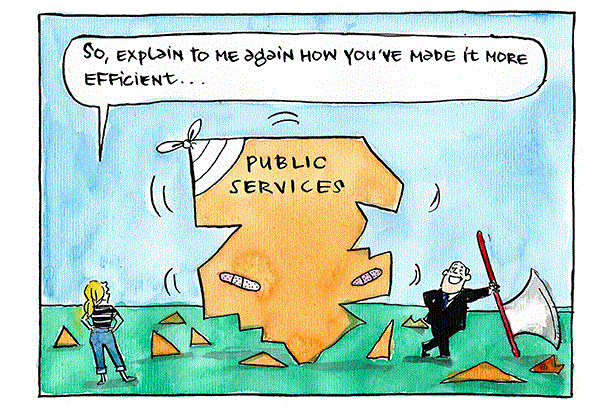
false economy cartoon

Image

People in local government regularly discuss effectiveness and efficiency. Often this happens in relation to pressure on revenues, such as rate capping. Most of the discussion centres on efficiency rather than effectiveness, and opportunities to stop delivering those services that are seen as ‘cost shifting’ from other government. The efficiency discussion is often not well informed. Frequently it focuses on inputs while ignoring outcomes and public value. Any savings are usually equated with cost cutting, not creating the same value at lower cost.

Australian researcher and writer Christopher Stone has published several papers on ‘false economies’. Each addresses a different aspect of productivity and efficiency in the public sector.

“Everyone has the right to know that money is not being wasted; that it is being spent as efficiently as is possible.” Christopher Stone, Decoding Efficiency, April 2013.

So, what is efficiency and how does it differ from effectiveness? Continue reading

181 – Applying the public value concept in local government using systems thinking

Posted by Colin Weatherby                                                                                         1100 words

dominoes

Image

Systems thinking is potentially a great lever for improvements in the design and delivery of local government services. However, it will require a major shift in thinking about how work is designed and managed because the systems thinker is focussed on the purpose of a service from the customer’s point of view.   This is a change from the needs of the organisation and the people working in it driving the design of work and delivery of services. Here are some thoughts building on the earlier post by Parkinson.

Local government needs to work harder to put the needs of customers first despite the realities of multiple and conflicting accountabilities, limited potential for increased income from rates, difficulty defining who the customer is, and increasing expectations of service levels, reliability and speed.

The principal focus of systems thinking is designing and managing the organisation with the customer mind. Continue reading

179 – Some thoughts on local government and public value.

Posted by Parkinson                                                                       1400 words

common good

A number of posts written have been written about public value by others (see Why do we provide the services that we do in local government?, Customer, client, citizen, resident or ratepayer. Who are we dealing with?, Applying the public value scorecard in local government services. Part 1. , Applying the public value scorecard in local government services. Part 2., Public value gap analysis. A tool., Public value gap analysis. Some actions., Making high performance happen through value-led management., and Value-led management in local government. Some further thoughts). This post is an attempt to provide a context for further thinking about public value in local government.

Common good and public value

The political philosopher Michael Sandel has identified that rising social inequality is leading to a separation in ways of life between the rich and the poor. He believes that when this happens there is no longer a common way of life because “they don’t use the same public institutions, don’t inhabit the same civic spaces, and don’t avail themselves of the same public services”. As a result, Sandel believes that we can cease to think that we are ‘in it together’ enough to even deliberate together as members of a political community to determine common good.

The gap between the rich and poor is growing in Australia. According to the Oxfam report ‘Still the Lucky Country?’, the wealthiest Australian are disproportionately influential and the poor are at risk of being marginalised and unheard. Extreme wealth provides the power to influence government policies that favour those with wealth, regardless of what would work best for the whole of society.

The common good is the ‘large’ form of public value. Continue reading

178 – The Prime Minister’s mini summit – is there a lesson for local government leaders?

Posted by Colin Weatherby                                                                                                         500 words

malcolm turnbull

Image

Some time ago, I posted on what I would do if I was the CEO. This post is in a similar vein.

The new Australian Prime Minister Malcolm Turnbull called a mini summit last week and invited leaders from the worlds of business, unions, community organisations and think tanks to discuss the state of the economy and the best way forward for economic reforms.

Reporting about the planned summit reflected the openness of the new national leader to discussing ideas other than his own. It was a move that his predecessor failed to make. The Sydney Morning Herald described the summit as suggesting that the new Prime Minister is keen to discuss big ideas and ‘send a message of creative optimism’ to the leaders invited. The Prime Minister is quoted as saying that the summit is a ‘rare opportunity to achieve consensus on the most pressing economic and social issues’ facing the country.

I am not sure whether the summit reached consensus or whether it will really influence government thinking and action. It has certainly signalled a new approach by Malcolm Turnbull.

It occurred to me that local government leaders could take a similar approach. Continue reading

160 – Making a local government service catalogue. Part 2: What to do with it?

Posted by Colin Weatherby                                                                                      630 words

service category

In the first post I described a service catalogue and looked at where (and how) to start making one. This post discusses what to do next to refine the service catalogue and use it to improve organisational performance. I have no doubt that a service catalogue is essential to starting a discussion with the community about services required in a rate capped operating environment, however it should also drive continuous improvement by providing a focus for service reviews.

The ‘first cut’ service catalogue that defines services from the customer viewpoint and links that view to organisational structure, is really just the start.

Further analysis is required to determine the link between the service catalogue and organisational strategic plans (especially the council plan). This can be achieved by coding the spreadsheet of cost centres with the themes or key objectives or themes in the plans. This will allow further analysis by pivoting on different criteria. What is the link between council plan objectives, customer defined services and cost centres? Continue reading

158 – Customer perception. Why is it important in local government services?

Posted by Lancing Farrell                                                                              670 words

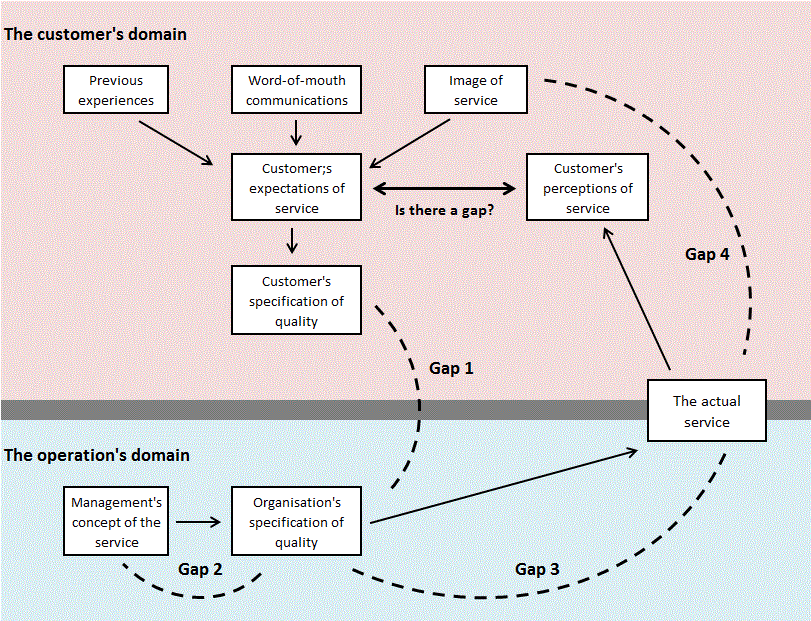
customer service gaps

Image adapted from Slack, Chambers, Harland, Harrison, and Johnston 1998, Operations Management, 2nd Edition.

There have been a number of posts on aspects of customer service – who are our customers, customer-introduced variability, how do you listen to the ‘voice of the customer, internal customers , what Gordon Ramsay might think about council customer service, and captive customers. If there has been a thread through these posts, it has been the need to look at services from the customers’ viewpoint and to understand constitutes value for them.

The posts on value have discussed how to understand both private and public value – why do we provide the services that we do, the private-public value continuum, applying the public value scorecar , public value gap analysis, local government and commodity services, value-led management, and a series on a new theory of value creation in local government. The idea that people seek private value and councils set out to create public value is at the heart of a lot of customer service problems.

One aspect of customer service that hasn’t been discussed is the role of perception. Continue reading

132 – ‘A new theory of value creation for local government’. Do we need one? Part 3 – operations strategy.

Posted by Lancing Farrell

Slack operations strategy

Image from Operations Management, 6th Edition, Slack, Chambers and Johnston.

In this third post in this series, I look at the concept of the operations strategy. Every organisation has one. Your organisation does, but do you know why or what it is? And how does it relate to the business model?

This series of posts is intended to make the case that local government needs a theory of value creation – a clear explanation of what local government does to create public value. That theory will require a reappraisal of the operations strategy and the role that operational capability can play in supporting the business model and strategy execution.

Hayes and Wheelwright describe operations strategy as guiding decisions about vertical integration (i.e. the extent to which the council owns the value chain), capacity planning (i.e. how variation in demands will be met), facilities planning (i.e. the facilities needed to deliver services), services technologies (e.g. information systems) and process technologies (e.g. batch or make-to-order).

The academics Nigel Slack, Stuart Chambers and Robert Johnston in their text Operations Management talk about strategy and the connection to operations Continue reading

127 – ‘A new theory of value creation for local government’. Do we need one? Part 2 – Business Model.

Posted by Lancing Farrell                                                                              750 words

walt disney theory of value creation

Image: ‘The greatest theory ever told’ – Walt Disney’s 1957 value creation map.

This is the second post in the series intended to make the case for a new theory of value creation for local government. The first post discussed business strategy. This post looks at the link between strategy and the business model.

Once the strategy has been determined, it leads directly to the selection of a business model that can deliver that strategy. I have chosen the following description of a business model from organisational theorist and academic David Teece to set the scene.

“Whenever a business enterprise is established, it either explicitly or implicitly employs a particular business model that describes the design or architecture of the value creation, delivery, and capture mechanisms it employs.

The essence of a business model is in defining the manner by which the enterprise delivers value to customers, entices customers to pay for value, and converts those payments to profit.

It thus reflects management’s hypothesis about what customers want, how they want it, and how the enterprise can organize to best meet those needs, get paid for doing so, and make a profit.”

As with strategy decisions, the difficulties for local government are again apparent. Continue reading

126 – ‘A new theory of value creation for local government’. Do we need one? Part 1 – Strategy.

Posted by Lancing Farrell                                                                              850 words
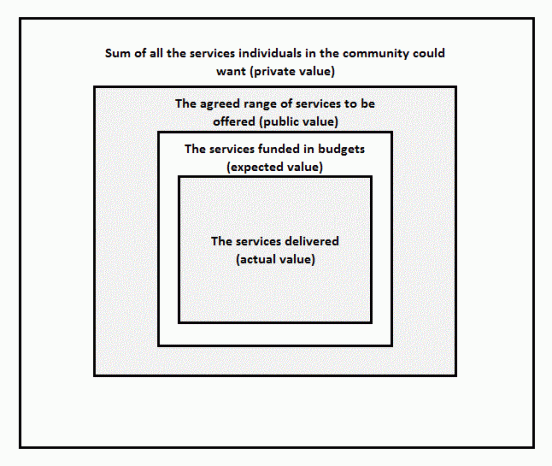
value diagram shaded

This is the first post in a series  exploring the relationship between business strategy, the business model and operations strategy. It is an attempt to pick up on the ideas in Colin Weatherby’s previous post discussing Henry Mintzberg’s ideas about different models for government organisations. Hopefully the series of posts will make my case for a local government theory of value creation.

I will begin with business strategy. To set the scene, I have chosen the following quotations from management consultant and academic David Maister  to highlight the strategy problem for local government.

“A strategy is not just choosing a target market, but is about actually designing an operation that will consistently deliver the superior client benefits you claim to provide.

However, each decision you make to be more effective at delivering the preferences of those you target will (inevitable, inescapably, unavoidably) make you less attractive to clients or market segments that look for different benefits.

You could try to design your operations to meet a wide variety of preferences and needs, serving each client or customer group differently, according to their individual wishes.

Your market appeal will then come down to ‘tell us what you want us to do for you and we’ll do that. We’ll do something different for other people tomorrow!’

The very essence of having a strategy is being selective about choosing the criteria on which a firm wishes to compete, and then being creative and disciplined in designing an operation that is finely tuned to deliver those particular virtues.

An operation designed to provide the highest quality is unlikely to be the one that achieves the lowest cost, and one that can respond to a wide variety of customized requests will be unlikely to provide fast response and turnaround. Any business that tried to deliver all four virtues of quality, cost, variety and speed would be doomed to failure.”

Maister may not have had local government in mind when he wrote this piece, but he provides an insight into the challenges in determining what provides value to people receiving services. He calls it ‘superior client benefits’. In the public service context, academic Mark H. Moore has called it public value. It is the same idea Continue reading

124 – The butcher, the baker and the candlestick maker. Our councillors?

Posted by Whistler                                                                                          800 words

butcher baker candlestick maker

Image

The original version of the rhyme ‘rub-a-dub-dub’ supposedly tells of three townsfolk watching a dubious sideshow at a fair. Later versions talk of them being ‘all put out to sea’, perhaps a reference to being ‘at sea’ or puzzled or bewildered (thanks Wikipedia). I think either version could work for some of our councillors today.

Councils usually have greater gender balance and occupational representation than in the rhyme. My question is, who are the people who become councillors? What attracts them to the role? Why do they do it? What do they offer? Do they really reflect the communities they represent? Continue reading