110 – Improving service operations. Start with a service action plan.

Posted by Colin Weatherby                                                                         1250 words

service brainstorming

I was recently discussing service improvement with a colleague. He described to me a two-stage process he has been using with operational staff in his team to determine how their work can be improved generally, and then how to re-design services if required.

It is an intensely practical two-stage approach to working with teams collaboratively to understand work and improve operations to get better customer outcomes.

The first stage involves bounded brainstorming by the whole work group, their Team Leader and the Manager to respond to the question – how can we do our work better? It is not intended to question whether or not services should be delivered, just how they can be improved. The process is intended to be inclusive and to quickly lead to action. The output is a service action plan.

The second stage involves redesigning services if this has been identified the way to make improvement. The redesign process is led by the Team Leaders and Manager using some simple reengineering and operations management tools. The output is a new service design.

Stage 1 – The service action plan Continue reading

77 – Operational excellence in local government. Does it matter?

Posted by Lancing Farrell                                                                        600 words

operational capability

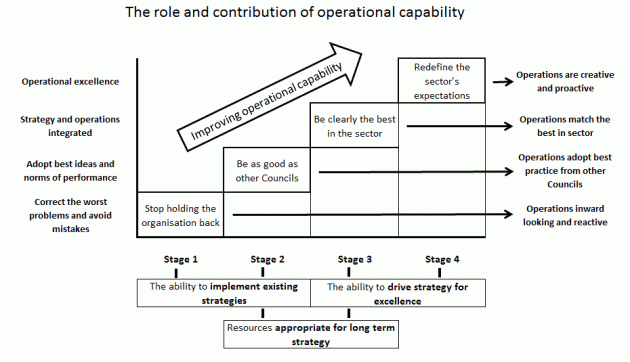
In a recent discussion with a colleague she mentioned that in her previous employment outside local government they had set organisational performance goals for leadership, finances, relationships, safety and operational excellence.   Each area of performance was rated equally. It started me thinking about how little you hear about operational excellence in local government. Is that because it doesn’t matter?

I am sure that operational performance matters. Whether councils want to be excellent or not, I am less sure. I think that the reason it is seldom discussed is that few people have a real understanding of operations management or what excellence would look like or how to achieve it. Continue reading

68 – Design a management job for high performance. Part 2 – some local government examples.

Posted by Lancing Farrell                                                              1000 words

sliders

In the first post I discussed a tool that you can use to test your current job design to see whether it has been designed for high performance. In the second post I elaborated on the theory behind the tool. In this post (another long one I am afraid) I will attempt to apply it to design three local government management positions that I am familiar with. Continue reading

58 – Performance appraisal in local government 4/4. What else could we do?

Posted by Lancing Farrell                                                                              650 words

optimus prime transformer

This is the last post in this series. It is also where things start to get interesting. There are alternatives to performance appraisal the way we have always done it. The difficulty is that most are quite different to the current approach and pursuing them will involve the risks that always accompany change. Are we up for it?

We could just stop using performance appraisals. As Peter R. Scholtes writes in The Leaders Handbook, this would require us to start thinking differently. In essence, this would involve adopting a ‘systems thinking’ approach to managing the organisation. This is likely to require systems to support employee development and promotion, providing feedback for improvement, determining training needs, and performance managing the poor performers.

Scholtes proposes what he calls ‘debundling’ of performance appraisal to focus on each benefit that the performance appraisal system supposedly provides. Continue reading

56 – Local government performance appraisal 3/4. What can you do in response to the issues?

Posted by Lancing Farrell                                                                                              530 words

apple and orange

Choices are necessary regarding the role of performance appraisal and how it will be done. I don’t think anyone thinks that performance should not be measured. It is a matter of how you do it.

Peter R. Scholtes points out the fundamental choice facing every organisation very clearly in The Leaders Handbook. What is most important to your organisation – controlling the behaviour of people to the satisfaction of management, or understanding, controlling and improving processes to benefit customers? Continue reading

52 – Local government performance appraisal 1/4. What are the issues? (or 5 reasons it doesn’t work)

Posted by Lancing Farrell                                                                             700 words

performance - rowing

This is the first in a series of four posts on performance appraisal. The central idea is that current performance appraisal systems are not effective.

To begin with, the annual performance appraisal process (sometimes called the performance development plan (PDP) or staff development scheme (SDS)) is often not carried out in local government. When it is, people have usually been compelled to do so or they are simply ‘ticking the boxes’ and being compliant. I have often thought that this is important evidence that the process is not helpful. People ‘vote with their feet’ – if they thought that performance appraisal was useful and that it added value, they would be doing it.

Continue reading

43 – Developing a dashboard for performance measurement. A case study.

Posted by Colin Weatherby                                                                         1000 words

mini dashboard

I was recently asked to create a dashboard for my unit with the intention that it function like the dashboard on my car (no this is not my car). This is to be done in the absence of an organisational dashboard or scorecard or performance reporting system. There have been a few posts on this topic by Lancing Farrell (here and here) and this post discusses the application of some of the theory.

I started by listing all of the current measures that are in place from external and internal sources of accountability. This included legislation, sector-wide improvement programs, customer satisfaction surveys, occupational health and safety accreditation audits, internal audit programs, culture surveys, organisational policies, and financial reporting. Some of these measures are applied continuously, some are annual and others occur periodically. All of them have some organisational or public reporting of performance. This list was very much a list of things that other people think it is important to measure about the performance of the department. For whatever reason.

Then I made a list of all of the things that I think it is important to measure to know work is being done properly. Continue reading

41 – ‘Where does the customer fit into a service operation?’ A brief discussion of the work of Richard B. Chase.

Posted by Lancing Farrell                                                                                                     1200 words

In 1978 Richard B. Chase published his paper Where does the customer fit into a service operation? John Seddon says this article began the separation of front and back office operations; something that he believes has created many problems in public sector service delivery today. Maybe he is right. But when you read the article, what Chase is advocating makes sense and I can’t help thinking that it isn’t necessarily a bad idea, rather it is an idea that has been used badly.

Chase is an operations manager. By 1978 he had already co-authored a popular operations management text. He starts his paper stating that a manager needs to understand the ‘operating characteristics that set one service system apart from another’ in order to make improvements. Continue reading

33 – Developing an organisational performance measurement system. Some ideas.

Posted by Lancing Farrell                                                                                     820 words

I have been thumbing through ‘Improving Performance – How to Manage the White Space on the Organisation Chart’ by Geary A. Rummler and Alan P. Brache, in particular the chapter about performance measurement. In it they describe measurement is the single greatest determinant of an organisation’s effectiveness as a system, and as the primary tool for ‘communicating direction, establishing accountability, defining roles, allocating resources, monitoring/evaluating performance, and taking improvement action’.

I haven’t seen a local government that has actively used performance measurement this way. Instead, it tends to be driven by external accountability requirements. We use the performance measurement that we do to convince others that we are doing what we should. Continue reading

31 – Measures, targets, KPI’s, KRA’s and CSF’s. What are we talking about?

Posted by Lancing Farrell                                                                              740 words

There is a lot of talk in the public sector about measurement. Some people say that you ‘can’t manage what you can’t measure’ or, ‘what gets measured, gets done’. There is no doubt that measurement is inextricably linked to the pursuit of better performance and greater accountability. In local government, we seem to be desperately looking for things we can measure that will tell us how well we are doing. But are we measuring the things that count? Continue reading