133 – If local government was a car, what sort of car would it be? The Hyundai Excel Sprint

Posted by Whistler                                                                                         700 words

hyundai excel

I have often wondered what local government would be like to work in if we were making cars. For a start we would need to produce something that resembled what the customer had in mind. We would need to make sure that cars left the assembly line with all of their wheels on, with doors all the same colour, and the engine connected to the drive train. People would be more easily able to judge the quality of output.

Then I started thinking about what if a council was a car, what it would be. After a random survey of colleagues, I settled on five choices. Each car is part of the Australian motoring tradition.

Think about what car your council might be.

The first is the Hyundai Excel. Economy car choice for thousands of Australians. Economical, reliable and inconspicuous. The car to own for the budget conscious. Own one of these and, if asked, none of your friends will be able to say what car you drive. Continue reading

128 – Council superheroes. Some feedback from readers.

Posted by Lancing Farrell                                                                              300 words

reader feedback

Editorship has some privileges. I have enjoyed Linda Perkin’s posts on Captain Council and look forward to what will unfold in future posts. Captain Council has generated some interest, with a few people ‘connecting some dots’ and telling us about them.

Apparently western suburbs local print media shock jock Kevin Hillier has commented that councillors in his community have a ‘cloak of invisibility’. It seems they haven’t been as publicly accountable as he would like.

It was suggested that Captain Council might need this superpower. If he did, I am sure it would not be to hide from his constituents!

Another colleague pointed out a scholarly article written a few years ago about whether CEO’s in local government are superheroes or puppets. In the introduction, the author comments that:

“… CEO’s are required to operate across multiple dimensions simultaneously.”

This sounds like ‘shape shifting’ to me. A quick check on Wikipedia reveals that this superpower is more likely to be ‘dimensional travel’ (i.e. the ability to travel between two or more dimensions, realities, realms) or ‘omnipresence’ (i.e. the ability to be present anywhere and everywhere simultaneously). Secretly, I think many CEO’s do aspire to omnipotence.

I should probably take this article more seriously. It concludes with the view that:

“Successful CEOs share several common characteristics which reflect the ability to effectively manage along the three edges+. These CEO’s tend to possess transformational, charismatic, and almost superhuman qualities.”

It is all starting to sound a bit eerie to me, but my confidence was restored by a more thorough perusal of the article, which revealed that the research was strictly scholarly and involved nothing supernatural.

+ The concept of the ‘three edges’ was developed by Henry Mintzberg to describe the work of the public sector manager. The edges are the ‘operating edge’, the ‘stakeholder edge’ and the ‘political edge’.

Jones, Stephen 2011. ‘Superheroes or Puppets? Local Government Chief Executive Officers in Victoria and Queensland’, Journal of Economic and Social Policy, August.

 

124 – The butcher, the baker and the candlestick maker. Our councillors?

Posted by Whistler                                                                                          800 words

butcher baker candlestick maker

Image

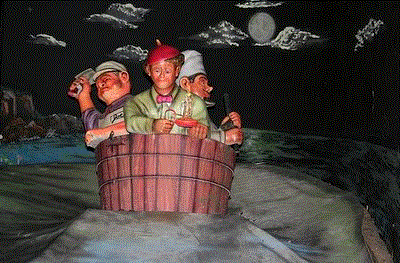
The original version of the rhyme ‘rub-a-dub-dub’ supposedly tells of three townsfolk watching a dubious sideshow at a fair. Later versions talk of them being ‘all put out to sea’, perhaps a reference to being ‘at sea’ or puzzled or bewildered (thanks Wikipedia). I think either version could work for some of our councillors today.

Councils usually have greater gender balance and occupational representation than in the rhyme. My question is, who are the people who become councillors? What attracts them to the role? Why do they do it? What do they offer? Do they really reflect the communities they represent? Continue reading

120 – Captain Council discovers a superpower – BFV.

Posted by Linda Perkin                                                                                                  750 words

Captain Council flying

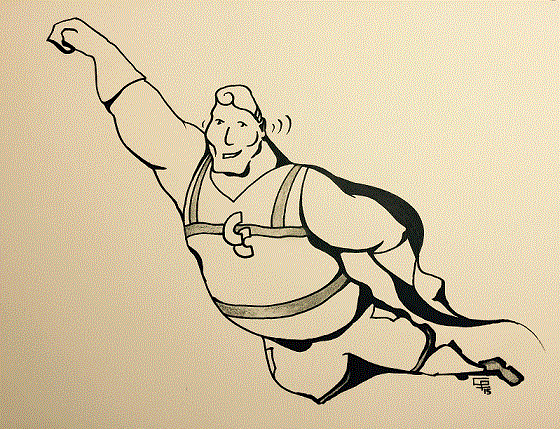
In the first instalment, Captain Council cast the management alchemy spell, only to immediately fall unconscious to the ground. Awakening some time later, he rushes to that evening’s council meeting ….

Taking his seat, Captain Council looked around the chamber. The usual crew were present. All of the councillors were in their usual positions, watching each other warily. The CEO and officers were sitting nervously waiting for business to commence.   Perched on chairs at the front of the auditorium were the two regular attendees – like Statler and Waldorf. Continue reading

118 – Improving service operations. Why it doesn’t happen in local government.

Posted by Whistler                                                                                          500 words

 walking the plank

I have read Lancing Farrell and Colin Weatherby’s posts on characteristics of demands, redesigning operations and improving service operations through action plans and service redesign, with some interest. It is all good stuff and not too difficult to understand or do. The question I ask myself is why I don’t see it happening everywhere across the sector. The ‘special and different’ posts partially explain it but I think there is more to it.

To begin with, the motivation to make improvements doesn’t really exist. People say they want to improve the quality of services to their community, and in response to threats like rate capping they say they want to be more efficient. But they don’t really want to do either.

Most councils have the potential to improve productivity by 10-15% (more in some councils). Continue reading

112 – Are we really that ‘special and different?’ An answer: ‘Yes, but’.

Posted by Lancing Farrell                                                                              400 words

peas in pod

This question was posted a week or so ago and readers and writers were asked to respond.  One reader responded (see comments below original post).  Here is my go at a response.

I am not a big fan of ‘yes, but’. In this case it is a useful way to respond to this question.

‘Yes’, of course every community is different – different people, different landscape, different housing. I could go on. These differences are important in determining the exact nature of the role each local government should play and the services they should provide. I wrote about this some time ago. Understanding these differences is critical to getting the public value proposition right and creating the value expected by the community.

I suppose the ‘but’ bit is about how the organisation responds to these differences. Because each community is different, does each organisation serving them need to be different? Continue reading

104 – Question: Are we all really that ‘special and different?’

running shoes

Editors note: This is a new type of post requesting responses from each of the regular writers and any interested readers to answering a question of relevance to the sector? It has been motivated by the realization that ‘through questions, knowledge becomes learning’.

So, the first question is:

Why do you think that councils tend to behave as though they are special and different, rather than choosing to see themselves as being similar or the same?’ 

Context

  • Councils regularly advertise jobs for the same role but with many different titles.
  • Attempts to get councils to share services across municipal boundaries have regularly failed.
  • Efforts to get councils to adopt standard systems (e.g. finance) have been unsuccessful.

Post your answer as a comment.

103 – Classic paper – ‘Managing Government, Governing Management’. Henry Mintzberg.

Posted by Colin Weatherby                                                                         1850 words

In 1996 Henry Mintzberg published a paper in the Harvard Business Review entitled ‘Managing Government, Governing Management’. In the paper Mintzberg covers four broad topics relevant to local government:

  1. Private, public, cooperative and non-owned organisations.
  2. The roles of people in society as customer, client, citizen and subject.
  3. The management myths that activities can be isolated, performance can be fully evaluated using objective measures, and activities can be entrusted to autonomous managers responsible for performance.
  4. The machine model, network model, performance-control model, virtual model and normative-control model available to organise government.

What relevance does it have for local government today?

100 – ‘We’ll get the managers to sign off’. The second most common local government phrase.

Posted by Whistler                                                                                          500 words

sign here

I guess this is the second most common phrase and it links to Colin Weatherby’s post about managers spending their time scraping burnt toast. One of the dysfunctions common in local government is the assignment of responsibility to managers for authorising everything by everyone changing a system or process, usually to eliminate their own risk.

I suppose some examples are in order. Advertising for a vacant job. An authorisation will already have been obtained to fill the position but the manager must sign to authorise the placement of the advertisement. Why? I guess that one day someone must have put in an advertisement for a position that wasn’t approved. But is this an effective or necessary control? Has the exception made the rule?

What about putting a new supplier onto the council’s system? Continue reading

97 – A question: What if we treated the community the way we treat internal customers?

Posted by Whistler                                                                                          400 words

bins in street

Colin Weatherby’s post about corporate services reminded me about a video clip that I saw some time ago showing what life might be like if the airlines ran like the health service. It was an interesting way to challenge accepted standards and made the whole system look out of touch. Colin’s post about our corporate services colleagues made me think that a similar parody might be needed to highlight the lack of respect internal service providers within councils often show for their customers.

Here goes.

Customer Service Officer (CSO) sitting in call centre answers the telephone to incoming call from a resident.

CSO:                      Hello, how can I help you?

Resident:             Hello. I put my bin out for collection on Monday and it hasn’t been collected. It is now Wednesday and I am wondering what is happening.

CSO:                      Did you put it out the front?

Resident:             Yes. I put it where I always put it on the nature strip.

CSO:                      Ah. There is your problem.

Resident:             I don’t understand.

CSO:                    Well, we no longer collect bins from out the front of houses. It is a new cost saving measure that will save lots of money. We won’t have to increase your rates by nearly as much this year. It will save at least $5 a week per household.

Resident:             But no one told me.

CSO:                     That’s because it would have cost us a lot of money to tell people. We don’t want to waste money.

Resident:             So what will happen now?

CSO:                      That depends. Do you still want your bin emptied? Continue reading