86 – Ten sayings that define local government culture.

Posted by Whistler                                                                          970 words

grass dreaming

In local government we talk a lot about culture and forces that shape it. Often these forces are evident in the things that people say each day. This post explores ten of the sayings heard daily in local government and attempts to translate them.

  1. ‘We have set a goal on this issue, it is an aspirational goal’.

This type of goal has no basis in reality. It is an idea of what might be good if it happened. At best it is a ‘guesstimate’. No one knows whether or not it is feasible. Mostly, it is just frustrating because someone powerful has effectively avoided making a decision or creating conflict by setting a goal that everyone can agree to because it means nothing. An aspirational goal makes ‘motherhood’ statement seem like a specific and readily measurable output. I think we do it because it gets us out of a difficult situation at the time or it makes us feel as though we are setting meaningful goals under difficult circumstances.

  1. ‘Never mind if you can’t get it done today, there is always tomorrow’.

This statement is often heard when planned work has not been completed. It reflects the low value placed on time in local government. When available capacity doesn’t easily match demand, jobs are just deferred. It takes the pressure off managers to be organised and ensure that operations are well managed. The customer just has to wait. Given they have no other choice of supplier, why not?

  1. ‘Let’s just park that’.

This is what happens when you can’t find the answer to the question the meeting was called to answer in the first place. This regularly happens because meetings are seen as potential circuit breakers for intractable organisational problems. The cross-functional decision that no one has the right to make. The escalated decision that no one seems to have the responsibility to make. Whatever. Parking it is a nice way to say we will just wait and see how long it takes before it either resolves itself or explodes.

  1. ‘This issue needs some ‘blue sky thinking’.

This is how we describe the generation of visionary ideas that don’t always have a practical application. Some people call it dreaming. It usually happens when past approaches have not worked and there is pressure to be ‘innovative’ and come up with a ‘creative’ solution – dangerous territory for all involved. Whilst people in local government like to say they are ‘thinking outside the box’, or thinking ‘laterally’, in reality we really just like to think the way we always have (but be seen to be doing otherwise). Hence, the popularity of ‘blue sky’ thinking – it is all care, no responsibility.

  1. ‘If it is not broken, don’t fix it’

This is a favourite. It is premised on the idea that things break suddenly and without any warning. No one could have anticipated it or prevented it happening.   The idea that it might be ‘breaking’ doesn’t enter into it. We are not looking for signs that something isn’t working and might fail. No. Everything that goes wrong in local government couldn’t have been foreseen and anything that seems to be working should be left alone. Makes sense doesn’t it?

  1. ‘This will have to go upstairs; you’ll need to run that past (write name of senior manager)’.

I quite like this one. It implies that we are getting on with business by sending something to someone more important to make a decision. The fact that you might already have the decision rights, and they really don’t have time to make the decision, is irrelevant. It is going upstairs to more senior people. That has to be better.

  1. ‘Let’s look for the low hanging fruit’.

Usually, this means just choose the simplest option to accomplish a task. Who can argue with that? It has a resemblance to efficiency. If the outcome is not what you expected or need, at least you have acted. It is related to another old local government saying, frequently heard in depots, – ‘just keep moving; you don’t have to do anything, just don’t stop’. Anyway, the cockatoos always get the high fruit.

  1. ‘We need to get a helicopter view of this’.

This implies that a higher altitude view will yield some information not currently available from the ground. There is really no arguing with this idea, but in practice, the altitude sickness that seems to ensue once senior management leaves the ground limits the potential. You often hear about executives seeking a helicopter view but seldom see any benefit from it.

  1. ‘We really need a burning platform if change is going to happen’.

I don’t think people have arson in mind when they voice this view. It is more metaphorical. It really means that they need a crisis to justify making sensible management decisions – someone has to set fire to something before we have a reason to fix it (enter rate capping).   Without an imminent crisis, the Executive can’t work out how to explain to people that they need to change and put customer needs ahead of their own. I get it.

  1. ‘You need to run that past the Admiral’.

This refers to the senior manager nicknamed the ‘Admiral’ because they regularly say that they will have to ‘take it on board’. It could as easily be the ‘Window’ or the ‘Mirror’ – they need to look into it before they can make a decision on what to do. The ‘Grasshopper’ is another nickname – this is the manager who needs to find out about something before deciding (a reference to disciple in the television series Kung Fu). Everyone in local government has worked with an Admiral, a Mirror or a Grasshopper. It really just reflects the difficulty managers have in making a decision quickly. I wonder why?

Have you got others?  Contribute them via a comment.


85 – Local government strategy implementation. Myth 2: Execution means sticking to the plan.

Posted by Lancing Farrell                                                                              600 words

Gantt chart

This is the second post in a series of five. The first post discussed the myth that execution equals alignment.

Sull, Homkes and Sull describe how organisations translate their strategic objectives into detailed plans that specify who will do what by when and with what resources. A large amount of time and energy is invested in the plans. Executives are then reluctant to deviate from the plan because they think that would reflect a lack of discipline and undermine execution.

However, a plan cannot anticipate all of the things that might help or hinder the organisation in achieving its strategic objectives. Continue reading

84 – Local government strategy implementation. Myth 1: Execution equals alignment.

Posted by Lancing Farrell                                                         700 words

alignment

Image from http://www.clipartpanda.com

This is the first post in a series of five posts drawin on ideas from the article ‘Why Strategy Execution Unravels – and What to Do About it’ by Donald Sull, Rebecca Homkes and Charles Sull.

In the article Donald Sull, Rebecca Homkes and Charles Sull describe the usual way strategy is implemented – i.e. it is translating it into organisational objectives, which then cascade down the hierarchy, progress is measured, and performance is rewarded. This accurately describes what theoretically happens in local government.

The authors found that when asked about improving strategy implementation, executives suggested greater use of tools such as management by objectives and the balanced scorecard to ‘increase alignment between activities and strategy up and down the line of command’.  In other words, execution relies on alignment and failure to implement strategy is a result of a breakdown in the linkages between strategy and action at each level in the organisation.

This type of thinking is also prevalent in local government. Continue reading

83- Myths of strategy implementation. A series of posts.

Posted by Lancing Farrell                                                                              280 words

treasure map 2

This series of posts builds on a previous series about how job design impacts on strategy implementation to focus on other systemic organisational factors. It draws on ideas from the article ‘Why Strategy Execution Unravels – and What to Do About it by Donald Sull, Rebecca Homkes and Charles Sull, which was published in the Harvard Business Review in March 2015. The authors have been conducting research for nine years into how complex organisations can execute their strategies more effectively.

The research is ongoing and the article discusses some of the insights that have already become apparent. In particular, five myths about how to implement strategy are exposed and alternative approaches are discussed. The central thesis is that most organisations have clear and accepted definitions of strategy but know a lot less about how to translate a strategy into results. Continue reading

82 – Is it a strategic decision?

Posted by Colin Weatherby                                                         500 words

yes no maybe

How to Tell which Decisions are Strategic’ is the title of a paper by Ram Shivakumar published in the California Management Review in 2014. It attracted my attention because I have often asked that question myself. What is it that distinguishes a strategic decision from a non-strategic decision? Well, hopefully you will know more after reading this post.

The essential idea in the paper is that a strategic decision is defined by the degree of commitment involved and the implications for the scope of the business or organisation.   Let me explain. Continue reading

81 – Designing a performance management system. Part 2 – A process.

Posted by Lancing Farrell                                                              560 words

measures process a

This is the second post in this series. The first post discussed the type of measures needed to manage for performance. This post looks at how you can design an integrated performance management system.

The starting point for developing a performance management system is the ‘performance logic’ of the organisation. What are the most important indicators or measures of performance for your organisation? What are the key requirements of customers and the main strategic business needs of the organisation? Continue reading

80 – Designing a performance management system. Part 1 – Some tips.

Posted by Lancing Farrell                                                              430 words

rummler and brache book

There have been several posts on performance (here, here,  here and here). The most recent by Colin Weatherby discussed his approach to developing a ‘dashboard’ for his department. This post is an attempt to consolidate all posts into an integrated performance management system based on the work of Geary A. Rummler and Alan P. Brache in Improving Performance – How to Manage the White Space on the Organisation Chart.

Before getting into the details of how to build a performance management system, it is worth thinking about what you are trying to achieve. From a management perspective, measurement specifically communicates performance expectations. It enables feedback to be provided against a standard and for any gap to be identified and addressed. Continue reading

79 – The local government reading test. Would you pass it?

Posted by Whistler                                                                                          710 words

books 2

Image from a friend – some books it wouldn’t hurt everyone in local government to read.

I am a reader, as are most people posting on this site. This has been identified as an annoying trait. I can testify to that. I am convinced that, unfortunately, it makes people feel insecure and inferior when you actively read and try to talk to them about what you are learning. Thank goodness for blogs. Over the years I have developed a reading test. This is how it goes.

When I start at a new organisation or someone new starts at the organisation I work at, I make a point of having a chat and saying hello. I am not highly extroverted but I like to make people feel welcome and to build a working relationship as soon as I can. When I get to know them, especially if they are in top management, I try to find out what their interests are and establish an intellectual connection. This is when the test starts. Continue reading

78 – Organisational comfort zones in local government. Where is yours?

Posted by Colin Weatherby                                                                         730 words

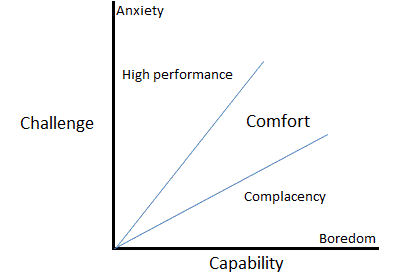
Challenge capability diagram
The idea that people are often in their comfort zones and that learning and improvement occurs when you move out of it has currency in local government today. The concern is that when people find their comfort zone they settle in and thereafter resist change, even beneficial change. Individuals are regularly being asked to leave their comfort zone and accept challenges. Does an organisation also have a comfort zone?

I think many organisations do – and they stay in them. It will usually be the zone that the organisational leaders, the council or the CEO and Executive, allow it to be in. Frequently, it is a place that they understand and there will be a level of challenge and change activity that the leaders are comfortable to support. The question is what is that level at your organisation? Continue reading

77 – Operational excellence in local government. Does it matter?

Posted by Lancing Farrell                                                                        600 words

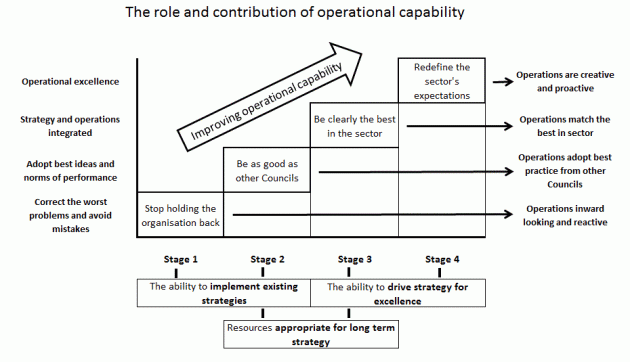
operational capability

In a recent discussion with a colleague she mentioned that in her previous employment outside local government they had set organisational performance goals for leadership, finances, relationships, safety and operational excellence.   Each area of performance was rated equally. It started me thinking about how little you hear about operational excellence in local government. Is that because it doesn’t matter?

I am sure that operational performance matters. Whether councils want to be excellent or not, I am less sure. I think that the reason it is seldom discussed is that few people have a real understanding of operations management or what excellence would look like or how to achieve it. Continue reading