550 words (4 minutes reading time) by Tim Whistler

Lancing has highlighted a key problem with many council services. I used to call it the ‘lowest common denominator effect’ (i.e. performance gets reduced to the lowest level tolerated) but I think the Taguchi Loss Function makes the point in a way that helps you to fix the problem.
Imagine that the diagram Lancing used to show the target value that a customer or citizen wants as fitting between two ‘goal posts’, to instead show a set of Australian Rules football goals. For those non-Australians, I have helped you imagine that with the diagram below.
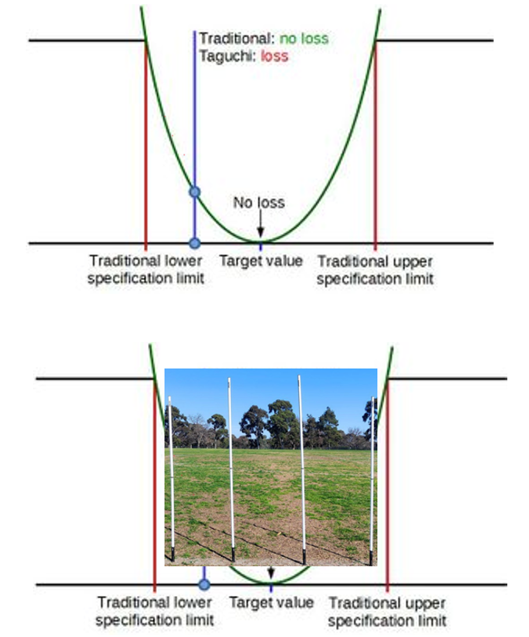
If you aren’t aren’t familiar with Australian Rules football, when the ball is kicked between the two centre posts it is a goal and scores 6 points. If it is kicked between a centre post and the post either side, it is called a behind and scores 1 point. If the ball is kicked outside all the goal posts it is out of bounds on the full and there is no score and the opposition gets to kick the ball back into play.
To help you understand how it works, here is some video footage of a player kicking a goal.
I am confident that all players kicking for goal are aiming for the ‘target value’ when they kick the ball. In fact, a player who kicks directly through the centre of the two middle posts is said to have ‘split the sticks’ and is acknowledged as a good kick for goal.
Now that we are imagining things, let’s go further and imagine that Australian Rules football is played the way things work at your council. Every score would be the same value if the ball is kicked anywhere between any of the goal posts. If the ball misses all the goal posts, instead of giving it to the opposition (if only there was some competition!) the team is given the ball back and asked to have another kick for goal, only this time they are moved 5m further away from the goals as a penalty for getting it wrong the first time. They have to keep kicking until they score and each time they miss, they are moved 5m further away.
There would be specialist kickers for these more difficult repeat kicks. I am betting they would be called ‘escalation kickers’. In local government, we call them managers.
I am pretty sure it would take some of the fun out of the game for spectators but it would be a lot easier for players to get the maximum score. The penalty for getting it wrong would encourage players to concentrate harder but the requirement for repeat attempts will increase their chances of scoring. At the same time, I am pretty sure it would frustrate spectators who just want players to get on with the game.
I have written once before about football working like councils. It is fun to parody local government, and it highlights some of its challenges. In this case, it shows that standardising services (i.e. every score is the same) lowers effort and quality, and that the failure demand created when services don’t meet the customer’s needs and expectations (i.e. all the goals are missed) creates extra effort (and cost) to ‘kick again’ to recover.
 Local Government Utopia
Pingback: 288 – Want to improve performance? – ask your local footy club. | Local Government Utopia