1300 words (14 minutes reading time) by Colin Weatherby

Some time ago I wrote a post about council performance measurement being like a dashboard on a car. I used the image of a dashboard like the one on my 1962 Morris Mini to keep it very simple. I noted that the car dashboard had evolved over many years and been refined to be a distillation of information to the minimum required for a driver to be in control of their car. It didn’t tell the driver where they were going or if they were on track to get there. I was hoping it would be an example councils could follow. Lately, I have turned my attention to sport.
Australian rules football and statistics
It is football season in Australia, and I was reading about how footy clubs, professional and amateur, are using data and statistics to measure and improve their performance. It started me thinking. Every council in Australia must have a local footy club. Perhaps they can learn something from them?
Australian rules football has been transformed using measurement, data and statistics. Starting in the mid-1990s, fully computerised services became available to provide Australian Football League (AFL) clubs with real time statistics. Before 1995, each club had someone, usually a volunteer, who compiled match stats for the coach to use in decision making or at the quarter time huddle to exhort greater effort from the players.
The thinking behind getting and using real-time computerised stats in football makes sense – measuring and analysing performance will help players and teams to improve, and, hopefully, win the premiership. It has helped football reach new levels of performance and professionalism. Teams and clubs have become more competitive and successful.
Competition and councils
Competition and councils is an interesting topic. If councils are competing, what are they competing to achieve? After all, there is no annual council premiership flag to be won. I have heard a CEO say that they want their council to be the ‘sector leading’ council. I suppose that means better than all the other councils in some way. I have also heard a CEO say that they want to lead a ‘high performing’ council. I suppose that means it is better than other councils. How success in achieving either of those goals would be measured is unclear to me.
It is also unclear how that would add value for the community the council serves, unless being better than all or most other councils also means that the community is being served as well as it needs and expects. More often than not, the competition I have seen happen at councils is within the organisation. In the absence of any real and meaningful external competition, human nature leads to internal competition (often as a way to motivate people). For example, the CEO compares managers to each other, and the managers considered to be the best are rewarded. This could be because they have made the largest savings from their allocated budget, complied with corporate requirements fully or on time, or achieved some corporate goal ahead of their colleagues. This sort of competition is questionable in terms of the value it creates for the community. Imagine a footy team where the players compete with each other, not the opposition team, with the goal of getting the best stats. The whole team would be on the forward line trying to kick goals!
Another form that competition takes for councils, and this is inherent in New Public Management, is competition for resources. This could be between council departments when annual budgets are being set, or in the marketplace for the right to deliver services when they are being outsourced. Encouraging competition for money seems to be a hallmark of councils focused on trying to reduce costs without understanding the impact it has on the value the community needs and expects them to produce.
It is interesting that Wigan Council, an exemplary council in the UK for the way it has responded to austerity measures, has recently released a Value for Money Statement. It explains the way the council decides on how money will be used to create value for the community. I won’t be critical of the document because it seems to be a step in the right direction. They say that to achieve their long-term strategic vision they must ensure they achieve value for money in all of their activities and the services they provide. Perhaps demonstrating that this is happening would be a real and meaningful competition for a council from one year to the next? Each year they could aim for a new personal best.
Value for money is about obtaining the maximum benefit from the resources available to the Council by balancing inputs outputs and outcomes. In simple terms value for money measures costs, performance, and satisfaction, and is often defined as achieving the right balance between economy, efficiency, and effectiveness – spending prudently, well, and wisely.
Value For Money Statement, Wigan Council
Australian rules football and councils
Back to the footy. Today Australian rules football has more and better professional services providing stats to AFL clubs, and Apps that local teams can use to use stats the way the professional do. The purpose of this post is not to promote any of these Apps but I have used information from one of them to look at what councils might learn from their local footy club.
The Great Coach 2.0 software allows a club to set up a team, plan the next game, collect statistics during the game, and then report on what happened at the end of the game. While setting up your team and making sure you have the players with the range of capabilities required is important, it is the collection of stats during the game seems most relevant to councils. The image below shows the type of data collected for a player. These stats are aggregated for the team in the Coach’s Clipboard function to focus on the positives and areas to improve in the next quarter.
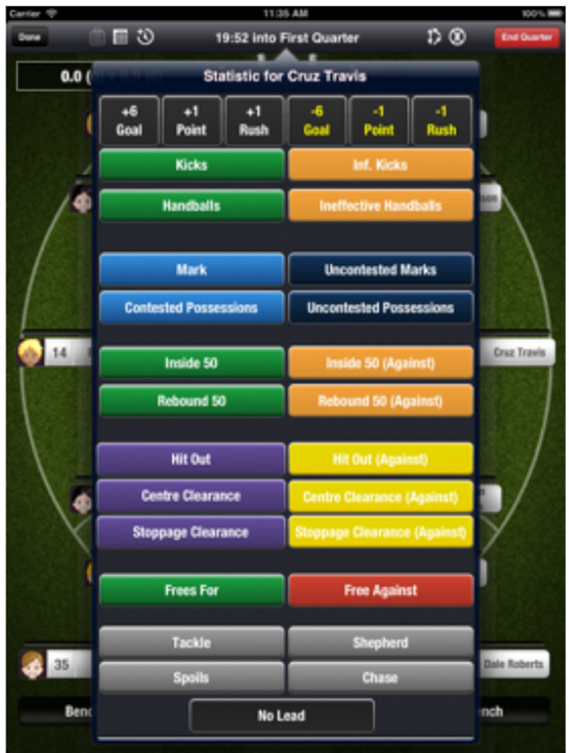
Match Statistics, Great Coach AFL – User’s Guide
At the end of the match, the Match Summary gives the final score and best players, etc. It tells you what happened during the game and what the result was. It is noteworthy that the Western Bulldogs used statistics in a version of the Moneyball strategy (surely one of the greatest uses of stats in sport) to recruit players ahead of their premiership win in 2016. They looked for a measurable aspect of individual player performance that would bring the team success and then assembled a team that exceled at that metric. In this case it was high tackle numbers and high possession numbers. How did they know who these players were? Game stats.
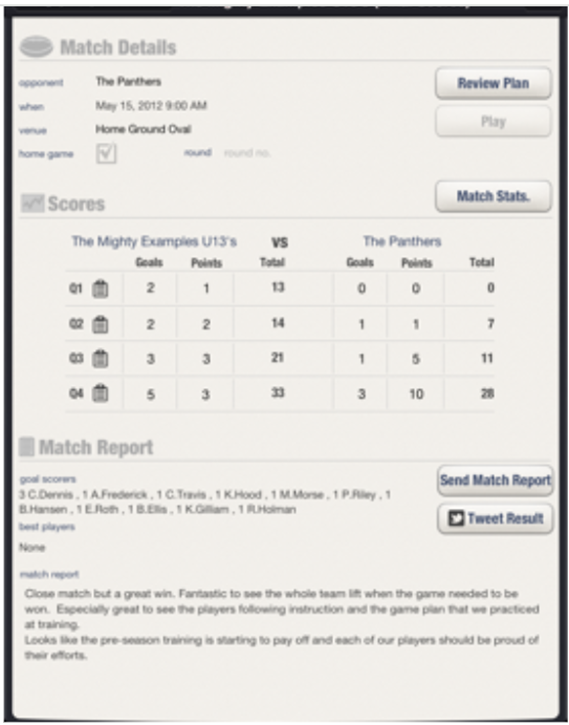
Match Summary, Great Coach AFL – User’s Guide
Councils produce lots of ‘match’ reports saying what happened after the event. All council performance reports I have seen are after the fact. Few (if any) capture data in real time and produce stats to guide leader decision making to ensure the council is producing the value the community needs and expects. I doubt any could tell you what their compelling metric is for individual or team performance.
Looking ahead for the AFL, there are developers working on using artificial intelligence to take data from game stats and compare it to historic match outcomes and team or player metrics during matches to provide coaches with real time feedback, predictions and suggestions to support their decision making. Could this be the future of local government?
Imagine, councils collecting data on real measures of whether performance is meeting community needs and expectations, using that data to compile real-time performance stats, and then using artificial intelligence to provide advice in real time on decisions that should be made to improve performance.
We can all dream.
Footnote
A colleague pointed out another aspect of football statistics known as ‘ stat padding’, in which players pass between each other to increase their stats without moving the ball forward. They benefit in terms of their personal performance but the team doesn’t.
She suggested the council equivalent could happen. I suppose filling the same pothole several times and counting each time as another service request completed is already a form of council stat padding. If you count failure demand as work, then I am sure some councils have impressive stats.
 Local Government Utopia
CEO HUNGER GAMES
We need a gladiatorial event each year where CEO’s could get this performance nonsense out of their meagre managerial minds.
They could compete to lay road aggregate, wrangle kids in kindergartens, do actual real time customer service talking to residents on the phone, lead story time at a local library, plant trees….
These events could be individual, with real time performance criteria ranked on mobile apps and aggregateed at the end, or they could be CEO on CEO, or in teams.
The performance criteria could be downloaded by the audience, providing real time ranking for the participants.
LikeLike