850 words (9 minutes reading time) by Colin Weatherby
As regular readers will know, we are partial to a good book that throws some light on the issues facing local government. The idea that knowledge of theory should underpin practice, or that learning how others have solved the problems you face can provide useful insights, is, unfortunately, not always valued as much as it should be
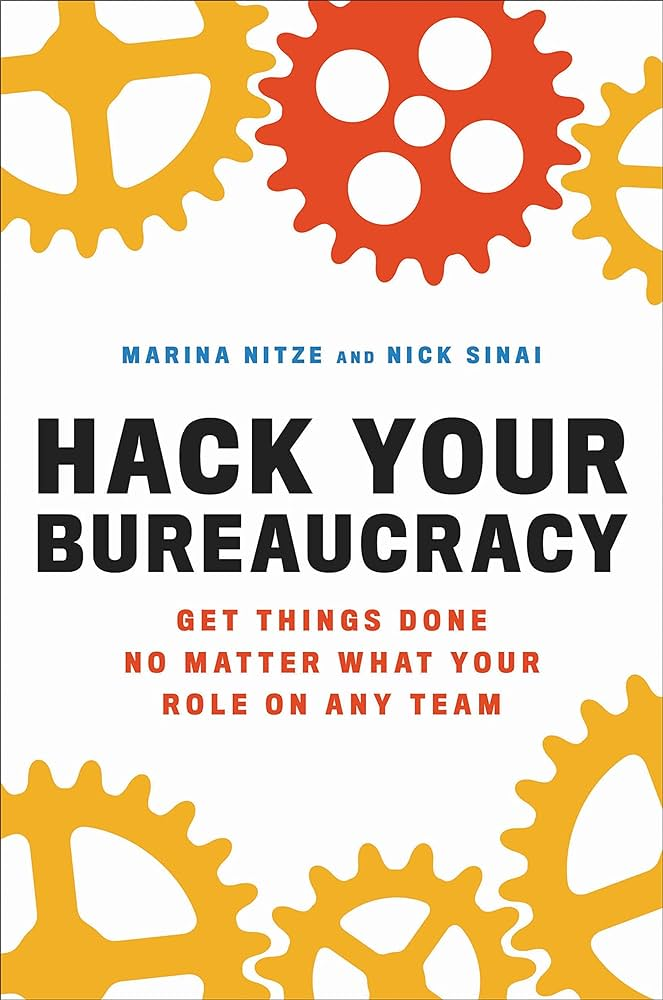
My latest read is an interesting book. ‘Hack Your Bureaucracy – Get Things Done No Matter What your Role on any Team’ is presented as a ‘how to manual’ of tips and tricks to work within bureaucracy to, unsurprisingly, ‘get things done’.
Marina Nitze and Nick Sinai are practical people who have worked in the U.S. Federal bureaucracy. They have documented the ‘hacks’ they have learned and applied with success. This is not a book about theory. It is about what works and each hack is supported by detailed stories of how it has been used and then a series of dot points saying how you can use it.
The book’s 56 hacks are sorted into 6 groups – define the problem; learn your organisation; pitch the solution; start small and build momentum; build your team; and make it stick. I won’t discuss every hack but there are several that seem more relevant to local government today.
‘Think of the end at the beginning’ – I have found this to be an obvious but often overlooked hack. By writing the press release and fact or Q&A sheet at the start, you describe the end goal succinctly and clearly. It allows you to test an idea, gather support and be clear on why you think something should be done. Building a constituency before acting can be helpful in execution.
‘Beware the obvious answer’ – This is a particular favourite. There is nothing more annoying than someone new walking around saying ‘why don’t you just do this, or just do that’. Nitze and Sinai point out that this is both unhelpful and counterproductive, and the person saying it is usually wrong because so many things have been tried before. I have worked with people, particularly those who are new to local government and in senior roles, who think really obvious ideas are being overlooked by everyone else. I have never been sure why. Their behaviour reminds me of one of my favorite sayings:
“When you don’t know what you are talking about, anything really is possible”
Instead, the authors recommend finding out what has been tried, learning about the issue in detail to understand root causes, and informally testing any hypothesis before broadcasting it.
‘Define metrics up front’ – Nitze and Sinai say that when you pitch an idea, you need to control the definition of success and say what it will look like and how it will be measured. Otherwise, you run the risk that you will achieve what you set out to do and it will not be agreed to be the required result. How often have you seen that happen? People start pumping the air and proclaiming success, only to have everyone ask them what happened. Success in public services can sometimes be difficult to see for the uninitiated and getting agreement before you start is smart.
‘Understand risks and incentives’ – for me this is the masterstroke hack to overcome resistance to change. What are the explicit incentives and risk frameworks for decision making used by the people leading your organisation? Incentives influence individual behaviour, and if the individuals are senior enough, the impact can be felt across the organisation. Nitze and Sinai list some incentives; recognition or reputation, security, convenience or comfort, being seen as smart or ‘in the know’, … This is not the complete list but when I got this far I felt they had covered the major incentives I have seen guiding leaders.
Their list of perceived risks also resonated with me; losing their job, losing resources, being seen as inexperienced, having to take on extra work, being ostracised by peers, … One piece of advice if you want to get things done is to assume all the risk. They say they haven’t had a lot of success getting others to take on risk, but when they take on the risk they get traction. Alternatively, try and find someone who is incentivised by taking on the risk. Good luck with that approach.
Nitze and Sinai close the discussion about this hack by discussing the ‘cobra effect’, or Godhart’s Law. It is based on a true story from Dehli where the local government tried to solve the problem of a plague of cobras by paying a fee for every dead cobra brought to them. Instead of reducing the cobra population, it resulted in an increase because people started breeding cobras to earn the payment. The lesson? Incentives also create risks!
‘When a measure becomes a target, it ceases to be a good measure’
Charles Godhart
If you have worked in local government for a decade or more, the chances are you already know a lot of these hacks. You probably call some of them workarounds. They are useful. Unfortunately, incremental improvement achieved by people smart enough to ‘hack’ the system seldom leads to sustained system transformation. You risk making something ‘wrong’ work ‘righter’ or simply reaching a new, albeit better, status quo. The chances are that the improved part of the system will only remain improved until something else in the system changes.
Having said that, the book will help newbies to government get their work done, it’s a nice reminder for those with experience, and there will be a few new hacks for your repertoire!
 Local Government Utopia
Pingback: Transduction — leading transformation — Issue #108 – chosen path