Posted by Whistler 730 words
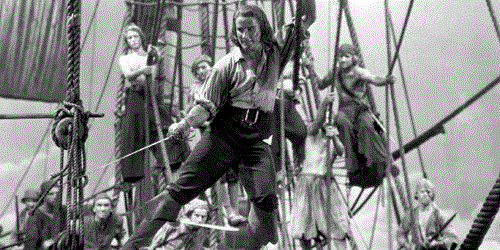
I must be reading too much. Along with the article on colonialisms, I re-read an article on pirates that resonated with me and the thoughts I have been having about local government leaders. I am not suggesting that CEO’s are pirates but do we need our version of the pirate code?
In a fascinating article about piracy, written to investigate the ‘internal governance institutions of violent criminal enterprise by examining the law, economics, and organisation of pirates’, author Peter Leeson examines the ‘system of piratical checks and balances crews used to constrain captain predation’, and how pirates ‘used democratic constitutions to minimize conflict and create piratical law and order’.
It is a fascinating read. It started me thinking about the checks and balances in local government that constrain (or otherwise) the behaviour of the CEO.
‘To effectively organize their banditry, pirates required mechanisms to prevent internal predation, minimize crew conflict, and maximize piratical profit.
Captain predation didn’t just occur on pirate ships. Merchant vessels had similar problems. In addition to laws constraining merchant captains, their reputation and the risk of mutiny helped keep them in check. Predation occurred in a number of ways, each an abuse of the power available to the captain. For example, the food rations given to crew members would be cut (sometimes to make more available for the captain and officers).
In both merchant vessels and pirate ships a captain was essential. They had a critical role to play in leading the crew, much like CEO’s in local government today.
‘Many important piratical decisions, such as how to engage a potential target, how to pursue when “chasing” a target or being chased by authorities, and how to react if attacked, required snap decision making. There was no time for disagreement or debate in such cases, and conflicting voices would have made it impossible to undertake the most essential tasks.’
The need for a captain created a dilemma. Someone leading who had the ability to wield unquestioned power was critical for success in battle. But, what would prevent that power being used in the same way in dealing with the crew?
‘Because of the threat of captain predation, pirates “were adamant in wanting to limit the captain’s power to abuse and cheat them”. To do this they instituted a democratic system of divided power, or piratical checks and balances, aboard their ships.
Captains retained absolute authority in times of battle. This gave pirates the benefits of the control necessary for success in battle. However, the power to allocate provisions, select and distribute loot, and adjudicate crew member conflicts or administer discipline was given to the quartermaster. As with the captain, the quartermaster was democratically elected.
“… the Captain of a Pirate Ship, is chiefly chosen to fight the Vessels they may meet with. Besides him, they chuse another principle Officer, whom they call Quarter-master, who has the general Inspection of all Affairs, and often controuls the Captain’s Orders” (William Snelgrave 1734).
The pirates’ system of checks and balances effectively prevented captains from preying on their crews. However, a problem remained – what was to prevent quartermasters from abusing their authority to privately benefit at the crews’ expense? The principle check on both captain and quartermaster was that they were democratically elected by the crew. In addition, pirate crews had written constitutions that specified their laws and the punishments for breaking them. More specifically, it limited the actions that quartermasters might take in carrying out their duties.
In doing this, pirates overcame leader predation using similar methods to those used by governments to constrain ruler predation by political rulers. Democratic checks, the separation of power and their social rules and governance institutions provided crews with the reassurance that their leaders could not take advantage of them for personal benefit.
There have been CEO’s in local government who have acted without the checks and balances in place for pirates. They have been selected by people who are unaware of their actual performance in dealing with the council organisation. They only see some aspects of the CEO’s behaviour, which is usually managed to retain their good will. There is no separation of power with a ‘quartermaster’. Some modern organisations do appoint dual CEO’s or a CEO and Chief Operating Officer (COO), which could have this effect, but it is unknown in councils.
Lastly, there is no ‘pirate code’ or other private, self-enforcing institution to overcome the absence of any externally imposed code of behaviour on leaders.
Leeson, Peter T. 2007. ‘An-arrgh-chy: The Law and Economics of Pirate Organization’, Journal of Political Economy, vol. 115.
 Local Government Utopia