188 – The council value proposition – what could it be?

Posted by Colin Weatherby                                                                                         1100 words

Kano model and brand

There have been a number of posts on value. In the context of imminent rate capping in Victoria it is timely to revisit some concepts of value relevant to local government. It is easy to overlook the fact that public service expenditure is about creating public value.  Especially when revenues are being constrained and thinking is turning towards making savings and cutting costs.

In the diagram above I have used the Kano model from Wikipedia and positioned three key council services that many regard as ‘core’ services – the provision of public parks, waste collection from residential properties, and provision of roads. Each has been placed in a different place on the diagram and I will explain why. Continue reading

187 – A high functioning Executive. What would it take?

Posted by Colin Weatherby                                                                                         1100 words

awesome

This is a question I was asked recently by a reader. Having read several posts critical of the behaviour of the Executive (What can a culture survey, an organisational self assessment, and your Executive’s risk appetite tell you?, The Executive. What exactly is their role? , Does your Executive suffer from altitude sickness?, and The Executive: filters, traffic controllers or drivers? ) she wanted to know whether I had a solution. Knowing that it is easier to be critical than creative, I cast my mind to thinking about the nature of the problem and some potential solutions.

I think the starting point is to understand the problem. In a nutshell, I think the following issues illustrate the problem:

  1. The Executive is overloaded with the small stuff handed to them by councillors (not the council). Much of it has to do with the personal idiosyncrasies of councillors and behaviours arising from their inability to work together as a group. It is dysfunctional, urgent and produces little value for the community. There are better ways for potholes to be reported.
  2. The Executive has to deal with high level relations with external organisations and strategic external pressures. These are often CEO to CEO relationships and cannot be readily delegated.
  3. The Executive is not putting enough time and effort into leading the organisation. Their focus on councillors and the external environment takes most of their time and energy. At the same time, they worry about problems 1 and 2 being made worse so they try to control organisational communication and decision making. When this is done ‘efficiently’ by time poor leaders it drives dysfunctional management behaviours.
  4. The Executive operates independently of managers and participates in the Senior Management Team (SMT) episodically. There is frequently no genuine and continuous engagement with the SMT in strategy and decision making. Managers are included in decision making when it suits the Executive – which is usually when they have the time and energy to do it. Managers are effectively isolated from information and the strategy decisions being made continuously by the Executive.

Obviously there are different solutions possible. Continue reading

186 – Essay No. 1 – Local government and accountability.

Posted by Lancing Farrell                                                                              2000 words

rabbit in headlights

This is the first in a series of essays to wrap up the 200 opinions, essays and observations from Local Government Utopia. As such, it attempts to bring together some of the themes that have emerged in the various posts.

Have you ever imagined yourself to be in the office of the CEO?

You have arrived at work to be told that The Ombudsman’s office wants to talk to you about the outcome of an investigation triggered by a Whistleblower. You have a meeting at the Auditor General’s office that morning to discuss the latest report they have released on Council Customer Service. A copy of the Independent Broad-based Anti Corruption Committee (IBAC) report on Council Depot Management is in your in tray along with a complicated Freedom of Information request.

That evening you have a Risk and Audit Committee meeting where you need to explain the lack of action in implementing recommendations from the 10 internal audits completed in the previous year. A councillor has left you a phone message saying they are unhappy with a decision regarding services delivered to an elderly resident. There is an email from the local newspaper wanting comment on an expose they are running on councillor entitlements.

I am sure this is not a usual day. But it also isn’t an entirely unrealistic scenario either. There are lots of sources of accountability for local government. Often, they act on the organisation independently and there is no effort (and sometimes no opportunity) to coordinate the organisational response. As a result, sources of accountability frequently operate at cross purposes and can be counter-productive. Continue reading

184 – Long Read: What matters and what works. Why feasibility is important in local government.

Posted by Parkinson                                                                                                       380 words

light

I have a colleague who often uses an analogy that I have always liked but never really understood why. Recently I have discovered that it is called the ‘streetlight effect’ or the ‘drunkards search’.

In the analogy two people are walking down a street to where their car is parked when they realise they have dropped their car keys somewhere in the pitch black darkness. They must find the keys before they can go home. They are looking around blindly in the darkness for the keys when one of them sees a light further down the street. They then go and look for the keys under the light where they can see.

The two people can’t do what they really need to do so they go off and do something that they can do. Even if it will never achieve the outcome they want. He often uses this analogy when talking about matters of council policy. What I have realised is that he is questioning the feasibility of the actions being taken to achieve something important.

I was recently listening to a podcast of the first Cranlana lecture for 2012 on the topic of the ‘Good Society’ given by Professor Dan Russell. In it he talks about the importance of feasibility in public policy. He says that often ambitious public policy fails because of the unavailability of feasible actions to implement it. Professor Russell says that putting feasibility first is the answer to the challenge of how to make hard moral decisions. This seems like good advice.

It is a variation on the streetlight effect, where what needs to be done to achieve what matters is known but impossible. Instead, effort is put into doing something that will never achieve what matters but it enables something to be done. It is pointless activity but it makes people feel better than they would just waiting for daylight.

Professor Russell believes that you must first look at what is feasible before setting priorities for action – we must think about both what really matters and what really works. If we do not do both, he believes it can makes it difficult to convince people that the action taken is really trying to do something about what matters.

So, how is this relevant to local government? Read on …

182 – Public management, or management in public?

Posted by Whistler                                                          220 words

scaredy cat

I was reminded today of a practice that seems to have crept into local government with the increasing insecurity and risk aversion of top management. It is similar to the concept of ‘risk farming’.

The practice involves your manager avoiding responsibility by setting up meetings for anything that is happening that they sense could have a down side. In the past, a discussion with your manager at your one-on-one meetings would have sufficed. You could let them know what is happening and undertake to keep them informed.

Now, they are likely to ask you to set up a series of meetings involving them and anyone else they can think of who may have an interest in the matter. The purpose is to ‘keep an eye’ on the issue and ‘support’ you in seeing it through. At the meetings you become publicly accountable for your management of the matter.

In the event that the matter blows up, your manager will implicate everyone else involved and they will be witnesses to your failure. Your manager will no longer be held accountable for your performance – after all, there was a whole group of people ‘supporting’ you.

I am old enough to remember when a manager would provide support by encouraging and advising, and by standing by your side when things were getting tough. They don’t seem to be able to get out of the way fast enough now.

As someone said to me recently, when people don’t know something they get sacred and when they get scared their aversion to risk goes up.

181 – Applying the public value concept in local government using systems thinking

Posted by Colin Weatherby                                                                                         1100 words

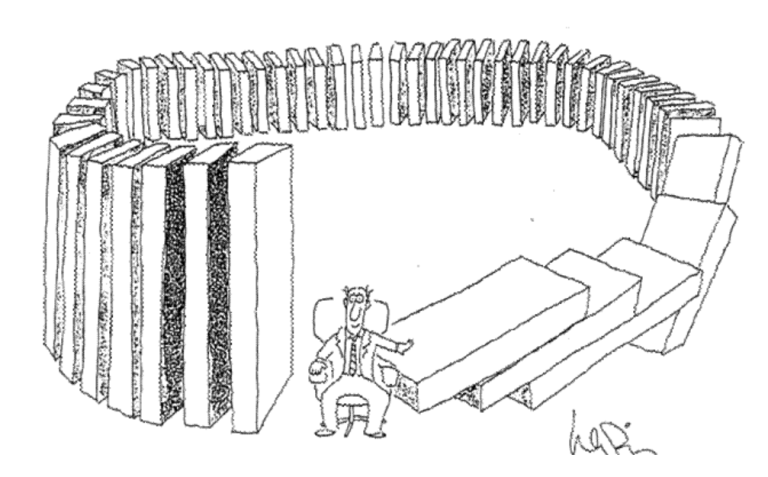
dominoes

Image

Systems thinking is potentially a great lever for improvements in the design and delivery of local government services. However, it will require a major shift in thinking about how work is designed and managed because the systems thinker is focussed on the purpose of a service from the customer’s point of view.   This is a change from the needs of the organisation and the people working in it driving the design of work and delivery of services. Here are some thoughts building on the earlier post by Parkinson.

Local government needs to work harder to put the needs of customers first despite the realities of multiple and conflicting accountabilities, limited potential for increased income from rates, difficulty defining who the customer is, and increasing expectations of service levels, reliability and speed.

The principal focus of systems thinking is designing and managing the organisation with the customer mind. Continue reading

180 – Long Read: Managers as designers in local government.

Posted by Lancing Farrell                                                                              300 words

design thinking wordle

This is a long read compilation of the series of posts on the manager as designer in local government. For those who prefer to get the whole story in one go, here it is.

Some years ago I read a book called ‘Managers as Designers in the Public Services’ by David Wastell (Professor of Information Systems at Nottingham University Business School). It made a lasting impression on me. It is a book worth reading for its treatment of systems thinking in public service management.

More recently, I read two articles from the September 2015 issue of Harvard Business Review; ‘Design Thinking Comes of Age’ by Jon Kolko and ‘Design for Action’ by Tim Brown and Roger Martin. Each article extends the idea of the manager as designer with specific application to improve corporate processes and culture.

Jon Kolko discusses the application of design to the way people work. He says that people need help to make sense out of the complexity that exists in their interactions with technologies and complex systems, and that design-thinking can make this ‘simple, intuitive and pleasurable’.

“ … design thinking principles have the potential to be … powerful when applied to managing the intangible challenges involved in getting people to engage with and adapt innovative new ideas and experiences.”

The principles he is referring to are empathy with users, the discipline of prototyping and tolerance of failure.

Roger Martin and Tim Brown provide a related but different view of design in organisations. They see it as helping stakeholders and organisations work better together as a system. The focus of their article is the ‘intervention’ required for stakeholders to accept a new design artefact – whether ‘product, user experience, strategy or complex system’.

They argue that the design of the ‘intervention’ (i.e. the way a new product or service is introduced to users and its integration into the status quo) is even more critical to success than the design of the product or service itself.

In effect, there are two parallel design processes; the artefact (i.e. a new service) and the intervention for its implementation (i.e. the change management).

So, how is this all relevant to local government? Read on …

179 – Some thoughts on local government and public value.

Posted by Parkinson                                                                       1400 words

common good

A number of posts written have been written about public value by others (see Why do we provide the services that we do in local government?, Customer, client, citizen, resident or ratepayer. Who are we dealing with?, Applying the public value scorecard in local government services. Part 1. , Applying the public value scorecard in local government services. Part 2., Public value gap analysis. A tool., Public value gap analysis. Some actions., Making high performance happen through value-led management., and Value-led management in local government. Some further thoughts). This post is an attempt to provide a context for further thinking about public value in local government.

Common good and public value

The political philosopher Michael Sandel has identified that rising social inequality is leading to a separation in ways of life between the rich and the poor. He believes that when this happens there is no longer a common way of life because “they don’t use the same public institutions, don’t inhabit the same civic spaces, and don’t avail themselves of the same public services”. As a result, Sandel believes that we can cease to think that we are ‘in it together’ enough to even deliberate together as members of a political community to determine common good.

The gap between the rich and poor is growing in Australia. According to the Oxfam report ‘Still the Lucky Country?’, the wealthiest Australian are disproportionately influential and the poor are at risk of being marginalised and unheard. Extreme wealth provides the power to influence government policies that favour those with wealth, regardless of what would work best for the whole of society.

The common good is the ‘large’ form of public value. Continue reading