117 – ‘Captain Council’. A local government superhero.

Posted by Linda Perkin                                                                                       670 words

Captain council

Introducing our newest superhero ‘Captain Council’. When writing something recently, I found myself asking ‘What would Arnie do?’ Arnold Schwarzenegger’s response to a situation has become something of a yardstick. It made me think that what we really need in local government is our own yardstick – what would ‘Captain Council’ think or do?

There is always a back story. Here goes.

Captain Council is a former council manager who sought election to his local Council to improve services.

In his job he had been marginalised for constantly focussing on how work could be done better. His continual efforts to get everyone else to think differently and challenge the status quo created enemies amongst those in the organisation who were threatened by change. These people criticised him to higher authority (behind his back) and diminished his career prospects to limit his influence. Higher office seemed the only way forward.

Elected at his first attempt, Captain Council (not yet a superhero) relished the opportunity to make things better. Continue reading

116 – Are we really that ‘special and different?’ Another answer: ‘Yes, of course’.

Posted by Parkinson                                                                                       450 words

fingerprint

It has been a while since I posted but I couldn’t resist this topic. I appreciate the views put forward by Lancing Farrell and they have merit. But, from my point of view it is obvious why councils are different and should remain different.

Councils need different capabilities to serve their communities. These capabilities have often been developed over time in response to drivers evident to community leaders. For example, provide excellent customer service in delivering basic services to an affluent and demanding community; be able to build new infrastructure quickly and well to meet the needs of a rapidly growing peri-urban council – with limited resources; make sure that ageing facilities are cared for to protect their cultural values in a heritage place.

The leadership of every community will be different. Continue reading

112 – Are we really that ‘special and different?’ An answer: ‘Yes, but’.

Posted by Lancing Farrell                                                                              400 words

peas in pod

This question was posted a week or so ago and readers and writers were asked to respond.  One reader responded (see comments below original post).  Here is my go at a response.

I am not a big fan of ‘yes, but’. In this case it is a useful way to respond to this question.

‘Yes’, of course every community is different – different people, different landscape, different housing. I could go on. These differences are important in determining the exact nature of the role each local government should play and the services they should provide. I wrote about this some time ago. Understanding these differences is critical to getting the public value proposition right and creating the value expected by the community.

I suppose the ‘but’ bit is about how the organisation responds to these differences. Because each community is different, does each organisation serving them need to be different? Continue reading

109 – How can you influence a council decision? Some tips.

Posted by Posted by Colin Weatherby                                                                  670 words

sprinfield monorail

Hear the song.

 A friend recently asked me for advice on influencing a council decision regarding a park near his home. His council had plans to demolish an old community building in a park and allow a nearby disused tennis facility to be converted into bowling greens by the club based at the park. He disagreed with the plan and wanted to see the building retained and the old tennis courts turned into open parkland.

After thinking about it overnight I proposed the following ten actions Continue reading

106 – Some of the seldom asked questions in local government. What are they?

Posted by Whistler                                                                                          390 words

the thinker

I am sure these are not the only great unasked questions. But they are questions that frequently come to mind when you are in one of those interminable meetings talking about the same old topics.

  1. How does this add value? This is a question that often runs through my mind but it never seems appropriate to ask it. It just doesn’t seem relevant. As much as we say that we are serving the community, we choose to do it in our own way. What the community sees as value, and how they want it to be delivered, isn’t something we question enough.
  2. Am I the best person to do this? I like this question and have regularly asked it of my direct reports and encouraged them to ask it. My Group Manager has never asked it. As officer, we seem to like spending time doing things that we know how to do well, or that make us feel good because we have ‘saved the day’, or because it is just easier than the effort required in getting someone else to do it properly. Looking for the work that only you can do, and then doing it, can take you out of your comfort zone.
  3. What can we do to act on the customer survey? Each year, councils in Victoria participate in sector wide customer satisfaction monitoring. The survey results are made public and daily media report on the state wide results. Through this process it is possible to be identified as the worst performing council and this places a high level of pressure on councils. But does it lead to serious questioning of what can be done to act on the survey and really make a difference? Not often. There will be discussion about the results. A lot of time will be spent discussing the shortcomings of the methodology. But really trying to understand the results and act to improve customer or community satisfaction by taking some risks to improve value? I don’t think so.

After writing them, I found that there was a theme to these questions – we need to question what we are doing to make sure that we are adding value by doing what needs to be done to satisfy purpose or meet need or create value. Call it what you like, just do it.

104 – Question: Are we all really that ‘special and different?’

running shoes

Editors note: This is a new type of post requesting responses from each of the regular writers and any interested readers to answering a question of relevance to the sector? It has been motivated by the realization that ‘through questions, knowledge becomes learning’.

So, the first question is:

Why do you think that councils tend to behave as though they are special and different, rather than choosing to see themselves as being similar or the same?’ 

Context

  • Councils regularly advertise jobs for the same role but with many different titles.
  • Attempts to get councils to share services across municipal boundaries have regularly failed.
  • Efforts to get councils to adopt standard systems (e.g. finance) have been unsuccessful.

Post your answer as a comment.

102 – Reflections on the first 100 posts.

my wordle

After discussion with writers, this post is an assessment of what has happened so far. It is about half way through the 52 week life of the blog. Here goes.

At the start of 2015 blog club members weren’t sure about the amount of material we would have to blog. As it turns out, there has been ample. Enough for a post each working day and 70,000 words so far. This is thanks to the writers and their colleagues who have contributed ideas and feedback (sometimes unwittingly). Thank you to everyone who has contributed in some way.

The readership has been unexpected. Given it is a niche topic and focussed on Australian local government, the fact that most readers are from overseas has been a revelation. I am not sure whether it is the topics attracting attention or whether there is genuine interest in Australian local government. Most overseas readers have come from the US or UK where there are some similarities in the way local government works. The lack of comments posted by readers (there have been lots of ‘likes’ and small band of ‘followers’) was a surprise. Maybe this is common for new blog sites.

The topics that have emerged have also been a surprise. Continue reading

101 – Index post – posts 76 to 100.

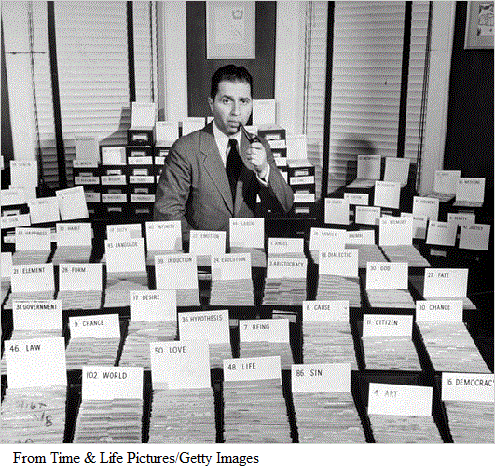
syntopicon

It is a century in posts and about the half way mark in our 52 weeks in the life of local government downunder. Again the index post follows themes in alphabetical order.  An upgrade of the current index page to a more comprehensive syntopicon, or collection of topics, is planned.  Stay tuned.

Budgeting post 76 discusses capital expenditure targets and creative ways to achieve them, or at least appear to have achieved them. Have a go at the test and see whether you are equipped to manage your council’s capital program.

Classic paperpost 88 is the first in a new series looking at classic papers and examines Peter F. Drucker’s thoughts on managing public services.

Cost shiftingpost 93 looks at State government services required to be delivered by local government, which are often identified as ‘cost shifting’, implying that the State is forcing local government to do something that it should be doing. The question is whether this is the best way to look at it when council rates are a highly efficient way to tax people to pay for the services they use.

Culturepost 86 provides ten sayings that define local government culture and attempts to interpret them. Post 100 follows an earlier post on managers as the ‘scrapers of burnt toast’, to look at how risk and workload is being shifted to managers continuously by making them sign-off on everything.

Decision makingpost 82 looks at whether a decision is strategic or not. The article ‘How to Tell which Decisions are Strategic’ by Ram Shivakumar is discussed in relation to his matrix connecting decision making to their impact on ‘degree of commitment’ and ‘scope of the firm’. Post 98 examines the role of the functional organisation structure (common to local government) in impeding collaborative decision making, and the involvement of the Executive in re-managing, in the context of benefits available from a greater focus on cross-functional processes.

EsotericaPost 91 continues a them established by Tim Whistler looking at esoteric ideas that he somehow connects to local government. How are phenomenology, cautery and augury relevant concepts to local government today?

Internal servicespost 96 asks whether the ‘productivity’ improvements made at the centre of the organisation are always a genuine improvement. Sometimes they reduce centralised delivery costs for a few people but pass on greater costs to many times more new decentralised service deliverers. In post 97 Tim Whistler parodies corporate service cost savings using the analogy of cost savings in external service being made in a similar way. Why do we have different standards?

Operational excellencepost 77 describes what is it, how you achieve it, and why it should matter to be an excellent organisation. Post 78 discusses the organisational comfort zones where leaders are most at home and aligns those comfort zones with stages in operation improvement. Does your community want you to move out of their comfort zone and towards operational excellence?

Operations managementpost 94 reviews the minor forms of civil insurrection becoming evident in local government with guerrilla gardening, depaving, and, now, comedy penis graffiti. Is it just a way for people and communities to signal their dissatisfaction with councils that are out of touch with their needs?

Performance managementPost 80 provides advice on designing a performance management system based on the ‘nine performance variables’ described by Geary Rummler and Alan Brache. What types of measurements do you need? Post 81 then takes a detailed look at a process for managing performance, including worked examples, based on the work of Geary Rummler and Alan Brache.

Professional development – In post 79 the local government reading test is explained. Designed to determine whether leaders learn by reading it has produced interesting results.

Strategy implementationPost 83 introduces a series of posts about the article ‘Why Strategy Execution Unravels – and What to Do About it’ written by Donald Sull, Rebecca Homkes and Charles Sull in which they discuss how organisations can implement strategy more effectively by addressing five myths.

Post 84 looks at the first myth is that strategy implementation relies on organisational alignment and effective ‘line of sight’ from corporate mission to each individual and their work. Post 85 is about the second myth that effective strategy implementation requires sticking to your plan, not matter what happens. In post 87 the third myth covered is that communication is effective in achieving the understanding necessary to implement strategy.

Post 89 covers the fourth myth that an organisation with a strong performance culture will naturally be effective in strategy implementation. The fifth and final post about ‘Why Strategy Execution Unravels – and What to Do About it’, discusses the myth that strategy implementation should be driven from the top by senior management.

In post 92 Tim Whistler provides a further word on failure to implement strategy in local government based on his experiences.

Value-led management (and high performance) – post 95 discusses an approach to helping organisations fundamentally re-think what they are doing rather than continue to optimise what they are currently doing. Viewing a service as a value chain enables the demand and supply chains to be separated and joined by a ‘value proposition’ to focus operations design on creating specific value required by customers. Post 99 looks at the need to redesign council operations to deliver better value. The ideas of Mark H. Moore, and David Walters and Mark Rainbird are linked to provide an integrated approach to understanding value.

100 – ‘We’ll get the managers to sign off’. The second most common local government phrase.

Posted by Whistler                                                                                          500 words

sign here

I guess this is the second most common phrase and it links to Colin Weatherby’s post about managers spending their time scraping burnt toast. One of the dysfunctions common in local government is the assignment of responsibility to managers for authorising everything by everyone changing a system or process, usually to eliminate their own risk.

I suppose some examples are in order. Advertising for a vacant job. An authorisation will already have been obtained to fill the position but the manager must sign to authorise the placement of the advertisement. Why? I guess that one day someone must have put in an advertisement for a position that wasn’t approved. But is this an effective or necessary control? Has the exception made the rule?

What about putting a new supplier onto the council’s system? Continue reading

98 – Is your organisation an echosystem? How would you know, … know, … know?

Posted by Whistler                                                                                          530 words

The scream

Does everything seem to echo around? Messages are usually heard when they reverberate off distant walls? Management decisions are revisited regularly – ‘Hasn’t a decision been made on that already?’ Worse still are the matters that keep coming up, decisions aren’t made and they keep going up and down the organisational hierarchy. Perhaps your echosystem is afflicted by re-managing.

I suppose you are thinking what is ‘re-managing’. I didn’t invent the term. I have borrowed it from Managing the White Space by Geary Rummler and Alan Brache. They use it to describe the behaviour of senior managers when they re-manage the work already carried out by the managers below them. In local government the senior managers are typically Directors or Group Managers. You may ask why they find the need to do this. After all, haven’t they got more ‘strategic’ work to do? Continue reading