1250 words (12 minutes reading time) by Lancing Farrell
Gary Hamel and Michele Zanini wrote ‘Humanocracy – Creating organisations as amazing as the people inside them‘ in 2020. It examined the way organisations have become over-burdened with bureaucracy, which stops workers learning and contributing, and destroys productivity. In it they produced a blueprint for creating organisations that are more resilient, and improve worker’s jobs and productivity at the same time.
Hamel and Zanini describe the legacy of bureaucracy as ‘top-heavy power structures and rule-choked processes that make organisations timid, inertial and incremental’ in the face of disruptive change. This triggered my interest because of the problems facing councils in Victoria who are starting to deal with the spending gap arising from the State imposed rate cap.
The book followed an influential essay in the Harvard Business Review by Hamel and Zanini in 2016 that estimated bureaucracy in the US costs $3 trillion each year, or 17% of GDP.
From this thinking, the New Human Movement was born through a Youtube channel, where Hamel and Zanini speak to the ‘bold thinkers and radical doers who are reimagining work, leadership and organization for a new age.’ There are now 29 episodes online and they are all worth watching.
I have selected one episode to discuss because I think it has particular relevance to local government in Victoria. It provides a transformation example all councils could follow.
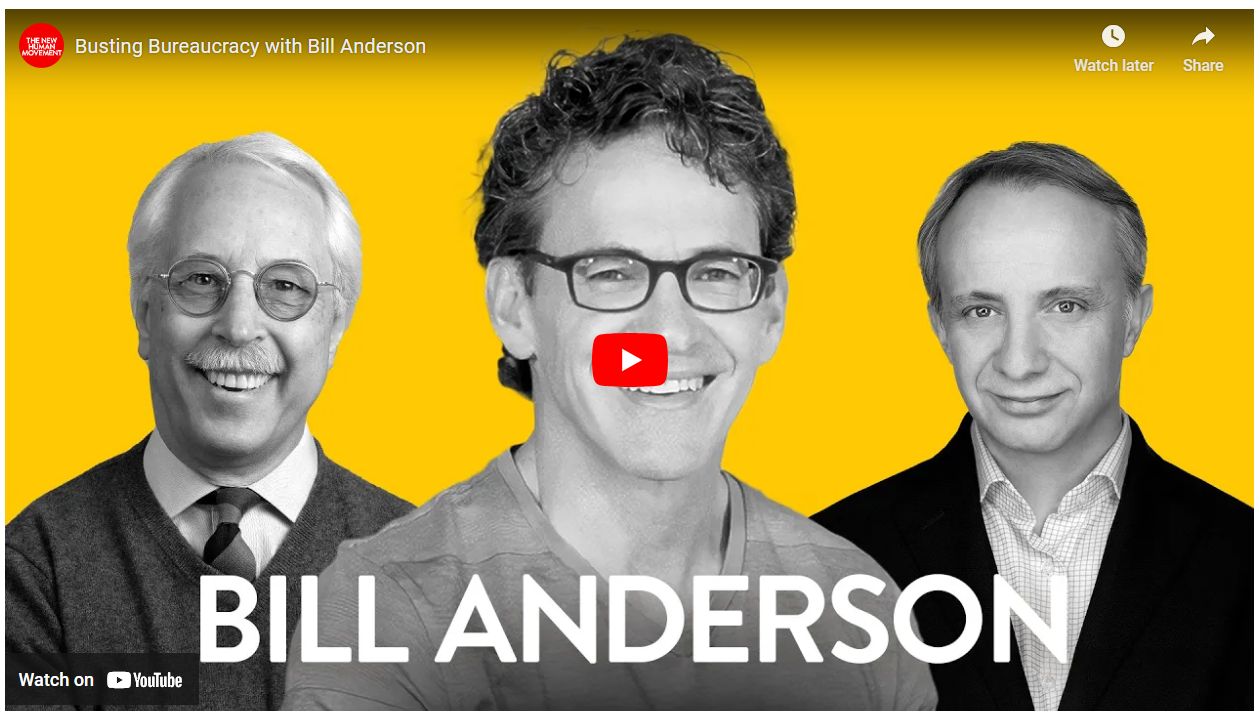
Busting Bureaucracy with Bill Anderson
Bill Anderson was the CEO of Roche Pharmaceuticals when he was interviewed, a position he had held since 2019. He subsequently left Roche in 2022 to join Bayer as CEO. It is noteworthy that prior to becoming the CEO of Pharmaceuticals at Roche, Bill joined subsidiary Genetech in 2006 and was a Senior Vice President when he joined Roche in 2013. This is an important part of Bill’s story.
One of Bill’s first actions as CEO was to meet with staff across the organisation to discuss their work. Even though Bill had worked at Roche for over 10 years in a leadership role before being appointed as CEO, he was surprised by what he heard from people across the organisation – ‘I love the mission, love the science focus, love colleagues, love the supportive culture, but I can’t get anything done. Can you fix that?’
‘I love the mission, love the science focus, love colleagues, love the supportive culture, but I can’t get anything done. Can you fix that?’
Bill Anderson
Bill said that if he hadn’t been at Roche for over 10 years, he would have thought, we have some bureaucracy and we need to do some bureaucracy busting. Let’s get some teams together and tell them to go and fight bureaucracy! However, he knew that Roche had already been doing that for 10 years without success. His main concern was that his leaders were asking him to fix this problem. He expected frontline workers to say they couldn’t get their work done, but for leaders to say it meant that they were not in charge of the system.
This finding concurred with the experience of Gary Hamel and Michele Zanini. They describe bureaucracy as being ‘sticky’ because it works better than a lot of alternatives and leaders have been successful in bureaucratic systems of work. It is what they know and are good at. However, the reality is that it wastes more human capacity than it uses effectively, and Gary Hamel cited 50 or 60% of people’s productive capacity being lost to bureaucratic stickiness.
At this point, Bill decided to start over again. The system was too big and complicated to fix. Fortunately, he had long-term and committed leaders who were prepared to reimagine what was happening. This is an important point because this change required a mindset change from leaders and commitment to working together to create a new system of work, which turned out to be emergent and meant leaders needed the confidence to persist in the face of uncertainty.
Bill said that there were a few keys to the transformation at Roche. The first was to stop command and control leadership (i.e. stop setting goals, cascading them and making sure people achieve them). Instead, leaders became ‘coaches’ and catalysts to ‘unstick’ work. The second big change was in resource allocation decision making – they stopped setting budgets. At first they tried to fix budgeting before realising it couldn’t be improved. They needed to do something different.
Gary Hamel asks what happened when budgets were no longer set and accountability shifted from setting and achieving a budget expenditure goal, to spending what was required to meet customer needs and expectations. Bill said expenditure went down. Customers were more satisfied. Accountability shifted from convincing your manager to give you funds for your work, to convincing your peers. There were controls on expenditure through reporting, it just wasn’t a budget. It proved to be more effective.
‘Bureaucracy is a massive multi-player game that is played for the stakes of positional power and people who are good at it have learned a very deep set of behaviours about how you win.’
Gary Hamel
Bill and his team developed a guide to support decision making known by the acronym ‘VITAL’. It genuinely empowered staff to break down bureaucracy and make decisions about their work by checking if those decisions met the VITAL test:

The interview has a lot more detail on the transformation at Roche and the thinking behind the approach taken by Bill and his team.
Bill finished the interview with this parting advice:
- Don’t even try this sort of transformation unless you are willing to upend your life. It is much easier to just turn the handle on what you are doing now and not challenge the bureaucracy.
- If you do start, you really have to own it. You and your leaders have to lead the change yourself. It can’t be done by a team on the side or consultants, and it takes years.
- You will need help from people who have done it before.
Having said that, he also said that people engaged with the change were excited about being part of something new.
Busting Bureaucracy with Bill Anderson, New Human Movement Youtube Channel, March 21, 2022 https://www.humanocracy.com/movement/episodes/busting-bureaucracy-bill-anderson
Excess Management Is Costing the U.S. $3 Trillion Per Year, by Gary Hamel and Michele Zanini, Harvard Business Review, September 05, 2016 https://hbr.org/2016/09/excess-management-is-costing-the-us-3-trillion-per-year
Our bold ambition and our critical choice, by Bill Anderson, LinkedIn, October 1, 2020 https://www.linkedin.com/pulse/our-bold-ambition-critical-choice-bill-anderson
Footnote
An earlier post discusses Terry Leahy’s bureaucracy busting at Tesco, which he described as simplifying the organisation.
 Local Government Utopia