Posted by Colin Weatherby 670 words

Lancing Farrell recently posted on value-led management. There is increasing demand for improved performance in delivering local government services that are responsive, efficient and fair. Communities want change. Councils today operate in much the same way as they did 30 years ago, despite some radical legislative reforms, and it is time for a re-think of how council operations are designed to deliver value to communities. In this post I have added to the ideas introduced by Lancing Farrell.
Value is often mentioned in local government when talking about services, particularly ‘best value’. However, there is often inadequate understanding about the different types of value, the difference between private and public value, and how value is actually created. The concept of public value, as conceived by Professor Mark H. Moore, is extremely relevant in local government.
“Unless there is a clear understanding of the value to be produced, how can you design operations to produce it or measure performance in delivering it? “
Value-led management is a management approach to improving organisational systems and the value they produce. It focuses on the service recipient and value to be created in service delivery. In public services value is created along a continuum from essentially private value, similar to the concept of customer value, through to public value that reflects the aggregate desires of citizens. The following diagram is based on the work of Mark H. Moore and illustrates this continuum.
 At the private value end of the spectrum, the focus is on the individual service recipient and delivering value that meets their needs or expectations or, in John Seddon’s terms, fulfils their purpose. Often this relates to their material well-being. The individual determines whether or not value has been provided. At the public value end of the continuum, the focus is on achieving the social outcomes sought by the community (public). This typically covers aspects of the welfare of the community and social justice. The collective public or community determines whether or not value has been provided.
Services are delivered through cross-functional work flows. Value-led management requires understanding and management of the organisational systems and processes to create desired value. This begins with an understanding of the collectively valued social outcomes that will create public value. The organisational mission or purpose statement should encapsulate what the organisations exists to do. For a council, it should provide a clear, complete and compelling public value proposition. This forms the basis of a public value account, as shown in the table below.

The public value account records the financial costs associated with achieving the mission (i.e. creating value) and any unintended consequences (positive and negative), the satisfaction of service recipients (i.e. private value or purpose fulfilment), any social costs in using authority to achieve the mission and whether or not that authority has been used fairly. It brings together all aspects of value as they relate to a public service where the coercive power of the state is used to obtain taxes and regulate people’s activities.
Mark H. Moore describes a public value chain covering the transformation of inputs into outputs that become outcomes after interactions with service recipients or clients. The public value chain considers both customer and organisational expectations and integrates the demand and supply chains. Organisations need to understand end-user customer demand because it defines the supply chain target.
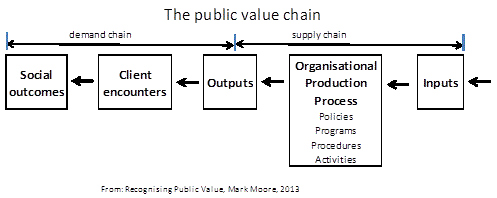 Value-led management focuses on the value chain that leads from raw materials to service delivery. This encompasses demand and supply chains, and identifies the core processes and capabilities involved in meeting the essential value drivers, as shown in the following diagram recently posted by Lancing Farrell.
As Lancing Farrell discussed, the public value proposition sits between the demand and supply chains and connects the value to be produced to satisfy demands with the operations producing it. It guides the decision making and trade-offs occurring between creation of private value and public value in the operations. Service recipients’ demands for services that are not consistent with the collectively valued outcomes or public value are managed through the design of operations.

Taking a value chain approach also facilitates service reviews. The high level, strategic review of a service by the Executive can consider the demand chain. At the end of this review objectives the value proposition can be set for a more detailed and intensive operational review of the supply chain.
Value-led management aims to produce the desired public value, measure performance, and ensure that services are delivered that meet the value expectations of recipients.
Moore, Mark H. 2013. Recognising Public Value.
Walters, David, and Rainbird, Mark 2007. Strategic Operations Management – a value chain approach.
 Local Government Utopia